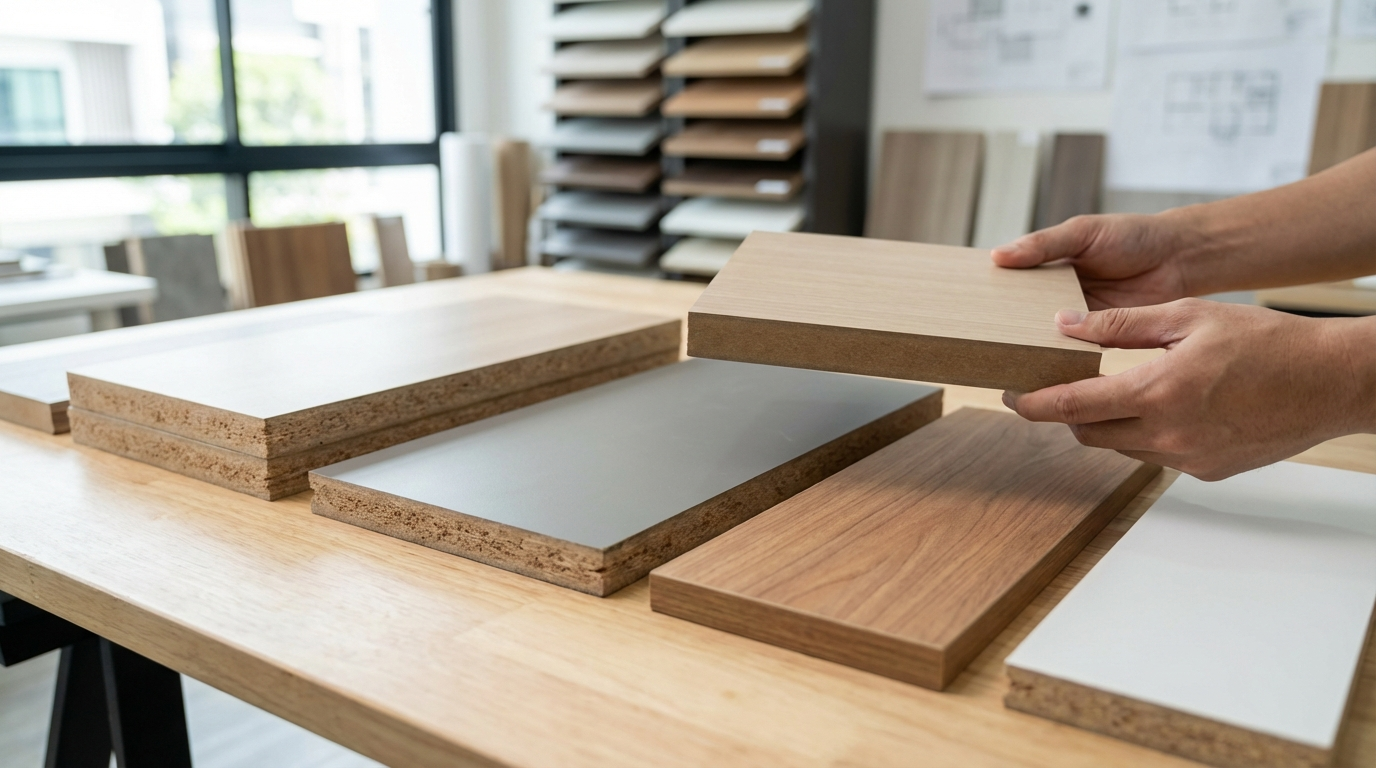
Why Compare Action Tesa Against Other Brands Before You Buy?
Action Tesa dominates conversations in Indian interior markets—but dominance doesn't mean it's automatically right for your project. Whether you're building kitchen cabinets in humid Chennai, wardrobes in dry Rajasthan, or office furniture in Bangalore, the "best" board depends on your specific use case, budget constraints, and local dealer availability.
This comparison cuts through marketing noise to answer practical questions: Where does Action Tesa genuinely outperform competitors? Where do alternatives offer better value? And most importantly—which brand should you specify for which application?
Action Tesa: What You're Actually Getting
Action Tesa manufactures HDHMR (High Density High Moisture Resistant) boards, MDF panels, particle boards, and laminate flooring from their facilities in Uttarakhand and Andhra Pradesh. Their HDHMR product line has become particularly popular for modular kitchen and wardrobe applications since 2018.
Core Technical Specifications
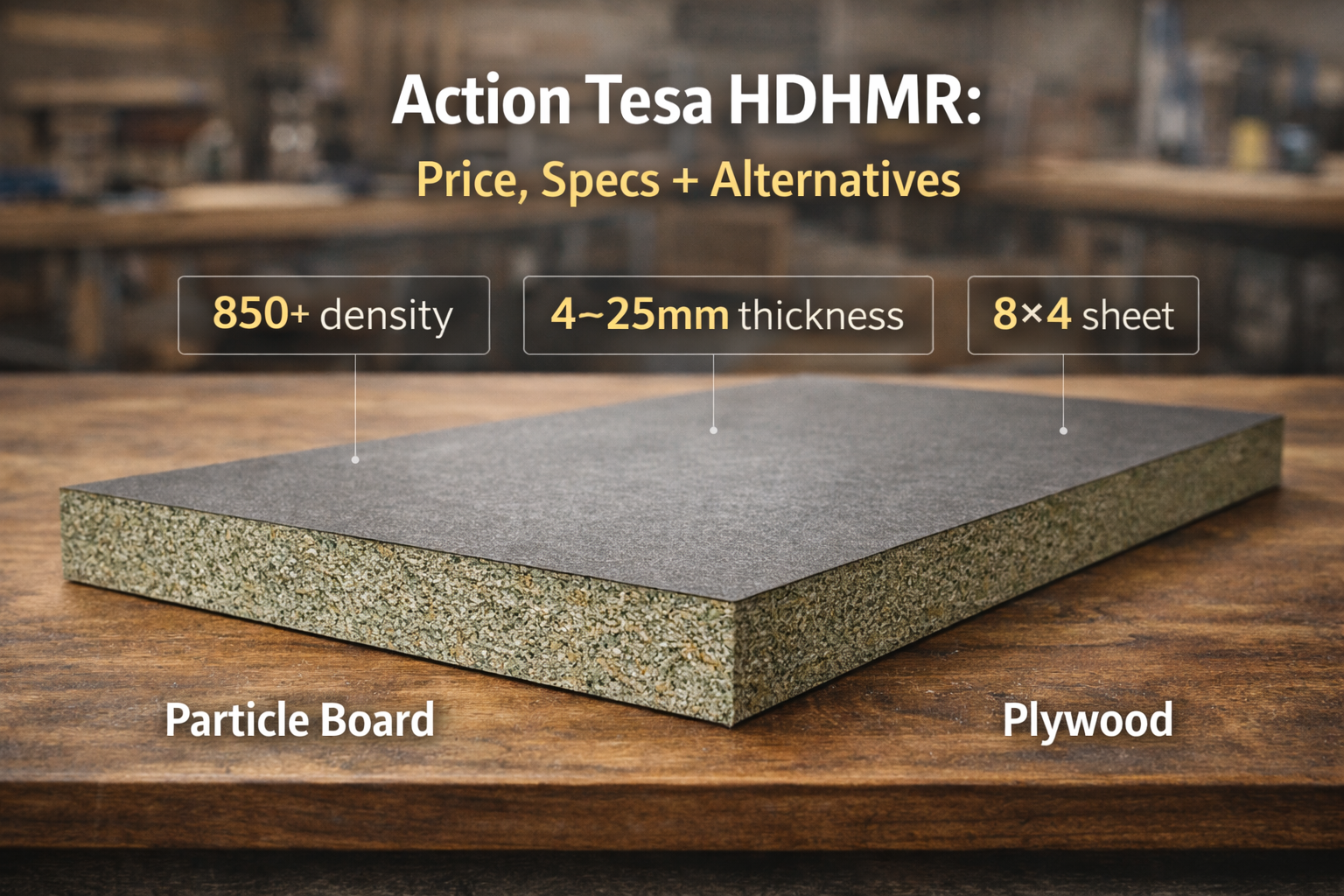
Action Tesa HDHMR boards typically offer density ratings of 850+ kg/m³, which places them in the premium engineered board category. Their moisture resistance comes from phenolic resin bonding—the same technology used in BWP (Boiling Water Proof) plywood adhesives. The company offers thicknesses from 6mm to 25mm, with 17.5mm and 18mm being their most specified options for furniture carcasses.
Key differentiators Action Tesa promotes:
- E1 emission standards (formaldehyde below 0.124 mg/m³)
- Boiling water resistance claimed at 72+ hours without delamination
- 10-year warranty on HDHMR products
- Pre-laminated options with factory-applied decorative surfaces
Where Action Tesa Genuinely Excels
Three areas where Action Tesa has earned its reputation:
Surface consistency: Their factory finish produces remarkably uniform surfaces ideal for laminate application. Carpenters consistently report fewer laminate bubbles and better adhesion compared to many MDF alternatives.
Screw holding in edges: The high density translates to superior screw retention—critical for cabinet hinges and drawer slides that undergo repeated stress cycles.
Distribution network: Action Tesa's dealer presence across tier-1 and tier-2 cities means reliable availability. You won't typically wait weeks for stock.
Honest Limitations to Consider
No product is universally superior. Action Tesa's limitations include:
Weight: High density means heavy panels. An 18mm 8×4 sheet weighs approximately 42-45 kg—requiring two people to handle safely and adding load considerations for wall-mounted cabinets.
Price positioning: Action Tesa sits at the premium end. For projects where moisture resistance isn't critical, you're paying for capability you don't need.
Not truly waterproof: Despite marketing, HDHMR is moisture-resistant, not waterproof. Prolonged water contact (think: persistent sink leaks) will eventually damage any HDHMR, including Action Tesa.
Major Competitors: Head-to-Head Analysis
Century Ply HDHMR (Century Prowud / Premium Plus)
Century Ply entered the HDHMR segment to compete directly with Action Tesa. Their "Prowud" and "Premium Plus HDMR" lines target the same modular furniture market.
How it compares:
- Density: Similar range (830-870 kg/m³)
- Emission rating: E0 grade available (lower formaldehyde than E1)
- Warranty: 8 years versus Action Tesa's 10 years
- Price: Typically 5-8% lower than Action Tesa for equivalent thickness
Choose Century when: You prioritize E0 emission standards (better for bedrooms and children's furniture) or want slight cost savings without significant quality compromise.
Choose Action Tesa when: Extended warranty matters, or your local Century dealer has inconsistent stock.
Greenply / Greenpanel HDHMR (MDF 710)
Greenpanel (formerly Greenply's panel division) manufactures what they market as "MDF 710"—essentially their HDHMR equivalent meeting IS:710 moisture resistance standards.
How it compares:
- Thickness range: 3mm to 18mm (no 25mm option commonly available)
- Pricing: Generally 8-12% below Action Tesa
- Surface quality: Good but slightly more variation batch-to-batch
- Availability: Strong in North and East India; patchier in South
Choose Greenpanel when: Budget constraints are significant, or you're working on projects where cosmetic perfection isn't critical (like internal partitions or garage storage).
Choose Action Tesa when: Surface finish matters (visible furniture faces) or you need thicker boards (20mm+).
Rushil Décor (VIR HDHMR)
Rushil Décor's VIR brand positions itself as the value alternative in the HDHMR space. Their Gujarat-based manufacturing keeps costs competitive.
How it compares:
- Price: Often 10-15% below Action Tesa
- Quality: Acceptable for most applications; slightly lower density in some batches
- Warranty: 5-7 years depending on product line
- Distribution: Strongest in Western India (Gujarat, Maharashtra)
Choose VIR when: Value matters more than brand prestige, particularly for rental properties, commercial fit-outs, or budget-conscious residential projects.
Choose Action Tesa when: You're building premium furniture expected to last 15+ years.
Merino HDHMR and Laminates
Merino is primarily known for laminates but has entered the HDHMR space. Their strength lies in integrated solutions—board plus matching laminate.
How it compares:
- Product focus: Pre-laminated boards rather than plain HDHMR
- Integration advantage: Factory-laminated surfaces with Merino's extensive design catalogue
- Pricing: Premium positioning, often 5-10% above Action Tesa pre-lam
Choose Merino when: Design variety matters—they offer patterns and textures Action Tesa doesn't match.
Choose Action Tesa when: You're applying third-party laminates or prefer plain boards for custom finishing.
Complete Brand Comparison Table (2026)
| Parameter | Action Tesa | Century HDMR | Greenpanel | VIR (Rushil) | Merino |
|---|---|---|---|---|---|
| Density (kg/m³) | 850-880 | 830-870 | 820-860 | 800-850 | 840-870 |
| 18mm Price (₹/sq ft) | 100-110 | 92-102 | 88-98 | 85-95 | 105-115 |
| Emission Grade | E1 | E0/E1 | E1 | E1 | E1 |
| Warranty (Years) | 10 | 8 | 7 | 5-7 | 8 |
| Thickness Range | 6-25mm | 6-18mm | 3-18mm | 6-18mm | 8-18mm |
| Pre-Lam Options | Yes (limited) | Yes | Limited | Limited | Extensive |
| Pan-India Availability | Excellent | Excellent | Good (North/East) | Good (West) | Good |
| Best For | Premium kitchens, wardrobes | Low-emission projects | Budget builds | Value projects | Design-focused interiors |
Note: Prices are indicative ranges for early 2026; actual rates vary by region, dealer, and bulk quantities. Always get multiple quotes.
Alternative Material Categories to Consider
Sometimes the right answer isn't "which HDHMR brand" but "should I use HDHMR at all?" Here's when alternatives make sense:
BWP Plywood vs HDHMR
Traditional BWP (Boiling Water Proof) plywood like Century Sainik 710 or Greenply BWP remains relevant. Key considerations:
Choose BWP plywood when:
- You need structural strength for large spans (plywood has better bending strength)
- Natural wood veneer finish is desired
- Your carpenter is more experienced with plywood joinery
- Budget is tight—quality BWP is often 15-25% cheaper than equivalent HDHMR
Choose HDHMR when:
- Smooth laminate finish is the goal
- CNC routing or detailed machining is planned
- Consistent surface density matters for edge banding
- Kitchen cabinet carcasses need superior screw holding
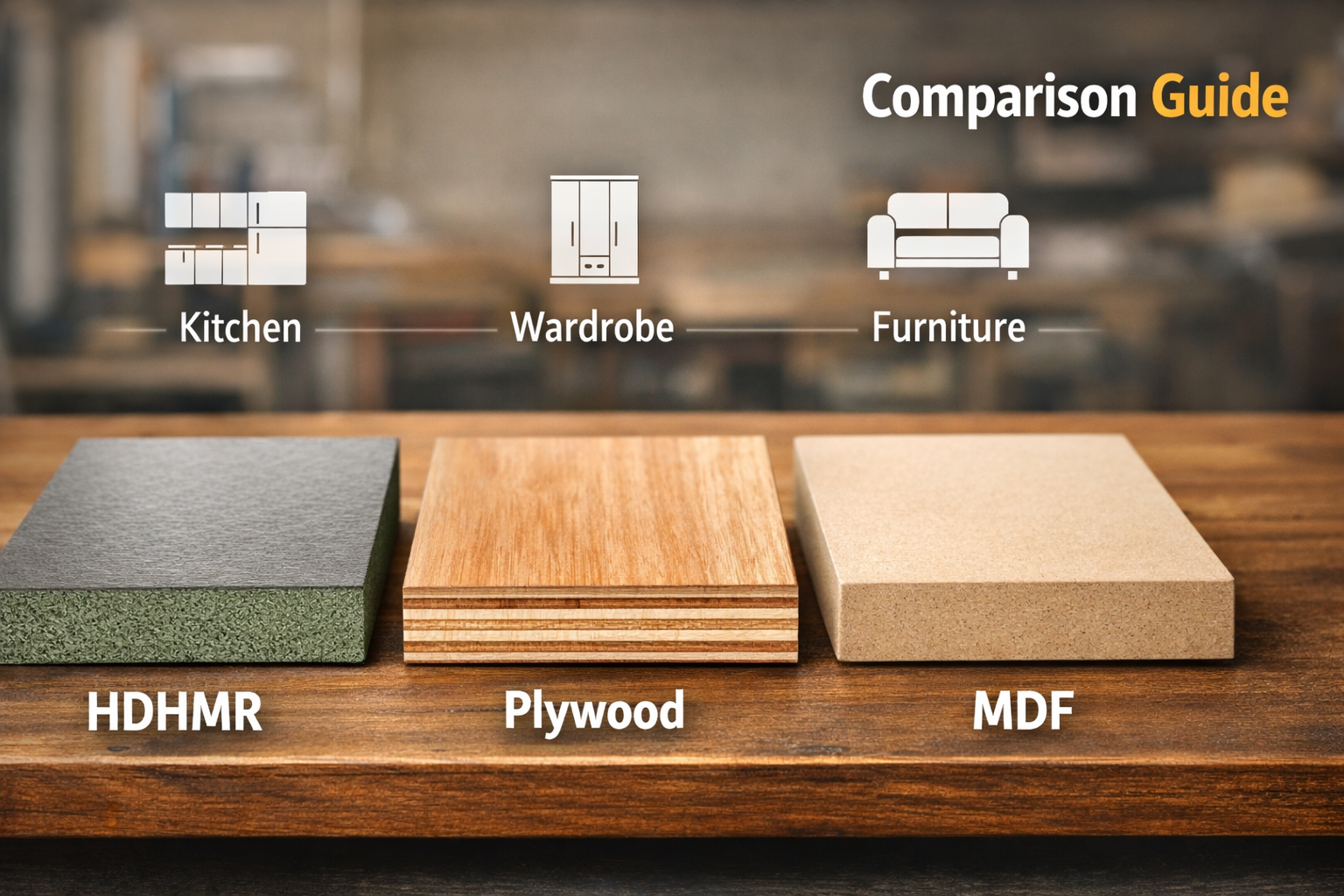
Many experienced contractors use a hybrid approach: HDHMR for carcasses and CNC-cut elements; BWP plywood for shutters and structural shelving. This optimizes cost while leveraging each material's strengths.
MDF vs HDHMR
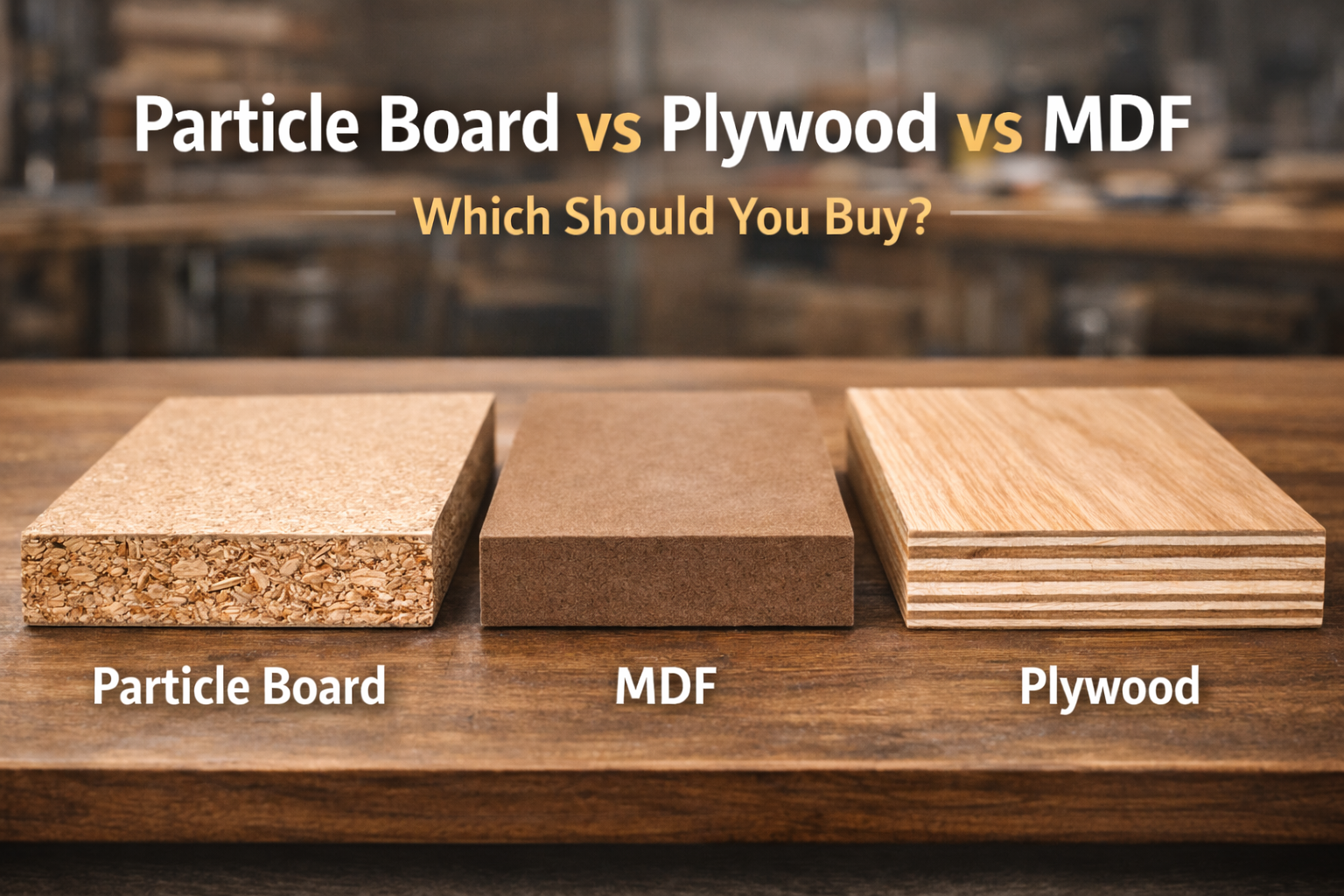
Standard MDF (Medium Density Fibreboard) costs 30-40% less than HDHMR. The key difference is moisture resistance.
Use standard MDF for:
- Bedroom furniture in dry climates (Rajasthan, parts of MP, interior Maharashtra)
- Office furniture away from pantry areas
- Decorative wall panels and CNC jali work
- Study tables and bookshelves
Never use standard MDF for:
- Kitchen cabinets (anywhere in India)
- Bathroom vanities
- Any application in coastal cities (Mumbai, Chennai, Kolkata) where ambient humidity is high
Particle Board: When Budget Dominates
Pre-laminated particle board (like those used in flat-pack furniture) costs roughly 50% less than HDHMR. It's genuinely suitable for:
- Rental property furnishing with 5-7 year lifespan expectations
- Commercial office fit-outs with planned refresh cycles
- Storage furniture in dry, climate-controlled environments
Avoid particle board in humid environments, load-bearing shelving, or anywhere screws will be repeatedly inserted and removed (hinge locations).
Application-Specific Brand Recommendations
Modular Kitchens
Best choice: Action Tesa 18mm HDHMR for carcasses; Action Tesa or Century for internal components.
Why: Kitchens face moisture, heat, and mechanical stress. The premium cost of Action Tesa is justified by superior screw holding (critical for soft-close hinges) and consistent surface quality for laminate application.
Budget alternative: Greenpanel or VIR HDHMR for internal shelves and less-visible components; reserve premium boards for door frames and visible edges.
Wardrobes and Closets
Best choice: Century HDMR or Action Tesa 16mm for carcasses; 6mm HDHMR for back panels.
Why: Wardrobes face less moisture than kitchens. Century's E0 emission rating is particularly valuable for bedroom furniture where you spend 8 hours daily.
Budget alternative: Standard MR-grade MDF works adequately in dry-climate cities for wardrobe interiors. Reserve HDHMR for the base (floor contact) and any sections near attached bathrooms.
Bathroom Vanities
Best choice: Action Tesa HDHMR 18mm with waterproof edge banding and PU-sealed edges.
Why: Bathrooms present the harshest moisture conditions. Even HDHMR needs edge protection here. Action Tesa's higher density provides marginally better edge sealing.
Critical note: No HDHMR brand survives continuous water contact. Ensure proper waterproofing, sloped surfaces directing water away, and silicone sealing at all wall junctions.
Office Furniture and Commercial Interiors
Best choice: VIR or Greenpanel for workstations and partitions; Action Tesa for reception desks and executive furniture.
Why: Commercial projects balance budget against appearance. High-visibility areas warrant premium boards; back-office furniture can use value alternatives without compromise.
Quick Decision Guide: Choosing Between Brands
Use this framework to match your project to the right brand:
Choose Action Tesa if:
- You're building kitchen cabinets or bathroom vanities
- Long warranty (10 years) provides peace of mind
- CNC routing or detailed machining is planned
- You need 20mm+ thickness options
- Budget allows premium positioning
Choose Century HDMR if:
- Indoor air quality matters (E0 emission)
- You want slight savings without major quality compromise
- Building bedroom or children's furniture
- Century dealer in your area offers better service than Action Tesa
Choose Greenpanel if:
- Budget constraints are significant
- Project is in North or East India (better availability)
- Building commercial fit-outs with 7-10 year replacement cycles
- Internal components where surface perfection isn't critical
Choose VIR (Rushil) if:
- Value is the primary criterion
- Project is in Western India
- Building rental property furnishing
- Combining with premium boards for visible surfaces only
Choose BWP Plywood instead if:
- Structural strength matters more than surface smoothness
- Veneer or natural wood finish is desired
- Your carpenter lacks HDHMR experience
- Building large shelving with heavy loads
Price Comparison and Budget Planning
Understanding price differences helps budget accurately. For an 18mm 8×4 sheet (32 sq ft) in early 2026:
| Brand | Price per Sheet (₹) | Price per Sq Ft (₹) | Premium vs VIR |
|---|---|---|---|
| Action Tesa 18mm | 3,200-3,500 | 100-110 | +18-20% |
| Century HDMR 18mm | 2,950-3,250 | 92-102 | +10-12% |
| Greenpanel 18mm | 2,800-3,100 | 88-98 | +5-8% |
| VIR 18mm | 2,700-3,000 | 85-95 | Baseline |
For a typical 10×10 ft kitchen requiring approximately 250 sq ft of board material:
- Action Tesa: ₹25,000-27,500 (board only)
- Century: ₹23,000-25,500
- Greenpanel: ₹22,000-24,500
- VIR: ₹21,250-23,750
The difference between premium and budget brands for a standard kitchen is roughly ₹3,500-4,000—meaningful but not dramatic in the context of total kitchen costs (typically ₹1.5-3 lakhs including hardware, countertop, and installation).
Practical Buying Advice for 2026
Verify What You're Actually Getting
The engineered board market has quality variance. Always:
- Check edge density—genuine HDHMR has uniform density visible on cut edges
- Verify brand markings on sheets (not just dealer claims)
- Request warranty cards and ensure they're registered
- Buy from authorized dealers rather than unknown suppliers offering steep discounts
Calculate Total Project Cost, Not Just Board Cost
Board selection affects other costs:
- Heavier boards (Action Tesa) may need stronger hinges and wall anchors
- Boards with inconsistent surfaces require more laminate adhesive and preparation
- Budget boards with shorter warranties may need earlier replacement
Match Brand to Application Within Single Projects
Smart contractors mix brands strategically:
- Premium brand for cabinet faces and high-stress zones
- Value brand for internal shelves and back panels
- This approach can reduce material costs 15-20% without visible quality compromise
Get Multiple Quotes and Negotiate
Dealer margins on engineered boards are typically 10-15%. For projects requiring 20+ sheets:
- Request quotes from at least 3 dealers
- Ask about bulk discounts (usually available above 15-20 sheets)
- Check if delivery is included—board transport adds ₹500-1,500 depending on distance
Final Recommendations
Action Tesa earned its market position through consistent quality and wide availability. However, it's not automatically the right choice for every project. Century offers comparable quality with better emission ratings; Greenpanel and VIR deliver genuine value for budget-conscious builds.
The right approach: specify by application, not by brand loyalty. Use premium boards where performance demands it (kitchen carcasses, bathroom vanities, high-visibility furniture). Use value alternatives where equivalent results come at lower cost (internal components, back panels, dry-area furniture).
Whatever you choose, ensure proper edge sealing, appropriate thickness for the load, and installation by someone experienced with engineered boards. These factors matter as much as brand selection for long-term furniture performance.
Disclaimer: This content is provided for general informational purposes based on industry practices and publicly available information. Product specifications, standards, prices, and availability may vary by manufacturer, region, and time. Readers should independently verify details with manufacturers, dealers, or qualified professionals before making purchase or construction decisions.