Why Your Furniture Material Choice Matters More in 2026
Here's a scenario playing out in thousands of Indian homes right now: a modular wardrobe purchased three years ago is showing edge swelling near the hinges, the shelf has developed a noticeable sag under book weight, and there's an unmistakable musty smell after this year's monsoon. The culprit? A material mismatch — the wrong board selected for the wrong application.
The engineered wood versus particle board debate isn't about declaring a universal winner. It's about understanding which material performs better for your specific furniture, budget, climate zone, and expected lifespan. A particle board kitchen cabinet in coastal Mumbai faces entirely different challenges than one in dry Jaipur. A wardrobe carcass has different structural demands than a decorative TV unit.
This comparison cuts through marketing jargon to give you decision-ready clarity. By the end, you'll know exactly which scenarios favour engineered wood, where particle board genuinely makes sense, and the hybrid approaches that professional carpenters increasingly recommend in 2026.
What Exactly is Engineered Wood? A First-Principles Explanation
Engineered wood is a manufactured wood product created by binding wood fibres, veneers, particles, or strands together using adhesives, heat, and pressure. The term is deliberately broad — it encompasses everything from premium plywood to basic particle board. This is where confusion begins for most buyers.
In the Indian furniture market, "engineered wood" typically refers to the higher-grade manufactured boards: plywood, MDF (Medium Density Fibreboard), HDF (High Density Fibreboard), HDHMR (High Density High Moisture Resistant board), and blockboard. These products share common characteristics — dimensional stability superior to solid wood, consistent quality across sheets, and manufacturing processes that can incorporate moisture-resistant treatments.
The manufacturing logic is straightforward: instead of relying on a single piece of timber with natural defects, grain variations, and moisture movement, engineered wood reconstructs wood elements into a more predictable, uniform material. Plywood achieves this through cross-laminated veneers. MDF and HDF use finely ground wood fibres compressed under high pressure. HDHMR adds moisture-resistant resins throughout the board composition.
What makes engineered wood genuinely useful for furniture is its screw-holding capacity, edge finishing quality, and resistance to warping. A well-made MDF panel holds paint and laminate finishes beautifully because its surface is uniformly dense without grain patterns that telegraph through. HDF and HDHMR offer structural integrity that approaches commercial-grade plywood at competitive price points.
What is Particle Board? Understanding Its Actual Composition
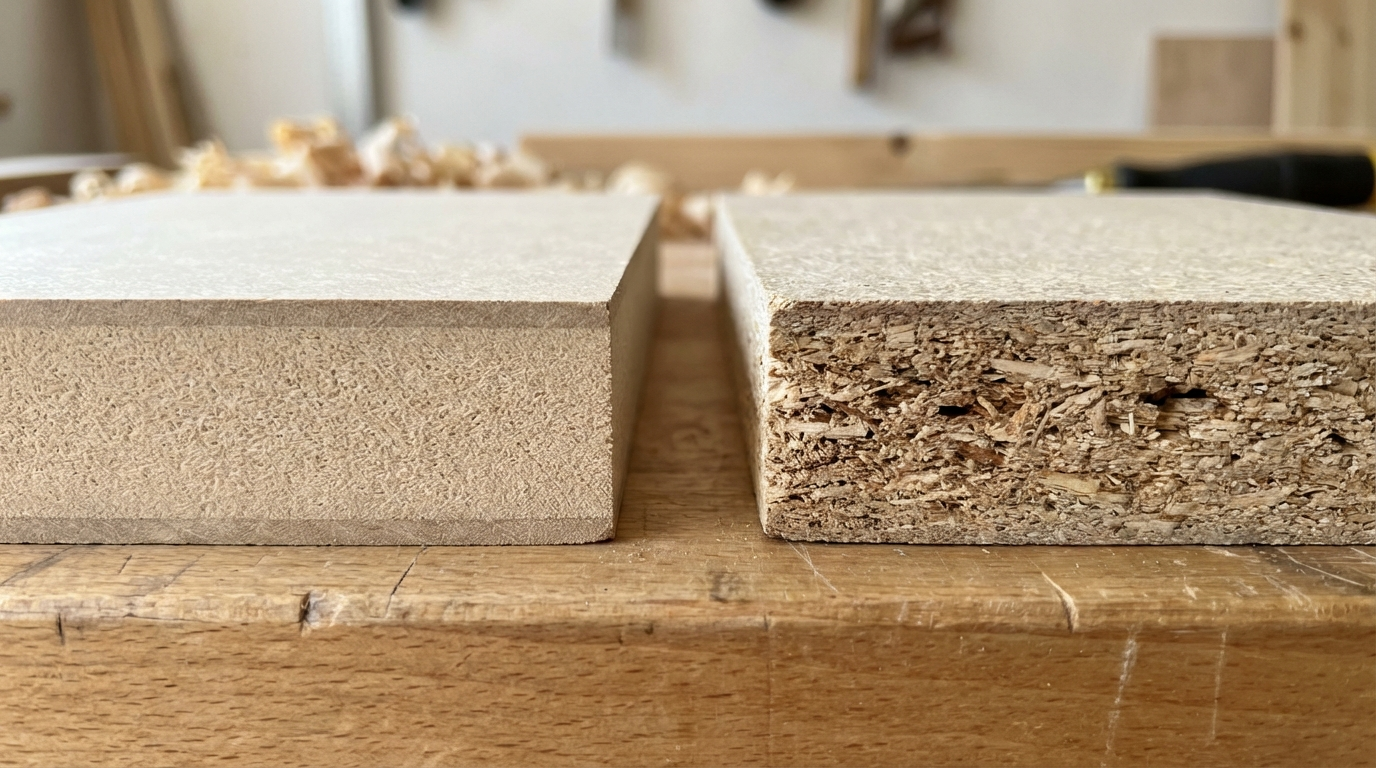
Particle board is manufactured by compressing wood chips, sawmill shavings, and sawdust with synthetic resin binders. The resulting board has a characteristic appearance — visible wood particles throughout the cross-section, with density typically higher at the surfaces than the core.
This manufacturing approach makes particle board the most economical wood-based panel material available. Furniture manufacturers favour it for cost-sensitive projects where the board will be fully laminated and protected from moisture exposure. The material accepts veneers, laminates, and edge banding well, allowing finished furniture to appear indistinguishable from pieces built with premium boards.
However, particle board's composition creates inherent limitations. The wood particles don't interlock the way plywood veneers or MDF fibres do. This means lower screw-holding strength, particularly for repeated fastener insertions. More critically, particle board absorbs moisture readily — and once water penetrates the surface, the particles swell irreversibly. That swelling near hinges and edges isn't repairable; it's permanent damage.
Modern particle board has improved significantly from decades past. Pre-laminated particle board (often marketed as PLPB) comes with factory-applied melamine surfaces that provide reasonable moisture protection. Higher-density particle boards offer better structural performance. Yet the fundamental material characteristics — lower density core, limited moisture tolerance, reduced fastener retention — remain consistent across grades.
Head-to-Head Comparison: Technical Parameters That Matter
| Parameter | Engineered Wood (MDF/HDF/HDHMR) | Particle Board | Why It Matters |
|---|---|---|---|
| Density Range | 700-1000 kg/m³ | 450-700 kg/m³ | Higher density = better screw holding and structural strength |
| Screw Holding (Face) | 1100-1400 N | 600-900 N | Critical for hinges, handles, and hardware that takes daily stress |
| Screw Holding (Edge) | 700-1000 N | 350-500 N | Determines whether edge-mounted fittings stay secure over time |
| Moisture Resistance | Good to Excellent (varies by grade) | Poor to Moderate | Defines suitability for kitchens, bathrooms, and humid climates |
| Swelling (24hr water soak) | 5-12% | 15-25% | Lower swelling means better monsoon performance |
| Surface Smoothness | Excellent (especially MDF) | Good when laminated | Affects paint finish quality and laminate adhesion |
| Internal Bond Strength | 0.55-0.80 N/mm² | 0.28-0.45 N/mm² | Resistance to delamination under stress |
| Typical Price Range | ₹50-190 per sq ft | ₹20-50 per sq ft | Budget implications for full-home furniture projects |
| Weight | Heavier | Lighter | Affects installation, wall-mounting, and transport |
| Expected Lifespan | 15-25 years | 5-10 years | Total cost of ownership over time |
Durability Reality Check: How Each Material Ages
The durability question isn't theoretical — it shows up in real furniture failures that homeowners experience. Understanding how each material degrades helps predict which will serve your needs longer.
Engineered Wood Aging Patterns
Quality MDF and HDF furniture typically shows its age through gradual surface wear rather than structural failure. Laminate edges may chip after years of use. Painted surfaces might show minor scratches. But the underlying board structure remains sound — shelves don't sag noticeably, doors stay aligned, and carcasses maintain their shape.
HDHMR specifically resists the moisture-related degradation that claims other boards. In high-humidity environments, HDHMR furniture after 8-10 years often shows less damage than particle board furniture after 2-3 years. The moisture-resistant resins distributed throughout the board — not just on surfaces — provide protection even when edge banding fails or laminate chips expose the substrate.
The failure modes for engineered wood tend to be predictable and often repairable: hardware loosening can be addressed with larger screws or inserts, surface damage can be refinished, and edge damage can be re-banded.
Particle Board Aging Patterns
Particle board furniture follows a different degradation curve. Initial performance is acceptable — the laminated surfaces look good, hardware holds adequately, and the furniture serves its purpose. Problems typically emerge in year 2-4, accelerating with each monsoon season.
The characteristic failure is edge swelling. Water vapour penetrates through cut edges, laminate joints, and hardware holes. Particle board absorbs this moisture and expands. Unlike solid wood that might swell and contract seasonally, particle board swelling is largely irreversible — the particle bonds break permanently. You'll notice this first around sink cut-outs in kitchen cabinets, near bathroom vanity bases, around wardrobe doors that see humid air circulation, and under hinge mounting points where repeated stress has opened micro-gaps in protective surfaces.
Shelf sagging is the second common failure. Under sustained load — books, folded clothes, kitchen equipment — particle board gradually deforms. The lower-density core can't maintain shape indefinitely. This is why experienced carpenters recommend maximum 60cm unsupported spans for particle board shelves, versus 90cm or more for MDF/HDF.
Application-Specific Recommendations
Wardrobes and Closets
Best choice: HDHMR or BWR plywood for carcass, MDF for shutters if painted finish desired
Wardrobes face moisture stress from clothing stored slightly damp, humid air circulation when doors open, and the weight of hanging garments pulling on internal fittings. The carcass — the structural box — needs reliable screw holding for shelf supports, hanging rods, and hinges that open hundreds of times yearly.
Particle board wardrobes work adequately in air-conditioned, climate-controlled environments with careful use. But for most Indian homes without 24/7 climate control, the monsoon moisture exposure makes particle board a risky choice for furniture expected to last beyond 5-7 years.
Kitchen Cabinets
Best choice: BWR plywood or HDHMR — particle board is not recommended
Kitchens combine every stress factor: moisture from cooking steam, washing, and sink proximity; heat from cooking appliances; chemical exposure from cleaning agents; and heavy loads from stored vessels and provisions. This is the harshest environment for any furniture material.
Particle board kitchen cabinets fail predictably. The sink base cabinet swells first, typically within 18-24 months. Under-counter cabinets near the cooking range show heat damage. Even wall-mounted units absorb rising cooking steam. The cost of replacing kitchen cabinets far exceeds the initial savings from choosing particle board over quality engineered wood.
Beds and Bed Frames
Best choice: HDF, HDHMR, or blockboard for structural components; particle board acceptable for non-structural elements
Bed frames require excellent screw holding for rail connections that endure nightly stress. Headboards and footboards face less demanding conditions. A practical approach: use engineered wood or blockboard for the structural frame, particle board for decorative panels that bear no load.
Study Tables and Office Furniture
Best choice: MDF or HDF for surfaces; particle board acceptable for budget applications
Study tables face moderate stress — equipment weight, occasional spills, daily surface wear. Quality particle board with good lamination performs adequately for 5-8 years. For furniture expected to last longer or face heavier use, MDF or HDF offers better value over time.
TV Units and Display Shelves
Best choice: MDF for painted finishes, particle board acceptable for laminated budget units
TV units typically bear moderate, static loads without moisture exposure. This is where particle board genuinely makes sense — the cost savings are substantial, the stress factors are manageable, and a well-laminated unit looks identical to expensive alternatives.
Shoe Racks and Utility Storage
Best choice: Particle board is reasonable for budget applications; HDHMR for long-term use
Shoe racks near entrances face moisture from wet footwear, dust, and occasional cleaning. Budget particle board units serve adequately as replaceable furniture — expect 3-5 years of service. For permanent built-in storage, HDHMR or moisture-resistant plywood justifies the premium.
Price Comparison and Total Cost of Ownership
The upfront price difference between particle board and quality engineered wood is substantial — particle board costs roughly 40-60% less per square foot. For a complete 3BHK furniture package, this translates to lakhs of rupees in apparent savings.
However, total cost of ownership tells a different story:
| Cost Factor | Particle Board Furniture | Engineered Wood Furniture |
|---|---|---|
| Initial Cost (3BHK full furniture) | ₹3.5-5 lakhs typical | ₹5.5-8 lakhs typical |
| Expected Lifespan | 5-8 years | 12-20 years |
| Replacement Cycle (20 years) | 2-3 replacements needed | 1 replacement or none |
| 20-Year Total Cost | ₹10-15 lakhs | ₹7-12 lakhs |
| Disruption/Inconvenience | Multiple renovation cycles | Minimal intervention |
| Resale Value Impact | Negligible to negative | Positive addition |
The calculation shifts further toward engineered wood when you factor in the hassle cost — the disruption of furniture replacement, the disposal challenge of damaged particle board, and the compounding effect of inflation on future furniture prices.
Climate Considerations Across Indian Regions
India's diverse climate zones create dramatically different stress conditions for furniture materials. What works in Bengaluru may fail in Kolkata.
High Humidity Coastal Zones (Mumbai, Chennai, Kolkata, Kochi)
Relative humidity regularly exceeds 80% during monsoon months. Even air-conditioned homes experience humidity spikes when cooling fails or doors open frequently. Particle board is a high-risk choice here — expect accelerated degradation unless the furniture is in continuously climate-controlled environments.
Recommendation: HDHMR or BWR plywood for all load-bearing applications. Particle board only for fully enclosed, laminated decorative elements with minimal edge exposure.
Semi-Arid and Continental Zones (Delhi-NCR, Jaipur, Hyderabad, Pune)
These regions experience seasonal humidity variation — dry winters, moderately humid monsoons. The cycling between dry and humid conditions stresses particle board through repeated absorption-release cycles. Particle board performs better here than coastal zones but still faces monsoon challenges.
Recommendation: MDF/HDF acceptable for most applications. Particle board reasonable for budget furniture in climate-controlled spaces. HDHMR recommended for kitchens and bathrooms regardless of climate.
Hill Stations and High Altitude Areas
Cooler temperatures with moderate to high humidity. Condensation on cold surfaces can create localised moisture problems even in otherwise dry interiors.
Recommendation: Moisture-resistant grades essential. Avoid particle board in areas prone to condensation.
Quick Decision Framework: Choosing the Right Material
Choose quality engineered wood (MDF/HDF/HDHMR/BWR plywood) when:
- The furniture will be used in kitchens, bathrooms, or near water sources
- You live in high-humidity coastal regions
- The furniture needs to last more than 8-10 years
- Load-bearing shelves span more than 60cm unsupported
- Hardware will be subject to frequent use (wardrobe hinges, drawer slides)
- You want painted or lacquered finishes that require smooth substrates
- The furniture will face temperature variations (near windows, external walls)
Particle board is acceptable when:
- Budget is the primary constraint and shorter lifespan is acceptable
- The furniture will remain in dry, climate-controlled environments
- Applications are decorative rather than structural (TV units, display shelves)
- The piece will be fully laminated with protected edges
- You're furnishing rental property with shorter occupancy expectations
- The furniture carries light, static loads only
What Carpenters and Manufacturers Don't Always Tell You
The furniture industry has financial incentives that don't always align with buyer interests. Understanding these dynamics helps you ask better questions.
Particle board offers higher margins. The material cost is substantially lower, but finished furniture prices don't always reflect this proportionally. Some manufacturers charge engineered wood prices for particle board construction, relying on buyer inability to distinguish materials once laminated.
"Commercial board" often means particle board. The term sounds professional but typically refers to basic particle board. Ask specifically: "Is this MDF, HDF, HDHMR, plywood, or particle board?" Don't accept vague categorical answers.
Laminate quality matters as much as substrate. Premium particle board with quality lamination may outperform budget MDF with poor laminate. The complete system — substrate plus finish plus edge treatment — determines real-world performance.
Edge banding is critical. Exposed edges are the vulnerability point for any engineered board. Proper edge banding — especially ABS edging over paper-based options — significantly extends particle board lifespan. Inspect edges before accepting delivery.
Warranties often exclude moisture damage. Read warranty documents carefully. Many furniture warranties become void if damage is attributed to moisture — which is exactly how particle board typically fails. This effectively makes the warranty worthless for the most likely failure mode.
Practical Buyer Checklist for 2026
Before finalising any furniture order, verify these points:
- Request material specification in writing. The quotation should explicitly state board type, thickness, and grade for each component.
- Check board samples. Ask to see cross-sections of the actual materials being used. Compare density, edge composition, and surface quality.
- Inspect edge treatment. Confirm whether edges will be ABS-banded, PVC-banded, or painted. Ensure all edges — including back panels — receive treatment.
- Verify hardware quality. Hinges, drawer slides, and handles often fail before boards do. Specify brand names for critical hardware.
- Clarify warranty scope. Ask explicitly: "Does this warranty cover moisture-related swelling?" Get the answer in writing.
- Calculate price per component. Compare quotations at the component level, not just total price. Some vendors use quality materials for visible elements and particle board for hidden carcasses.
- Consider climate. If you're in a high-humidity zone, factor in replacement costs when evaluating particle board's lower upfront price.
The Verdict: Making the Right Choice for Your Situation
There's no universal answer to the engineered wood versus particle board question — but there are clear guidelines based on application, climate, and expected lifespan.
For furniture you want to last 15+ years in typical Indian conditions, quality engineered wood (MDF, HDF, HDHMR, BWR plywood) is worth the premium. The total cost of ownership favours these materials once replacement cycles are factored in.
For budget-constrained situations where 5-8 year lifespan is acceptable, particle board with quality lamination serves adequately in dry environments and light-duty applications. Be realistic about limitations and avoid particle board in moisture-prone areas entirely.
The smartest approach for most homeowners: use engineered wood for kitchens, bathrooms, and primary wardrobes; consider particle board for guest room furniture, utility storage, and decorative units where budget matters more than longevity. This hybrid strategy optimises total spending while ensuring critical furniture survives Indian conditions.
Disclaimer: This content is provided for general informational purposes based on industry practices and publicly available information. Product specifications, standards, prices, and availability may vary by manufacturer, region, and time. Readers should independently verify details with manufacturers, dealers, or qualified professionals before making purchase or construction decisions.