Why Green MDF Board Matters for Indian Interiors
Your contractor mentioned "green MDF" for kitchen cabinets. Your dealer quoted it at ₹15–20 more per square foot than regular MDF. And now you're wondering: is it actually worth the premium, or just marketing dressed in green dye?
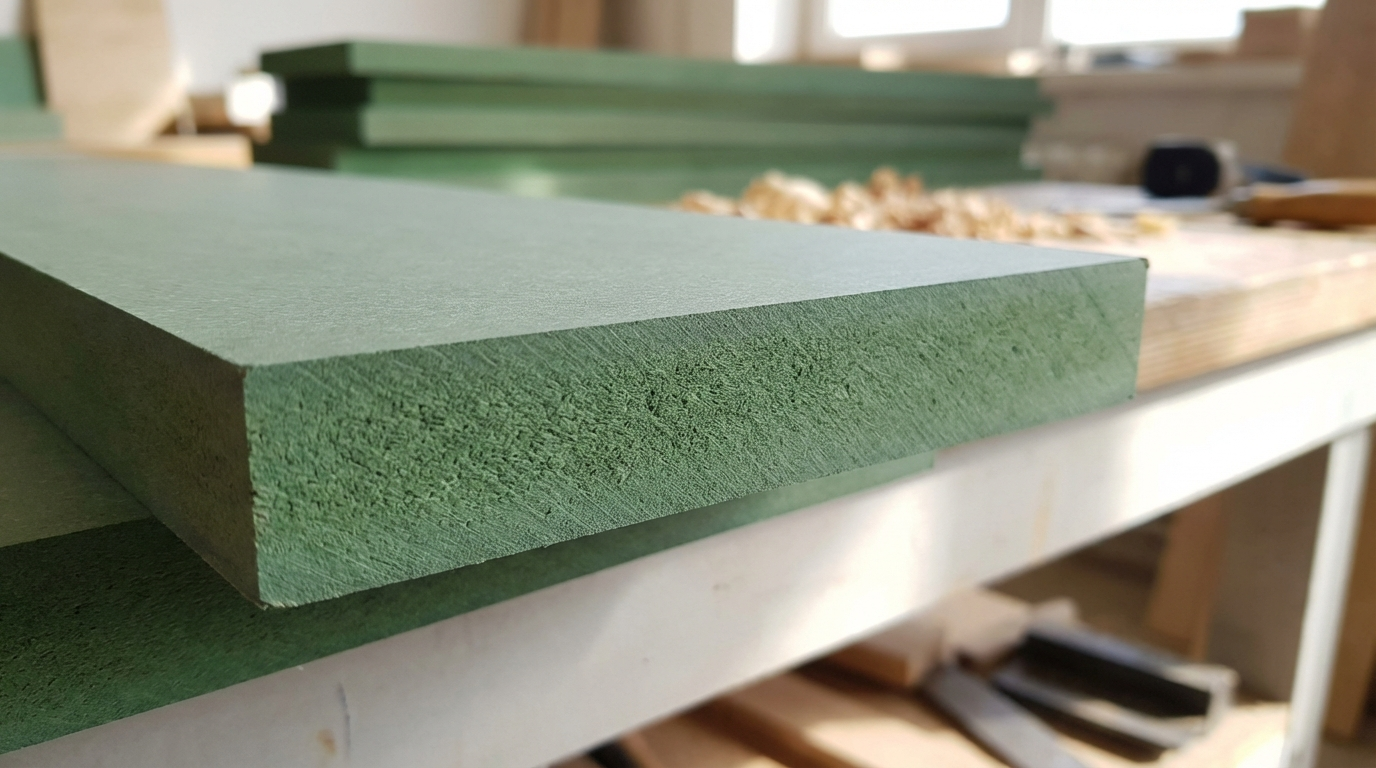
Moisture resistant boards are usually (but not always) coloured green for identification purposes. That distinctive green core isn't decorative—the MDF sheets were dyed to easily differentiate between grades. The truth is there is no impact of the color on the property of the MDF; it is just for identification purposes.
What actually matters is what's inside: the moisture-resistant property of the MDF board is achieved with the help of the resin that is used in the process of making the board. This guide breaks down everything Indian homeowners, contractors, and interior designers need to know about green MDF—including when it genuinely protects your investment and when regular MDF works just fine.
What Is Green MDF Board? The Technical Reality
Green MDF board is the common market name for moisture-resistant MDF (MR MDF). Moisture-resistant MDF, sometimes called MR MDF, is engineered to withstand damp or humid conditions better than traditional MDF. It's made the same way as standard MDF—by compressing wood fibers with resin under heat and pressure—but with the addition of water-repellent agents.
Like traditional MDF, it's produced by compressing wood fibers and resin under heat and pressure, but it incorporates water-repellent additives to enhance its resistance. A distinctive green-tinted core is commonly used to identify MR MDF, indicating its moisture-resistant properties.
How Moisture Resistance Is Achieved
MR MDF is treated during the manufacturing process to create greater water repellency and resistance to humidity and dampness. The wood fibres in MR MDF are coated with hydrophobic wax and resin which inhibits swelling and structural breakdown.
Moisture Proof MDF is manufactured with the addition of a moisture resistant resin, paraffin, and usually consists of Green Core MDF and Black Core HDF. Some manufacturers use melamine-urea-formaldehyde (MUF) resins instead of standard urea-formaldehyde (UF) resins, which provides enhanced water resistance at the molecular level.
Critical Clarification: Moisture-Resistant ≠ Waterproof
Waterproof MDF board is a bit of a misnomer—most MDF products, even treated ones, aren't designed for full water exposure. MR MDF resists humidity and occasional moisture contact, making it suitable for indoor use in wet areas. But for outdoor use or direct water contact, materials like marine-grade plywood or PVC panels are more appropriate.
Most of the time, waterproof and moisture-resistant are used interchangeably. The moisture-resistant MDF boards are not waterproof but have more resistance power compared to normal MDF boards. If normal MDF starts chipping when exposed to moisture levels of 50% and above, moisture-resistant MDF will perform well when exposed to humidity levels of 75% and above.
Green MDF vs Regular MDF: Technical Comparison
| Parameter | Regular MDF (Interior Grade) | Green MDF (MR Grade) |
|---|---|---|
| Core Colour | Natural brown/tan | Green-tinted (identification dye) |
| Resin Type | Standard UF resin | Modified melamine/MUF resin + paraffin wax |
| Humidity Tolerance | Up to 50–55% RH | Up to 75–80% RH |
| Swelling (24hr water soak) | 8–12% thickness increase | 3–6% thickness increase |
| Density (18mm) | 680–720 kg/m³ | 720–780 kg/m³ |
| Typical Price Premium | Base price | 15–25% higher |
| BIS Grade (IS 12406:2021) | Grade 2 / Hazard Class 1 | Grade 1 / Hazard Class 2 |
| Best Use | Dry interior spaces | Kitchens, bathrooms, humid climates |
MR-MDF is engineered to resist moisture better, thereby minimizing the risk of swelling and structural damage compared to standard MDF, which readily absorbs water. Despite its enhanced properties, MR-MDF may come at a slightly higher cost due to the specialized resins incorporated into its composition. This additional expense is justified by its superior performance in environments where moisture is a concern.
Indian Standards for MR MDF: IS 12406:2021
IS 12406:2021 outlines the requirements for MDF boards with densities ranging from 600 kg/m³ to 900 kg/m³. It specifies that these boards should be flat-pressed single-layer types and categorizes them into two grades based on properties and formaldehyde emission values—Grade 1 and Grade 2, further classified into Formaldehyde Class E1 and E2.
As per the latest BIS Standard IS 12406:2021 (Grade 1), moisture-resistant MDF is classified and is ideal for varied Indian climatic conditions.
Understanding BIS Grades
- Grade 1 (MR Grade): Higher moisture resistance, designed for Hazard Class 2 environments (relative humidity above 70%)
- Grade 2 (Interior Grade): Standard moisture performance, suitable for Hazard Class 1 environments (controlled indoor humidity below 65%)
- E1 Emission Class: Lower formaldehyde emission (≤0.124 mg/m³)—preferred for bedrooms and children's rooms
- E2 Emission Class: Standard formaldehyde emission—acceptable for general furniture applications
The Wood Based Boards (Quality Control) Order, 2023, issued by the Ministry of Commerce and Industry, mandates BIS certification (ISI Mark) for MDF boards intended for general-purpose use. This requirement ensures the quality, safety, and durability of the boards while promoting consumer confidence.
Green MDF Board Prices in India (2026)
Pricing varies significantly based on thickness, brand tier, location, and dealer margins. Use these ranges for budgeting—always get local quotes for project accuracy.
| Thickness | Regular MDF (₹/sq ft) | Green MDF / MR Grade (₹/sq ft) | Premium Brands (₹/sq ft) |
|---|---|---|---|
| 6mm | ₹18–28 | ₹24–35 | ₹30–42 |
| 8mm | ₹22–32 | ₹28–40 | ₹35–48 |
| 12mm | ₹32–45 | ₹40–55 | ₹50–68 |
| 17/18mm | ₹40–55 | ₹50–70 | ₹65–85 |
| 25mm | ₹55–72 | ₹68–90 | ₹85–110 |
Moisture-resistant MDF is treated to prevent swelling and damage in high-humidity areas, like bathrooms or kitchens. It costs around 15–20% more than regular MDF.
Price Drivers to Understand
- Thickness: Thicker MDF boards have a higher price as the manufacturing process requires extra material compared to thinner ones.
- Brand Tier: National brands (Greenpanel, Action Tesa, CenturyPly) command 10–25% premium over regional manufacturers
- Calibration: MR grade adds 20–30%, calibration and smooth face add another 10–15%.
- City/Region: Metro pricing (Delhi, Mumbai, Bengaluru) typically runs 8–15% higher than tier-2 cities due to logistics and dealer margins
- Pre-lamination: Factory-applied laminate adds ₹25–60/sq ft depending on design complexity
When to Choose Green MDF: Application Guide
Choose Green MDF (MR Grade) When:
Moisture resistant green MDF board is a defect-free sheet widely used in the joinery industry. These MDF sheets are ideal for applications with high humidity fluctuations such as bathrooms and kitchens.
- Kitchen cabinets and shutters: Kitchens are one of the most common areas where moisture-resistant MDF is used. Steam, spills, and high humidity are part of everyday life in a kitchen, and MR MDF stands up better to these conditions than standard boards.
- Bathroom vanities and storage: Bathrooms are another space where humidity can pose a challenge. While MR MDF shouldn't be used in areas exposed to standing water, it performs well in general bathroom applications.
- Coastal and high-humidity regions: Mumbai, Chennai, Kolkata, and Kerala experience sustained humidity above 70%—MR grade prevents warping
- Monsoon-prone areas: During 3–4 months of heavy monsoon, indoor humidity spikes—MR grade provides insurance against seasonal swelling
- Semi-outdoor applications: Covered balcony furniture, utility areas, laundry rooms
Regular MDF Is Sufficient When:
Standard MDF is best suited for dry settings and should be avoided in areas where moisture exposure is a risk.
- Bedroom wardrobes: Controlled humidity, no water exposure—save 15–20% on material cost
- Living room TV units and shelving: AC-controlled environments maintain stable humidity
- Office furniture and partitions: Climate-controlled commercial spaces rarely exceed 60% RH
- North India dry climates: Delhi, Jaipur, Chandigarh experience low humidity most of the year—MR grade is overkill for wardrobes
- 3D routing and decorative panels: If sealed properly with laminate/paint, interior grade performs identically
Top Green MDF Brands in India (2026)
National Brands with BIS Certification
Greenpanel Industries Ltd., India's No. 1 MDF Company and India's Largest Wood Panel Manufacturer, is one of the most trusted names in engineered wood products. They manufacture high-performance HDWR boards, MDF, Pre-Laminated MDF, Plywood, and Wooden Flooring.
Greenpanel Exterior Grade MDF is a high-performance engineered wood board designed for use in moisture-prone and semi-outdoor environments. Manufactured with high-quality melamine resin, it offers dimensional stability, strong internal bonding, and resistance to termites, borers, and fungus. As per the latest BIS Standard IS 12406:2021 (Grade 1), it is classified as Moisture Resistant (MR).
| Brand | MR MDF Product Name | Key Features | Price Tier |
|---|---|---|---|
| Greenpanel | Exterior Grade MDF / MDF 710 | IS 12406 Grade 1, termite resistant, melamine resin bonded | Mid-Premium |
| Action Tesa | Exterior Grade MDF | CARB certified, E1/E2 grades, eucalyptus wood base | Mid-Range |
| CenturyPly | Prowud MR MDF | 10-year warranty, calibrated thickness | Premium |
| VIR (Rushil Décor) | Maxpro HDFWR | European standards, low swelling rate | Mid-Range |
| Pioneer Panel | PDHMR Green Boards | 10-year warranty against moisture/termite damage | Budget-Mid |
Action TESA produces Interior and Exterior Grade MDF boards. They are engineered to meet the vivid needs of customers and remain great in changing Indian weather. They are resistant to termites, borers, fungus and moisture.
What to Ask Your Dealer
- Is this Grade 1 (MR) or Grade 2 (Interior) as per IS 12406:2021?
- Can you show the ISI mark and BIS certification number?
- What is the formaldehyde emission class—E1 or E2?
- Is this a fresh batch or older stock (check for warping)?
- What's the density specification (should be 700+ kg/m³ for MR grade)?
Green MDF vs Other Materials: Decision Matrix
| Parameter | Green MDF (MR) | HDHMR | MR Plywood | Marine Plywood (BWP) |
|---|---|---|---|---|
| Moisture Resistance | Good (75% RH) | Better (80%+ RH) | Good (70% RH) | Excellent (immersion safe) |
| Surface Smoothness | Excellent | Very Good | Moderate | Moderate |
| Screw Holding | Moderate | Good | Very Good | Excellent |
| Routing/CNC Work | Excellent | Good | Poor | Poor |
| Weight (18mm) | ~38–42 kg/sheet | ~45–52 kg/sheet | ~28–32 kg/sheet | ~30–35 kg/sheet |
| Price Range (18mm) | ₹50–70/sq ft | ₹70–100/sq ft | ₹65–90/sq ft | ₹110–180/sq ft |
| Best For | Painted kitchen shutters, decorative panels | Modular kitchens, heavy-duty furniture | Wardrobe carcass, general furniture | Bathroom cabinets near water, outdoor |
When HDHMR Beats Green MDF
If your project involves heavy kitchen hardware (soft-close hinges, drawer slides with 50kg+ capacity), modular furniture assembly, or areas with frequent water splashes, consider stepping up to HDHMR. For high moisture retaining spaces, HDHMR works best, whereas MDF is suitable for dry areas. Moreover, MDF is cost-efficient and easy to handle, while HDHMR, being heavier, is less manageable than MDF.
When Marine Plywood Is Non-Negotiable
Plywood, especially marine or exterior-grade types, is a better choice for areas exposed to constant moisture or water contact, like subflooring or behind tiled shower walls. For under-sink cabinets, washing machine platforms, or any area with direct water contact, invest in BWP plywood—no MDF variant survives prolonged water exposure.
Working with Green MDF: Carpenter Tips
Cutting and Machining
Moisture-resistant MDF behaves much like standard MDF, though it is slightly denser due to its water-repellent treatment. Use sharp tools to prevent chipping during cutting or routing. Seal all edges with primer or paint to boost moisture resistance.
- Use carbide-tipped blades—MR MDF dulls HSS blades faster than regular MDF
- Reduce feed rate by 10–15% compared to interior grade for cleaner cuts
- Support large sheets properly—the extra density means more weight and potential for snapping
Edge Sealing Is Mandatory
The biggest mistake: leaving edges unsealed. Always seal edges with primer or paint to enhance moisture resistance. Even MR grade MDF absorbs moisture through exposed edges—use:
- PVC edge banding (1mm or 2mm) for modular furniture
- Wood primer + PU paint for painted finishes
- Laminate edge strips for matching finish with surface laminate
Finishing Recommendations
Moisture Resistant MDF is an ideal substrate for a variety of surface finishes (e.g. paint, varnish, wood veneer, melamine paper, HPL/Formica, acrylic, PET, PVC film, etc.); further enhancing the board's moisture-proof, abrasion-resistant properties.
- Paint finish: Sand with 180-grit, apply wood primer (2 coats on edges), topcoat with PU or acrylic enamel
- Laminate: Use moisture-resistant adhesive (SR glue) for kitchen applications
- Veneer: Apply on both faces to prevent warping—single-side veneering causes cupping
Common Mistakes When Buying Green MDF
Mistake 1: Assuming Green Colour = Moisture Proof
Some low-quality manufacturers dye regular MDF green without adding moisture-resistant resins. Always verify BIS certification and Grade 1 classification—colour alone means nothing.
Mistake 2: Using MR MDF for Direct Water Contact
It's crucial to understand that while MR-MDF provides enhanced resistance to moisture, it doesn't render it completely waterproof. Extended contact with water can still lead to damage, making it unsuitable for outdoor applications or areas subjected to continuous water exposure. For such purposes, materials such as Marine Plywood or other waterproof options would be more suitable alternatives.
Mistake 3: Ignoring Storage Conditions
Ignoring storage—monsoon floor stacks swell. Instead, insist on covered godown stock. Before buying, inspect where the dealer stores boards. Stacks kept outdoors or in uncovered areas may already have absorbed moisture, causing hidden swelling that appears weeks after installation.
Mistake 4: Skipping Edge Treatment
Even premium MR MDF fails at unsealed edges. Budget 10–15% extra for proper edge banding on all kitchen and bathroom applications. This single step extends furniture life by 3–5 years in humid environments.
Quick Decision Guide: Which MDF Grade Do You Need?
| Your Situation | Recommended Grade | Why |
|---|---|---|
| Kitchen cabinets (any region) | Green MDF (MR Grade) | Steam, splashes, cooking humidity demand moisture resistance |
| Bathroom vanity (away from shower) | Green MDF + edge sealing | Handles humidity well, but seal all edges meticulously |
| Bedroom wardrobe (North India) | Regular MDF (Interior Grade) | Low humidity, AC-controlled—save 15–20% on material |
| Bedroom wardrobe (Coastal India) | Green MDF (MR Grade) | Sustained high humidity warps interior grade within 2–3 years |
| TV unit / living room furniture | Regular MDF (Interior Grade) | Dry indoor space, no moisture exposure |
| Office partitions (commercial AC) | Regular MDF (Interior Grade) | Climate-controlled, humidity never exceeds 55% |
| Modular kitchen with heavy hardware | HDHMR (better choice) | Better screw holding for hinges/slides; consider upgrading from MR MDF |
| Under-sink cabinet | Marine Plywood (BWP Grade) | Direct water exposure—no MDF survives here |
Green MDF Board: Buyer's Checklist
Use this checklist before finalizing your purchase:
- ☐ Verify ISI mark — Look for BIS certification number and IS 12406:2021 compliance
- ☐ Confirm Grade 1 classification — This is the MR (moisture-resistant) grade
- ☐ Check formaldehyde class — E1 for bedrooms/children's areas; E2 acceptable elsewhere
- ☐ Inspect for flat storage — Warped boards indicate improper storage
- ☐ Request density specification — MR MDF should be 720+ kg/m³ for 18mm
- ☐ Buy from same batch — Colour and finish may vary between batches
- ☐ Budget for edge treatment — Add ₹3–8/running foot for PVC edge banding
- ☐ Plan laminate/paint finish — Raw MDF is never moisture-resistant without surface protection
- ☐ Get written warranty details — Premium brands offer 5–10 year coverage against manufacturing defects
- ☐ Confirm GST-inclusive pricing — 18% GST applies; ensure quotes include this
Frequently Asked Questions
Is green MDF waterproof?
No. It's important to distinguish between moisture-resistant and waterproof. The term "waterproof MDF" is often misleading—even treated MDF is not intended for continuous or direct water exposure. Moisture-resistant MDF is formulated to handle humidity and occasional splashes, making it suitable for interior applications in damp environments.
Can I use green MDF in bathrooms?
Yes, with conditions. MDF is strong and dense enough to be used for typical furniture purposes. By choosing a moisture-resistant MDF, furniture can perform effectively in the humid settings of a bathroom. Keep it away from direct water (not near shower areas), ensure all edges are sealed, and apply waterproof laminate or PU paint on surfaces.
Why does green MDF cost more than regular MDF?
MR-MDF is specifically designed to withstand moisture more effectively, reducing the likelihood of swelling and structural deterioration. Despite its improved characteristics, MR-MDF may entail a slightly elevated price point due to the inclusion of specialized resins in its makeup. The 15–25% premium covers enhanced resin formulation, paraffin wax treatment, and additional quality control during manufacturing.
Which is better for kitchens: green MDF or HDHMR?
For painted shutters and decorative panels, green MDF works well—it routes beautifully and takes paint finishes better. For modular kitchens with heavy hardware (soft-close mechanisms, pull-out systems), HDHMR's superior screw-holding strength makes it the better investment. Budget-conscious projects can use MR MDF for visible panels and HDHMR for structural components.
How do I identify genuine MR MDF vs dyed regular MDF?
Check for ISI mark with BIS certification number, request the test certificate showing Grade 1 classification, and physically test density—MR MDF at 18mm should feel noticeably heavier (around 40 kg per 8×4 sheet) compared to interior grade (around 36 kg). If the dealer can't provide certification, consider alternate suppliers.
Does green MDF emit formaldehyde?
IS 12406:2021 categorizes MDF into Formaldehyde Class E1 and E2. E1-class MDF has low emissions and is safe for all indoor applications. If you're concerned about air quality (especially for children's rooms or allergy-sensitive occupants), specifically request E1-certified boards or look for CARB P2-compliant products from brands like Greenpanel.
Disclaimer: This content is provided for general informational purposes based on industry practices and publicly available information. Product specifications, standards, prices, and availability may vary by manufacturer, region, and time. Readers should independently verify details with manufacturers, dealers, or qualified professionals before making purchase or construction decisions.