What Is HDF Board? Understanding High Density Fibreboard
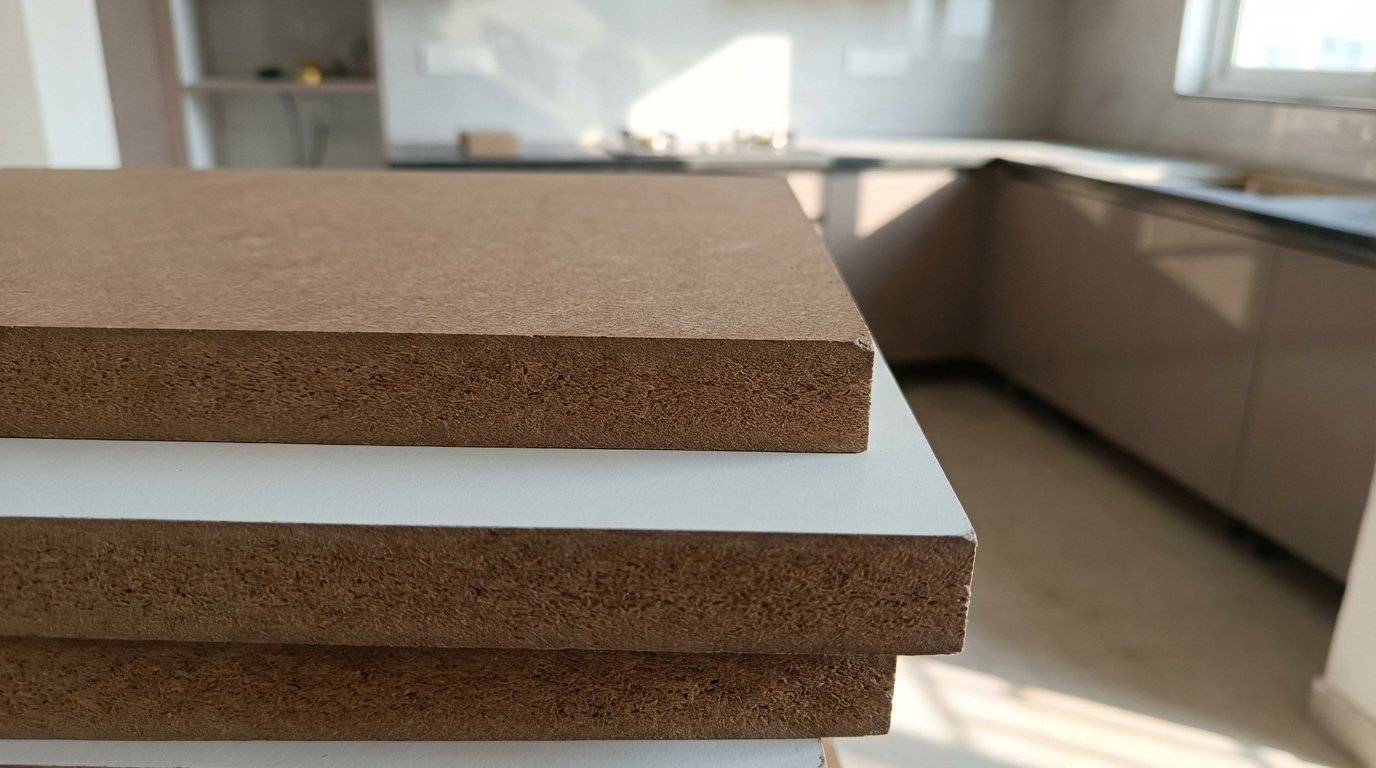
HDF (High Density Fibreboard) is an engineered wood panel manufactured by compressing wood fibres under extreme heat and pressure, bonded with synthetic resins. The defining characteristic is its density—typically between 850–950 kg/m³—which places it significantly above MDF (Medium Density Fibreboard) at 600–750 kg/m³.
This density difference fundamentally changes how the material performs. HDF delivers harder surfaces, superior screw retention, better impact resistance, and exceptional dimensional stability under load. These properties explain why HDF has become the preferred substrate for laminate flooring installations across India and is increasingly specified for door cores, wall panels, and furniture components requiring long-term durability.
Critical distinction for Indian buyers: HDF is NOT the same as HDHMR (High Density High Moisture Resistant board). Standard HDF lacks the moisture-resistant additives found in HDHMR, making it suitable only for dry interior applications. This confusion costs homeowners thousands in replacement costs when HDF gets installed in kitchens or humid coastal regions where it swells and fails.
How HDF Differs From MDF, HDHMR, and Particle Board
Before selecting any engineered board, understanding the hierarchy matters. Many dealers interchange these terms—sometimes deliberately—leading to wrong product selection and premature failures.
| Parameter | HDF | MDF | HDHMR | Particle Board |
|---|---|---|---|---|
| Density (kg/m³) | 850–950 | 600–750 | 800–850 | 400–650 |
| Moisture Resistance | Low | Very Low | High | Very Low |
| Screw Holding | Excellent | Good | Very Good | Poor |
| Surface Hardness | Very High | Medium | High | Low |
| Typical Price (₹/sq ft) | 35–75 | 25–55 | 60–130 | 18–35 |
| Best Application | Flooring, door cores | Furniture, shutters | Kitchens, humid areas | Budget furniture backs |
The takeaway is straightforward: HDF excels where hardness and wear resistance matter but moisture exposure is minimal. Choose HDHMR instead when the installation area involves water splashes, high humidity, or coastal climates. Selecting standard HDF for a Mumbai kitchen or Chennai bathroom is a recipe for swollen boards within 18–24 months.
HDF Board Types Available in India
The Indian market offers three primary HDF variants, each engineered for specific applications. Understanding these categories prevents over-specification (paying more than necessary) and under-specification (choosing inadequate material).
Plain HDF Panels
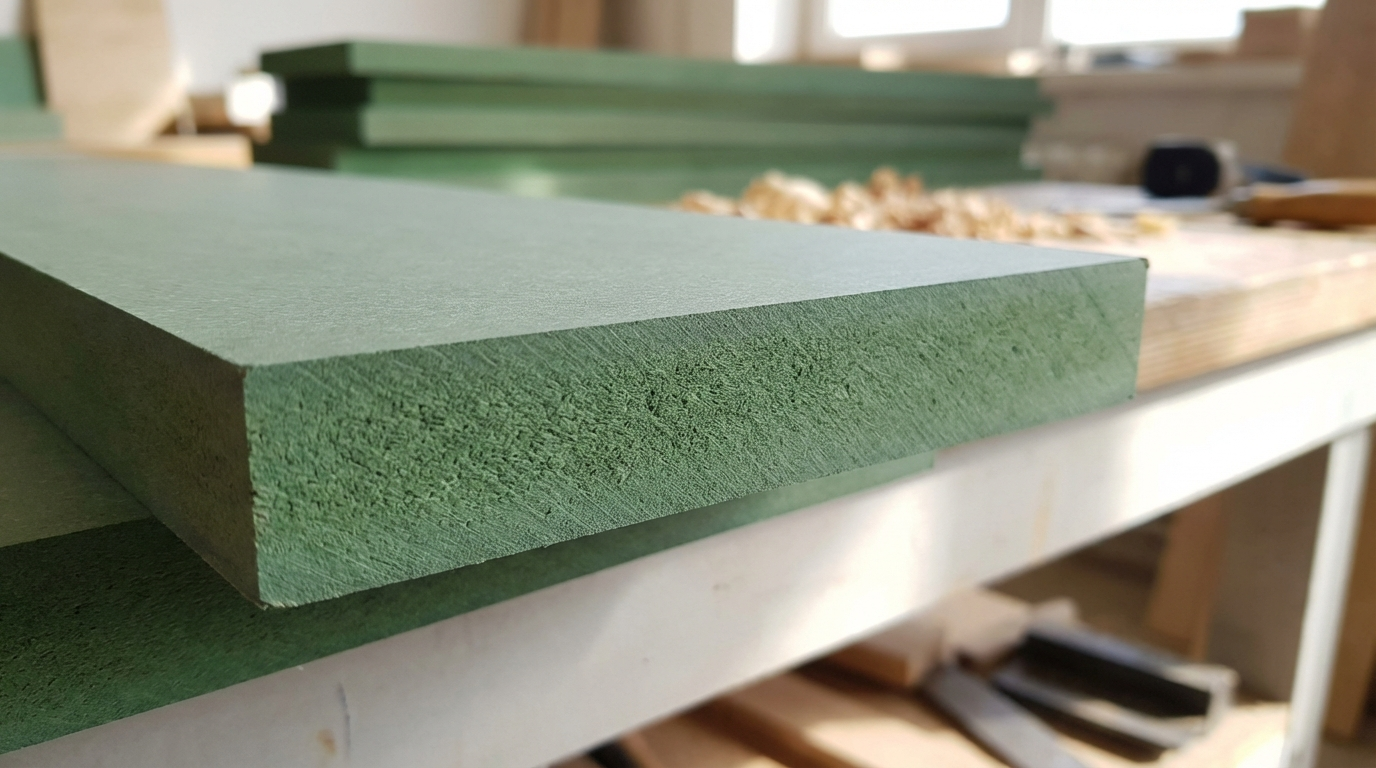
Raw, unfinished HDF boards sold without surface treatment. These are the workhorse substrate for custom applications:
- Base layer for laminate flooring systems
- Door core material where hardness matters
- Substrates for custom veneer or laminate application
- Backing panels requiring rigidity
- DIY projects needing custom finishing
Plain HDF typically costs ₹35–55 per sq ft for 6–8mm thickness and ₹50–75 per sq ft for 12mm variants. The lower price point makes it attractive when the surface won't be visible or when you're applying your own decorative finish.
Laminated HDF Panels
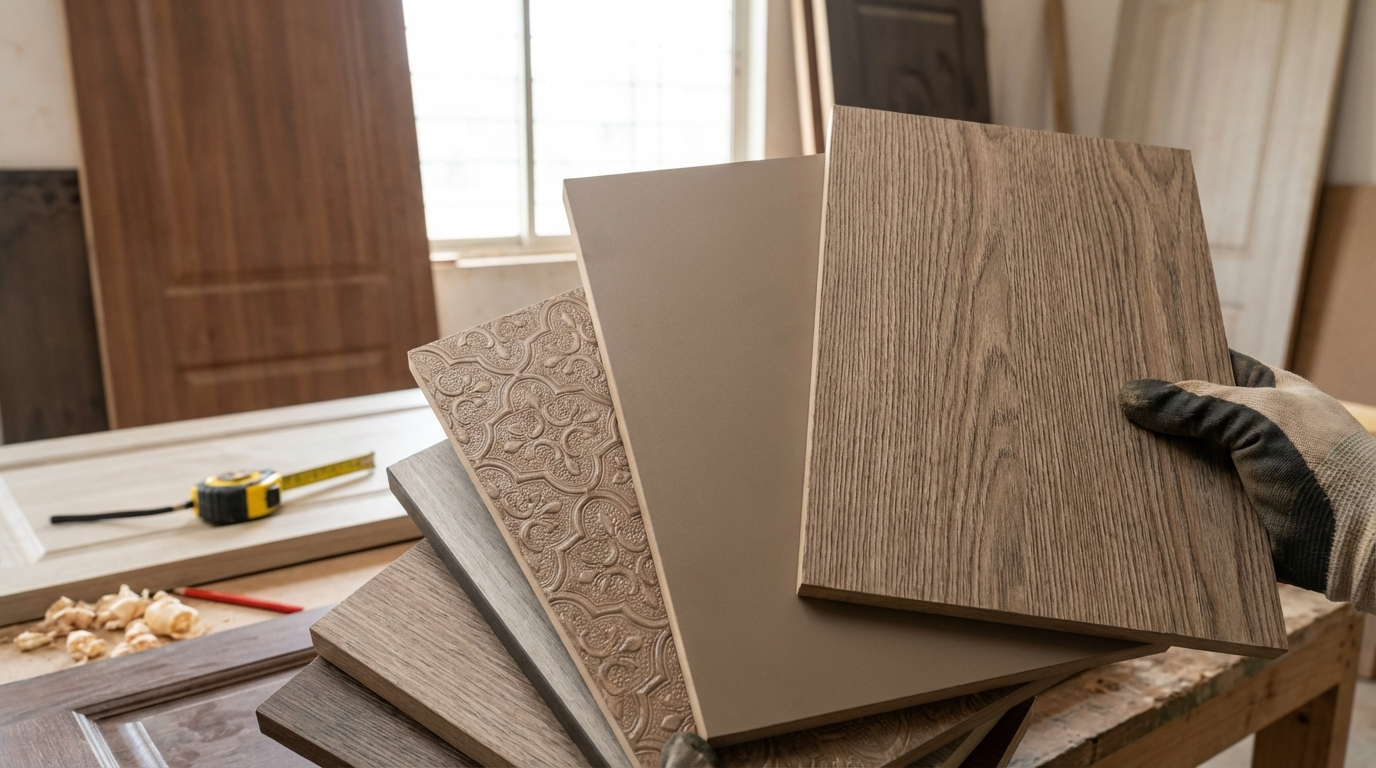
Factory-laminated HDF comes with a decorative melamine paper layer fused permanently to the surface using heat and pressure. This creates a ready-to-install product offering:
- Abrasion and scratch resistance (rated by AC classification for flooring applications)
- Decorative finishes spanning wood grains, stone patterns, solid colours, and abstract designs
- Surface moisture protection (though edges remain the weak point)
- Significant labour cost savings versus site-applied laminates
Laminated HDF dominates the Indian laminate flooring market. Pricing ranges from ₹65–120 per sq ft depending on laminate quality, AC rating, brand positioning, and design complexity.
Embossed HDF Boards (EIR Technology)
Embossed HDF represents the premium tier where the surface is textured during manufacturing to replicate the tactile feel of real wood grain, stone texture, or other patterns. The most advanced version—Embossed-in-Register (EIR)—aligns the physical texture precisely with the printed pattern beneath.
Run your hand across standard laminated HDF and it feels uniformly smooth regardless of the printed wood grain. Run your hand across EIR embossed HDF and you feel the grain ridges exactly where you see them. This realism commands premium pricing but delivers flooring that genuinely mimics solid wood underfoot.
Embossed HDF panels typically cost ₹90–150 per sq ft in the Indian market, with imported EIR products occasionally exceeding this range.
HDF Board Applications: Where It Works Best
HDF's high density and surface hardness make it ideal for specific applications while being entirely wrong for others. This section helps you match material to application correctly.
Laminate Flooring Substrates
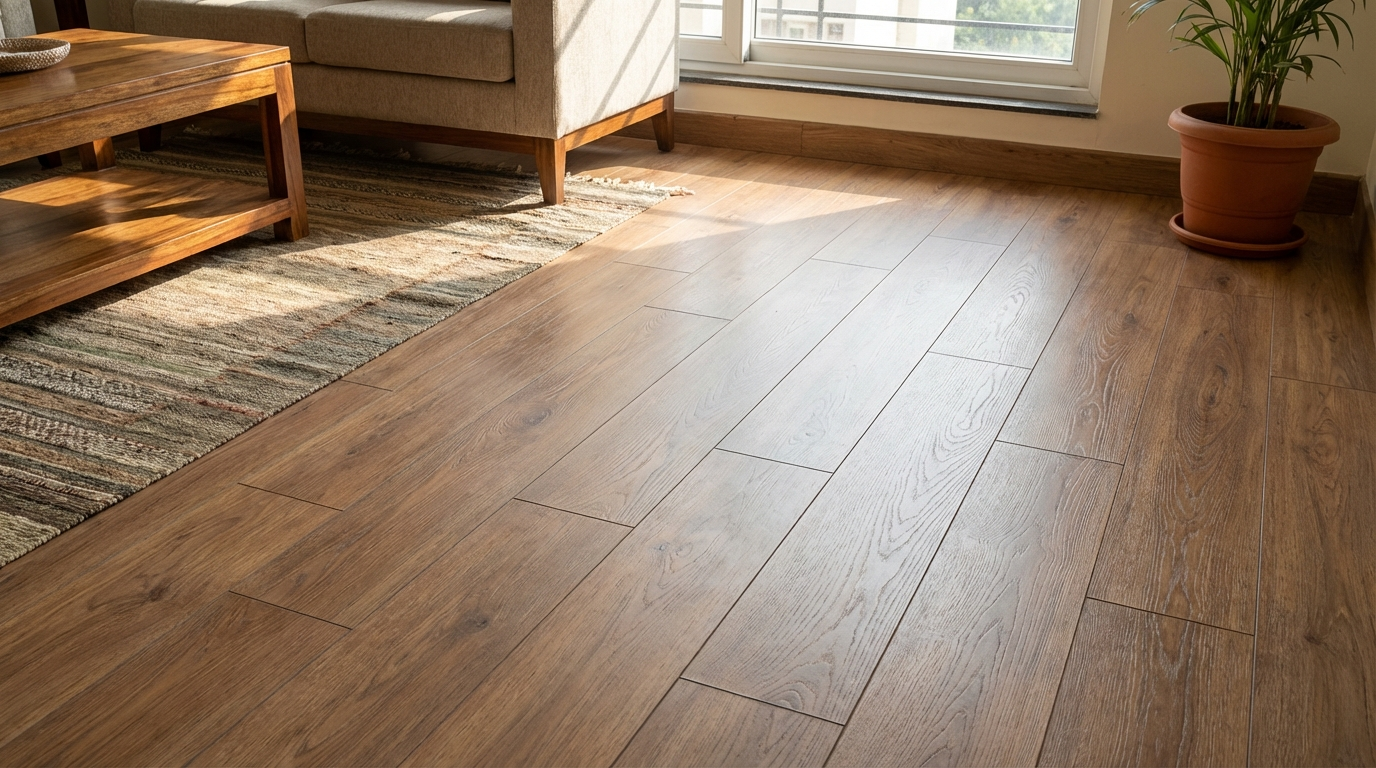
This is HDF's dominant application globally and in India. The density provides dimensional stability underfoot, resists indentation from furniture legs, and maintains click-lock joint integrity over years of use. When you purchase branded laminate flooring from Pergo, Quick-Step, or domestic brands like Action Tesa, the core material is almost always HDF.
Why HDF works here: Flooring experiences continuous compression loads, impact from dropped objects, and foot traffic abrasion. MDF cores would compress and distort; particle board would crumble at joints. HDF's 850+ kg/m³ density handles these stresses.
Interior Door Cores
Flush doors and engineered door systems increasingly use HDF cores instead of particle board or hollow honeycomb. The benefits include better sound insulation, superior screw holding for hinges and locks, and improved impact resistance—doors get slammed, kicked, and bumped constantly.
For door applications, 12mm or 16mm HDF provides the optimal balance of weight, strength, and cost. Thicker 18mm+ options add unnecessary weight and cost for most residential doors.
Wall Panelling and Cladding
Decorative wall panels in offices, retail spaces, and premium residences often use laminated HDF. The smooth surface accepts paints and finishes uniformly, while the density prevents telegraphing of wall imperfections through the panel face.
Furniture Components (Limited Applications)
HDF finds limited furniture use—primarily drawer bottoms, cabinet backs, and partition panels where rigidity matters more than thickness. It's rarely used for main carcass construction because HDHMR offers similar density with moisture protection at comparable cost.
Where HDF Should NOT Be Used
Knowing where HDF fails prevents costly mistakes:
- Kitchen cabinets: Steam, water splashes, and cleaning moisture will swell unprotected HDF within months. Use HDHMR or BWR plywood instead.
- Bathroom vanities: Daily humidity exposure guarantees edge swelling. Never use standard HDF here.
- Outdoor applications: HDF has zero weather resistance. Even covered balconies in humid climates are problematic.
- Ground-floor installations in flood-prone areas: Even occasional water contact causes irreversible damage.
- Coastal cities without climate control: Ambient humidity in places like Chennai, Mumbai, or Kochi can exceed HDF's tolerance over time.
HDF Board Price Guide: India 2026
HDF pricing in India varies significantly based on thickness, surface treatment, brand, and regional availability. These ranges represent typical market conditions and help with project budgeting—actual prices fluctuate with raw material costs, GST changes, and dealer margins.
Plain HDF Price Ranges
| Thickness | Price Range (₹/sq ft) | Typical 8×4 Sheet Cost | Primary Applications |
|---|---|---|---|
| 3mm | ₹18–30 | ₹575–960 | Backing panels, templates |
| 6mm | ₹35–45 | ₹1,120–1,440 | Wall panels, underlayment |
| 8mm | ₹40–55 | ₹1,280–1,760 | Flooring substrates, partitions |
| 12mm | ₹55–75 | ₹1,760–2,400 | Door cores, heavy-duty panels |
Laminated HDF Price Ranges
| Product Type | Price Range (₹/sq ft) | Includes |
|---|---|---|
| AC3 Laminate Flooring | ₹65–90 | Basic residential-grade wear layer |
| AC4 Laminate Flooring | ₹85–110 | Light commercial-grade durability |
| AC5 Laminate Flooring | ₹100–140 | Heavy commercial-grade specifications |
| Embossed/EIR Flooring | ₹110–150 | Premium textured surface |
Price Factors That Affect Your Quotation
Brand tier: Premium brands like Action Tesa or imported products command 20–40% premiums over regional manufacturers. This premium typically reflects better quality control, consistent thickness calibration, and reliable technical specifications.
Quantity: Bulk purchases (50+ sheets) typically attract 5–15% discounts from dealers. Retail single-sheet purchases carry the highest per-unit cost.
Regional variation: HDF costs more in Northeast India and remote locations due to transportation. Mumbai, Delhi, Bangalore, and Chennai typically have the most competitive pricing due to dealer concentration.
GST considerations: Verify whether quoted prices include 18% GST. Some dealers quote ex-factory rates while others include GST—this 18% difference significantly impacts project budgets.
Understanding AC Ratings for HDF Flooring
When purchasing HDF-based laminate flooring, AC ratings indicate abrasion resistance and expected durability. This European classification system (Abrasion Class) helps match flooring to traffic levels:
| AC Rating | Suitable For | Expected Traffic | Indian Context |
|---|---|---|---|
| AC1 | Light residential | Occasional walking | Rarely available; avoid |
| AC2 | General residential | Normal household traffic | Budget bedrooms only |
| AC3 | Heavy residential / Light commercial | Regular daily traffic | Living rooms, most homes |
| AC4 | General commercial | High traffic areas | Offices, shops, joint families |
| AC5 | Heavy commercial | Very high traffic | Retail, hospitals, public spaces |
Recommendation for Indian homes: AC3 suffices for most residential applications. Invest in AC4 for living rooms in large joint families, homes with pets, or areas with heavy furniture movement. AC5 is overkill for residential use and adds unnecessary cost.
Top HDF Board Brands in India
Brand selection affects quality consistency, warranty support, and long-term performance. Here's how major players position themselves:
Action Tesa
Market leader in engineered boards with extensive dealer networks across metros and tier-2 cities. Their HDF offerings include both plain substrates and pre-laminated flooring products. Known for consistent quality control and readily available technical documentation. Pricing sits in the mid-to-premium range.
Greenply (Greenpanel)
Strong presence in HDF flooring with emphasis on eco-certifications and formaldehyde emission compliance. Their products typically meet E1 or E0 emission standards—important for indoor air quality in bedrooms and children's rooms. Competitive pricing with good availability in North and East India.
Century Ply
Positions HDF products in the premium segment with emphasis on surface finish quality. Popular among architects specifying for luxury residential and commercial projects. Higher price point but strong after-sales support and warranty backing.
Imported Brands (Pergo, Quick-Step, Kronotex)
European and Southeast Asian imports available through specialised flooring dealers in metro cities. These typically offer superior embossing technology, wider design ranges, and stringent quality certifications. Pricing runs 40–80% higher than domestic equivalents, justified primarily for high-end residential and commercial installations.
How to Choose the Right HDF Board: Decision Framework
Use this framework to match HDF specifications to your specific requirements:
Choose Plain HDF When:
- You're installing laminate flooring and need a substrate
- The surface won't be visible (backing panels, underlayment)
- You're applying custom veneers or laminates yourself
- Budget constraints prevent pre-laminated options
- The application is strictly dry interior use
Choose Laminated HDF When:
- You want ready-to-install flooring without separate finishing
- Consistent factory-applied finish matters more than customisation
- Labour cost savings justify the higher material cost
- Design options available match your aesthetic requirements
Choose Embossed HDF When:
- Realistic wood-look flooring is the priority
- Budget allows premium pricing for tactile quality
- The installation is a prominent living space where aesthetics dominate
Choose HDHMR Instead of HDF When:
- Any moisture exposure is possible (kitchens, bathrooms, humid climates)
- Installation is in coastal cities like Mumbai, Chennai, Kochi, Goa
- The furniture application involves water contact (kitchen cabinets, vanities)
- Ground-floor installation in flood-prone areas
HDF Board Quality Checks: What to Inspect Before Purchase
Whether buying from dealers or specifying for contractors, these checks prevent quality issues:
Visual Inspection
- Surface uniformity: Check for rough patches, depressions, or visible fibre clumps. Quality HDF has smooth, consistent surfaces.
- Edge integrity: Edges should be clean-cut without crumbling or delamination. Poor edges indicate low-density cores or manufacturing defects.
- Colour consistency: Significant colour variation across sheets from the same batch suggests inconsistent processing.
Physical Tests
- Weight check: HDF should feel noticeably heavier than MDF of equivalent size. Suspiciously light boards indicate sub-standard density.
- Flex test: A properly dense HDF panel resists bending. If an 8mm sheet flexes easily under hand pressure, density is compromised.
- Knock test: Knocking on quality HDF produces a solid, dense sound. Hollow or dull sounds suggest voids or poor compression.
Documentation Verification
- ISI certification: Look for IS 12823 marking for medium density fibreboards. Though HDF technically exceeds MDF density, this standard applies.
- Emission rating: E1 certification indicates formaldehyde emissions below 0.1 ppm—important for bedroom and children's room applications. E0 certification indicates even lower emissions.
- Test certificates: Established brands provide technical data sheets showing density, thickness tolerance, and mechanical properties on request.
Installation Considerations for HDF Applications
For Flooring Installations
HDF laminate flooring requires proper subfloor preparation. Concrete floors need moisture barriers (polyethylene sheets) to prevent ground moisture migration into the HDF core. Uneven subfloors require levelling compounds—HDF's rigidity means it bridges small gaps poorly and may crack at joints over unlevel surfaces.
Acclimatisation matters in India's variable climate. Store HDF flooring panels in the installation room for 48–72 hours before installation, allowing the material to equilibrate with ambient humidity. This prevents post-installation expansion or contraction.
For Furniture and Door Applications
HDF machines well with standard woodworking tools but requires sharp carbide-tipped blades for clean cuts. Dull blades cause edge chipping and surface tearout. Pre-drilling for screws isn't strictly necessary given HDF's density, but prevents splitting near edges.
Seal all exposed edges when using HDF in furniture. The core readily absorbs moisture through cut edges even when face surfaces are protected. Apply edge banding, paint, or sealant to all cuts.
HDF vs Plywood for Indian Projects: When Each Makes Sense
This comparison addresses a common question, particularly for furniture applications:
| Factor | HDF | Commercial Plywood | BWR Plywood |
|---|---|---|---|
| Surface smoothness | Excellent | Requires finishing | Requires finishing |
| Moisture resistance | Poor | Moderate | Good |
| Screw holding | Excellent | Very Good | Very Good |
| Weight | Heavy | Medium | Medium |
| Price (comparable thickness) | Lower | Similar | Higher |
| Best for | Dry interiors, flooring | General furniture | Moisture-prone areas |
Decision logic: Use HDF when you need perfectly smooth surfaces for paint or laminate and moisture isn't a concern. Use BWR plywood when moisture exposure is possible. Use commercial plywood for general furniture where moderate moisture resistance suffices.
Buyer Checklist: Before Purchasing HDF Board
Use this checklist to ensure you're getting appropriate material at fair pricing:
- Confirm the application is moisture-free. If any water exposure is possible, switch to HDHMR or BWR plywood instead.
- Specify exact thickness required. Don't accept "approximately 8mm"—HDF thickness affects performance significantly.
- Verify brand and grade. Ask for brand name and check consistency with technical specifications. Generic "HDF" without brand identification often indicates inferior quality.
- Check emission certification. For bedrooms, children's rooms, or spaces with extended occupancy, insist on E1 or E0 certified products.
- Confirm pricing includes GST. Get written quotes specifying GST inclusion to avoid budget surprises.
- Inspect before accepting delivery. Check for surface damage, edge integrity, and thickness consistency. Reject substandard sheets before they enter your project.
- Order 10% extra for flooring. Cutting waste, damaged pieces, and future repairs require spare material. This small additional cost prevents matching problems later.
- Store properly before installation. Keep HDF sheets flat, off the ground, in dry conditions. Never store in areas with moisture exposure or direct sunlight.
HDF remains an excellent material choice when applied correctly—to dry interior applications where its density, surface quality, and cost-effectiveness deliver genuine value. The key is respecting its moisture limitations and selecting HDHMR or plywood alternatives when humidity enters the equation. Match material to application, verify quality before purchase, and your HDF installations will perform reliably for years.
Disclaimer: This content is provided for general informational purposes based on industry practices and publicly available information. Product specifications, standards, prices, and availability may vary by manufacturer, region, and time. Readers should independently verify details with manufacturers, dealers, or qualified professionals before making purchase or construction decisions.