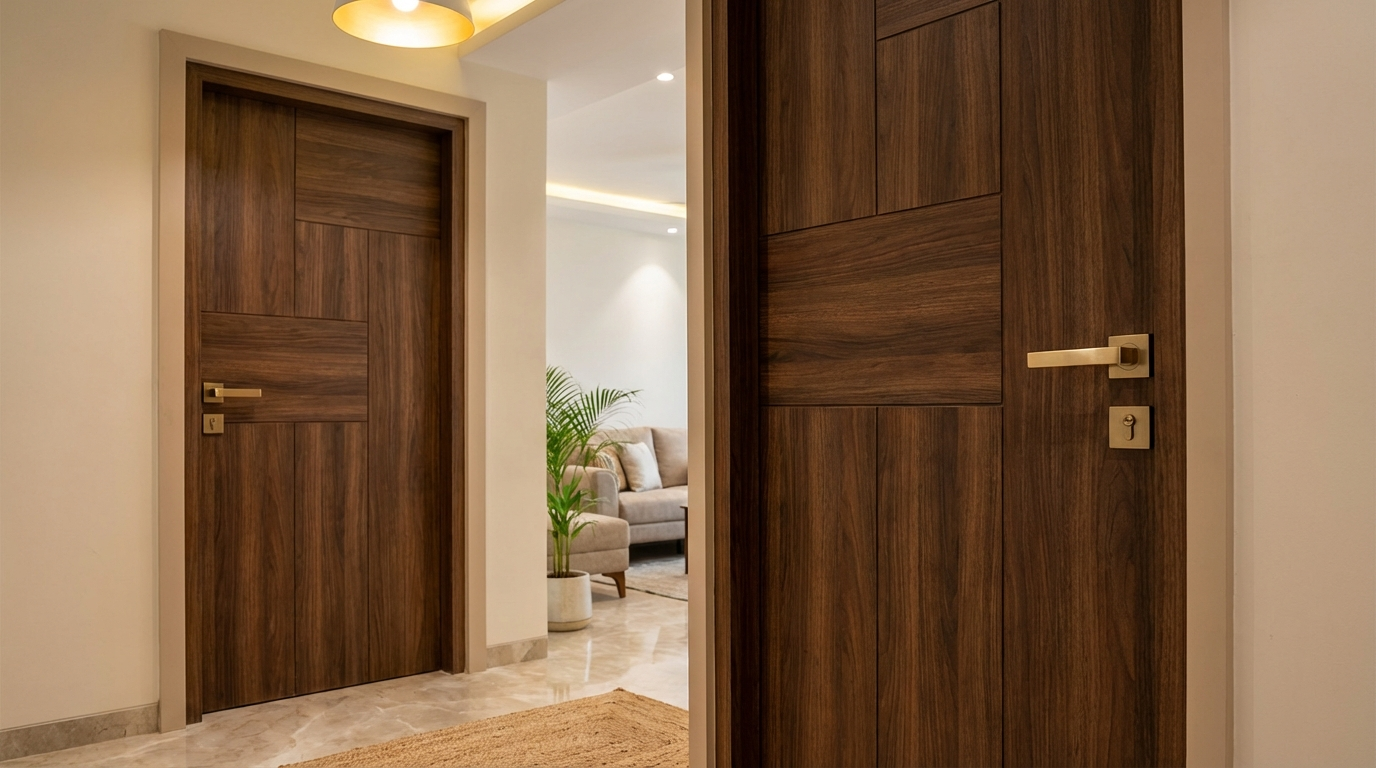
Why HDHMR Doors Are Replacing Traditional Options in 2026
If you're building or renovating in India right now, you've likely encountered a frustrating reality: solid wood doors are expensive and prone to warping, while cheap flush doors deteriorate within years. HDHMR doors occupy the space between these extremes, offering moisture resistance that standard MDF cannot match and a price point significantly below marine plywood.
This guide covers HDHMR door designs currently available in Indian markets, realistic price expectations for 2026, and practical selection criteria based on where you'll install them. Whether you're fitting out a modular kitchen, replacing bathroom doors, or furnishing an entire apartment, you'll find specific recommendations rather than vague generalisations.
What is an HDHMR Door? Understanding the Material
An HDHMR door is a door shutter or panel manufactured from High Density High Moisture Resistant board—an engineered wood product made by compressing wood fibres under extreme heat and pressure with moisture-resistant resins. The resulting board has a density between 850–900 kg/m³, substantially higher than standard MDF (typically 600–750 kg/m³).
Key distinction: HDHMR is not waterproof in the sense that marine plywood or solid plastic doors are. It is highly moisture-resistant, meaning it can withstand humid environments like kitchens and bathrooms without swelling or delaminating—provided edges are properly sealed.
The uniform fibre structure gives HDHMR doors three practical advantages over plywood doors:
- Superior surface smoothness – accepts paint, laminate, and veneer without visible grain or patches
- No internal voids – unlike plywood, which can have gaps that absorb moisture or weaken screw holding
- Consistent density throughout – CNC routing and detailed design work produce clean, sharp edges
HDHMR Door Design Categories for 2026
Indian manufacturers and modular furniture companies have expanded HDHMR door designs significantly over the past two years. Here's what's actually available in the market:
Flush Panel Doors (Flat/Minimalist)
The most common HDHMR door style. A single flat panel, typically 16mm or 18mm thick, finished with laminate or paint. These dominate modular kitchens and wardrobes because they're economical, easy to clean, and suit contemporary interiors.
Best for: Kitchen cabinets, wardrobe shutters, bathroom vanities, office storage
Finish options: High-gloss acrylic, matte laminate, PU paint, textured PVC membrane
Grooved/Fluted Doors
CNC-routed vertical or horizontal grooves create a ribbed texture. This design has become extremely popular in 2024-2026 for wardrobe doors and accent panels. The grooves are typically 8-12mm deep on an 18mm board.
Best for: Wardrobe doors, TV unit shutters, partition panels, entry foyer storage
Design tip: Vertical fluting elongates visual height; horizontal fluting suits wide cabinets
Shaker-Style Doors
A routed frame pattern around a flat centre panel, mimicking traditional framed doors. Achievable with CNC routing on HDHMR, though the design depth is limited compared to actual framed construction.
Best for: Kitchen cabinet doors in transitional or semi-traditional interiors
Geometric Pattern Doors
Diamond, hexagonal, wave, or abstract patterns routed into the surface. These serve as statement pieces—typically one or two accent doors in a room rather than throughout.
Best for: Pooja room doors, bar unit shutters, walk-in closet feature panels
Plain Painted/Lacquered Doors
HDHMR's smooth surface makes it ideal for high-quality paint finishes. PU (polyurethane) lacquer in matte, satin, or gloss creates a premium appearance comparable to Italian modular systems at a fraction of the cost.
Best for: Premium wardrobes, handleless kitchen systems, bedroom integrated storage
HDHMR Door Price Guide 2026: What You'll Actually Pay
Pricing varies significantly based on thickness, finish type, brand, and your city. The following table reflects street prices across major Indian metros as of early 2026:
| Door Type | Thickness | Finish | Price Range (₹/sq.ft) | Per Door Estimate (2ft × 7ft) |
|---|---|---|---|---|
| Plain HDHMR (unfinished) | 18mm | Raw board only | ₹90–110 | ₹1,260–1,540 |
| Laminated HDHMR | 18mm | Pre-laminated | ₹105–130 | ₹1,470–1,820 |
| PU Painted HDHMR | 18mm | 2-coat PU finish | ₹140–180 | ₹1,960–2,520 |
| Acrylic Finish HDHMR | 18mm | High-gloss acrylic | ₹160–220 | ₹2,240–3,080 |
| CNC Routed (Fluted/Pattern) | 18mm | Paint/Laminate + routing | ₹180–280 | ₹2,520–3,920 |
| Membrane/PVC Foil | 18mm | Vacuum-pressed PVC | ₹130–160 | ₹1,820–2,240 |
Important pricing notes:
- Prices above are for the door shutter only—hardware (hinges, handles, soft-close mechanisms) adds ₹300–1,500 per door depending on quality
- Edge banding (essential for moisture protection) typically costs ₹8–15 per running foot extra
- GST (18%) may or may not be included in quoted prices—always confirm
- Branded boards (Action Tesa, Century, Greenpanel) cost 10–20% more than generic HDHMR
Regional Price Variations
Transport and local demand create noticeable price differences:
- Delhi-NCR: Generally the lowest prices due to proximity to manufacturing and intense dealer competition
- Mumbai/Pune: 5–10% higher than Delhi; significant dealer networks in Dadar and Chinchpokli markets
- Bangalore: Similar to Mumbai; strong demand from IT corridor renovations
- Chennai/Hyderabad: Moderate pricing; good availability of Action Tesa and Century
- Kolkata: Slightly lower than Mumbai but limited high-end finish options
- Northeast/Tier-3 cities: 15–25% premium due to transport; limited brand choices
HDHMR vs Other Door Materials: Honest Comparison
Making the right choice requires understanding where HDHMR genuinely excels and where alternatives make more sense.
| Parameter | HDHMR Door | BWP Plywood Door | MDF Door | Solid Wood Door |
|---|---|---|---|---|
| Moisture Resistance | High (with sealed edges) | High | Low–Medium | Medium (species-dependent) |
| Weight | Heavy (40–50 kg/8×4 sheet) | Medium | Lighter | Heavy |
| Surface Finish Quality | Excellent (smooth) | Good (grain visible) | Excellent | Natural grain |
| Screw Holding | Good (pre-drill required) | Excellent | Moderate | Excellent |
| Termite Resistance | High (treated) | Varies (needs treatment) | Low | Low (needs treatment) |
| Price (18mm, per sq.ft) | ₹90–110 | ₹120–160 | ₹45–65 | ₹200–400+ |
| Best Application | Kitchens, wardrobes, bathrooms | Main doors, heavy-use areas | Dry interiors only | Premium main doors |
When HDHMR Doors Make Sense
- Kitchen cabinet shutters (especially near sinks and cooking areas)
- Wardrobe doors where humidity varies seasonally
- Bathroom vanity doors (not shower enclosures—those need waterproof alternatives)
- Interior room doors in apartments with controlled environments
- When you want CNC-routed designs without the cost of solid wood
When to Choose Something Else
- Main entry doors exposed to weather: Use BWP marine plywood, solid teak, or WPC
- Shower cubicle doors: Use glass, uPVC, or aluminium-framed options
- Exterior-facing balcony storage: HDHMR will degrade; choose exterior-grade plywood or WPC
- Very large doors (over 2m × 0.9m): Weight becomes problematic; consider plywood with aluminium framing
Quick Decision Guide: Selecting the Right HDHMR Door
Use this framework to narrow down your options efficiently:
Step 1: Determine the Installation Location
- Kitchen (near water sources): 18mm HDHMR with laminate or acrylic finish; ensure all edges are banded
- Wardrobe/Bedroom: 16mm or 18mm; finish choice based on design preference
- Bathroom vanity: 18mm minimum; PVC membrane finish performs well in humidity
- Interior room divider: 12mm may suffice if not load-bearing
Step 2: Choose Thickness Based on Door Size
- Small cabinet doors (under 600mm width): 16mm is adequate
- Standard wardrobe doors (600–900mm width): 18mm recommended
- Large wardrobe doors (over 900mm width or over 2100mm height): 18mm with rear rail reinforcement
- Sliding doors: 18mm; the track mechanism distributes weight
Step 3: Match Finish to Budget and Aesthetic
- Budget option: Pre-laminated HDHMR (₹105–130/sq.ft) in solid colours or wood-grain patterns
- Mid-range: PVC membrane press (₹130–160/sq.ft) allows routed designs with colour
- Premium: PU paint (₹140–180/sq.ft) or high-gloss acrylic (₹160–220/sq.ft)
Step 4: Specify Hardware Requirements
- Swing doors: Use 4-inch or 5-inch stainless steel ball-bearing hinges; three hinges minimum for doors over 1500mm tall
- Cabinet doors: Soft-close concealed hinges (Hettich, Hafele, or equivalent) rated for the door weight
- Sliding doors: Ensure track system is rated for HDHMR weight (approximately 1.1 kg per sq.ft for 18mm)
Design Catalogue: Popular HDHMR Door Styles in 2026
While we cannot embed images here, these are the design categories dominating Indian modular furniture showrooms this year:
Contemporary Minimalist
Flat slab doors in matte finishes (grey, white, charcoal, beige). Handleless profiles using J-pulls or push-to-open mechanisms. This style dominates urban apartments targeting clean, uncluttered aesthetics.
Textured Wood-Grain
Laminates replicating walnut, oak, teak, and ash with embossed surface textures. These provide a wood appearance without solid wood maintenance requirements or price.
Two-Tone Combinations
Upper cabinets in light colours (white, cream) with base units in darker tones (charcoal, navy). This combination creates visual interest while making spaces feel larger.
Fluted Accents
Vertical ribbed panels on feature doors—typically wardrobe central panels or tall storage units. Usually paired with plain adjacent doors to avoid visual overload.
Industrial/Cement Effect
Grey laminates with concrete-like textures. Popular in bachelor pads, home offices, and contemporary kitchens aiming for an industrial aesthetic.
High-Gloss Solid Colours
Acrylic finish in burgundy, forest green, cobalt blue, or classic white. Creates a lacquered appearance associated with Italian design. Requires careful handling as scratches are visible.
Installation and Maintenance Considerations
Critical Installation Points
Edge sealing is non-negotiable. The moisture resistance of HDHMR depends on sealing all cut edges. Options include:
- PVC edge banding (most common; available in matching colours)
- ABS edge banding (slightly more durable than PVC)
- Aluminium edge profiles (premium option; excellent for kitchen applications)
- Polyurethane sealant on edges before banding (extra protection in high-humidity areas)
Hinge installation requires pre-drilling. Unlike plywood, driving screws directly into HDHMR can cause splitting. Always drill pilot holes slightly smaller than screw diameter.
Weight affects handling. An 18mm HDHMR door panel (2ft × 7ft) weighs approximately 15–18 kg. Installation typically requires two people, and wall-mounted cabinets need heavy-duty anchors.
Maintenance Guidelines
- Daily cleaning: Wipe with soft damp cloth; dry immediately. Avoid abrasive scrubbers on laminate/acrylic finishes.
- Avoid prolonged water contact: Wipe up spills immediately, especially near edges and hinges.
- Check hinge tightness quarterly: HDHMR's screw-holding is good but not as forgiving as plywood. Tighten loose screws before they strip.
- Touch-up options: Minor scratches on laminate can be concealed with matching markers. Deep damage may require panel replacement.
Common Mistakes to Avoid When Buying HDHMR Doors
Mistake 1: Treating All HDHMR as Equal
Generic, unbranded boards may have lower density or inferior moisture-resistant resins. Verify the board density (should be 850+ kg/m³) and ask for brand certification. The ₹15–20/sq.ft savings on generic boards often results in premature swelling or edge degradation.
Mistake 2: Ignoring Edge Protection
Many carpenters skip edge banding on hidden edges (backs of doors, bottom edges) to save cost. In humid Indian climates, these unsealed edges absorb moisture over time, causing localised swelling. Insist on complete edge sealing.
Mistake 3: Using Standard MDF Hinges
HDHMR doors are heavier than MDF doors of the same size. Using hinges rated for MDF will result in sagging within months. Specify hinges rated for the actual door weight.
Mistake 4: Choosing Aesthetics Over Practicality
High-gloss finishes show fingerprints and scratches prominently—poor choice for kitchen cabinet doors that see heavy daily use. Reserve gloss finishes for bedroom wardrobes or display units with less handling.
Mistake 5: Not Accounting for Total Cost
Quoted per-sq.ft prices often exclude edge banding (₹8–15/rft), hardware (₹300–1,500/door), installation labour (₹50–100/sq.ft), and GST. A "₹100/sq.ft" door can easily reach ₹180–200/sq.ft fully installed.
Buying HDHMR Doors: Practical Checklist
Before finalising your purchase:
- Confirm brand and density – Ask for manufacturer stamps or certificates; verify density specification
- Get fully-loaded quotes – Request pricing including edge banding, hardware, and installation; compare apples to apples
- Specify thickness clearly – Don't assume; 16mm and 18mm look similar but perform differently
- Inspect sample finish – View actual samples under your home/office lighting; showroom lighting differs
- Understand warranty terms – Branded boards (Action Tesa, Century) typically offer 5–10 year warranties against manufacturing defects
- Plan for delivery logistics – Full sheets are heavy; confirm delivery includes carrying to your floor if you're in an apartment
- Get cutting done properly – Factory-cut edges are cleaner than on-site cutting; specify dimensions accurately
The Bottom Line: Is HDHMR Right for Your Doors?
HDHMR doors deliver excellent value for interior applications where moisture resistance matters but full waterproofing isn't required. They outperform MDF in durability, offer smoother surfaces than plywood for contemporary finishes, and cost significantly less than marine plywood or solid wood.
For 2026, expect to budget ₹150–250 per square foot for quality HDHMR doors including finish and hardware. This positions them as the sensible choice for modular kitchens, wardrobes, and bathroom vanities across most Indian homes.
The material isn't suited for exterior doors, shower enclosures, or applications requiring extreme structural strength. In those cases, alternatives like marine plywood, WPC, or solid hardwood remain appropriate despite higher costs.
When purchasing, prioritise branded boards, insist on proper edge sealing, and specify hardware rated for the door weight. These details separate HDHMR doors that last a decade from those that deteriorate within years.
Disclaimer: This content is provided for general informational purposes based on industry practices and publicly available information. Product specifications, standards, prices, and availability may vary by manufacturer, region, and time. Readers should independently verify details with manufacturers, dealers, or qualified professionals before making purchase or construction decisions.