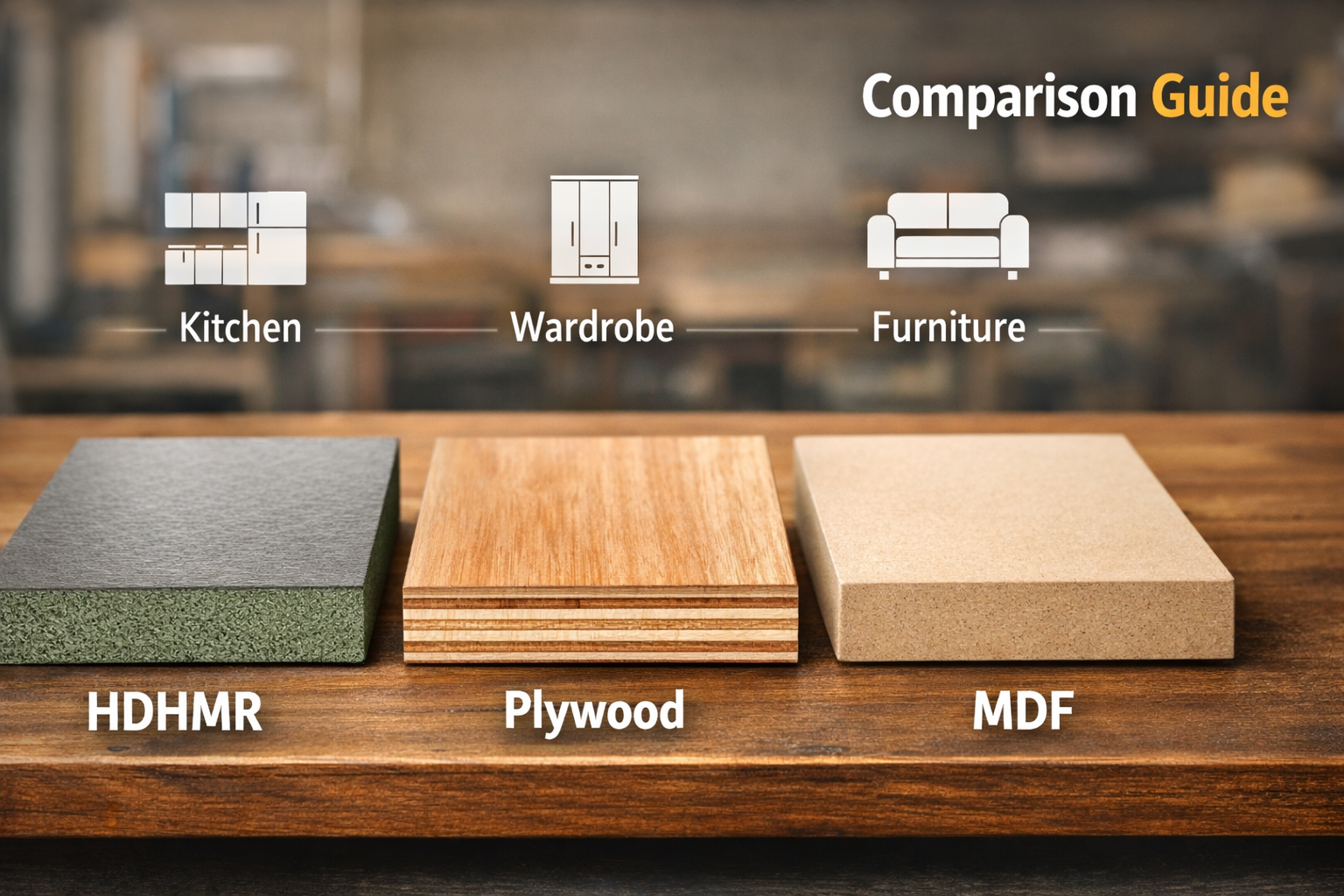
HDHMR vs Plywood vs MDF: Best Choice for Furniture?
When choosing materials for making furniture like kitchen cabinets, wardrobes, or other interior pieces, the three names that often come up are HDHMR board, Plywood, and MDF. Each of these has its own strengths and weaknesses. In this section, we’ll provide a side-by-side comparison of HDHMR vs Plywood vs MDF on crucial factors like composition, strength, moisture-resistance, screw holding, cost, and ideal uses. By the end, you should have a clear idea which material is best suited for which purpose in your home or project.
Material Basics: Let’s start with a quick intro to each: - HDHMR (High Density High Moisture Resistant Board): An engineered wood product made from hardwood fibers compressed with moisture-resistant resin under high pressure. It’s essentially an advanced form of fiberboard – very dense and smooth, with no layers or grain. Think of it as a “super MDF” that handles moisture better and is heavier/stronger. - Plywood: A sheet material made by gluing together thin wood veneers (plies) in alternating grain directions. Plywood is layered; its quality depends on the wood species, adhesive, and manufacturing. It’s been a staple for decades in furniture and construction. Plywood comes in grades like MR (Moisture resistant), BWR (Boiling Water Resistant), BWP/Marine (Boiling Waterproof) etc., indicating its glue type and intended use. - MDF (Medium Density Fiberboard): An engineered wood made from fine wood fibers mixed with resin and pressed into boards. It’s smooth and uniform, great for painting, but not very water-resistant and has moderate strength. It’s less dense than HDHMR (hence “medium” density) and is the cheapest of the three generally.
Now, let’s compare them feature by feature:
1. Strength & Load-Bearing Capacity: - HDHMR: High strength due to high density. It’s very sturdy in sheet form, meaning it resists bending or sagging under load better than MDF. Shelves or cabinets made from HDHMR can hold heavy items reliably without intermediate support over reasonable spans. Its uniform structure means no weak spots (like knots) anywhere. Many consider HDHMR’s strength comparable to good plywood for indoor uses. - Plywood: Also quite strong, especially high-grade plywood. Plywood’s cross-laminated structure gives it excellent tensile strength and resistance to cracking along the grain. A well-made plywood (like marine ply) can be extremely strong and even used structurally in building. Plywood typically has a better strength-to-weight ratio than HDHMR – i.e., for the same weight, plywood might bear more load. However, if we compare same thickness pieces, HDHMR (being heavier) can be just as stiff or stiffer in some cases. Plywood can sometimes flex slightly because of grain direction, but high-quality ones are very sturdy. One thing to watch: lower grade plywood can have internal voids or weaker core veneers that reduce its effective strength. - MDF: The weakest of the three in terms of load. MDF is fairly dense but it’s also more flexible and not as stiff as HDHMR. A long MDF shelf will sag more quickly under weight than a plywood or HDHMR shelf. It’s perfectly fine for light to moderate loads – e.g., MDF is used for cabinet doors, small shelves, or backing – but it is not ideal for heavy loads (like storing lots of heavy books or supporting granite countertops, etc. without reinforcement). Overloading MDF can lead to bowing or even breaking. So for durability under stress, MDF ranks below plywood and HDHMR.
2. Moisture Resistance: - HDHMR: Built for moisture resistance. The “HMR” in the name tells you it’s formulated to resist humidity. HDHMR handles kitchens, bathrooms, and humid climates much better than MDF or normal plywood. If it gets slightly wet or is in a damp area, it won’t swell or delaminate easily. However, remember it’s moisture-resistant, not waterproof – sustained exposure to water can still damage it over time. But for daily humidity and occasional splashes, it’s a top performer. Many kitchen makers use HDHMR for this reason, to avoid swelling problems near sinks and stoves. - Plywood: It depends on the type. Marine/BWP plywood is actually superior in water resistance – it can endure being boiled in water for hours (hence BWP) and is essentially waterproof due to phenolic resins used. That’s what you’d use for outdoor or frequently wet areas. Commercial MR plywood, on the other hand, is only somewhat moisture resistant – it can handle humidity but if it gets soaked, it can get damaged (the layers might peel or mold might grow). Plywood can also warp if one side is exposed to moisture more than the other. So, in a kitchen, if standard ply is not sealed well, it may warp near the sink area. In general: If you compare standard interior plywood vs HDHMR, the HDHMR likely performs better in moisture. But if you compare the best waterproof plywood vs HDHMR, the plywood wins in extreme water exposure scenarios (like outdoor conditions). - MDF: Very poor moisture resistance. Standard MDF will soak up water like a sponge and swell/warp badly. Even “moisture-resistant MDF” (often a green colored variant) is only slightly better – it can resist humidity a bit more, but if you leave it damp it will still swell over time. MDF absolutely must be sealed/painted on all sides in any application where moisture is present. For instance, MDF in a bathroom cabinet can puff at edges if not sealed. Therefore, MDF is not recommended for kitchens/bath except perhaps for painted door fronts in sections away from water. Between the three, MDF is clearly the worst in moist conditions.
3. Termite and Pest Resistance: - HDHMR: Generally good because of the adhesive and high-density core. Many HDHMR boards are treated with termite-resistant chemicals. The dense fiber board also doesn’t have natural voids or grain that termites easily chew through. While nothing is 100% termite-proof, HDHMR is about as close as it gets in wood-based materials – manufacturers often advertise it as termite and borer resistant and some give warranties. It’s certainly far less susceptible than normal plywood, which termites love if not chemically treated. - Plywood: If you get termite-treated plywood (sometimes called Borer & Termite proof ply) from a good brand, it should resist pests due to chemicals in the glue or wood. However, many cheaper plywoods are not well-treated, and termites can and do attack them, eating the wood layers. Especially in India, we hear of termite-infested plywood cupboards often when inferior material was used. You can add topical termite spray treatments to plywood periodically to protect it. But untreated plywood is a risk if you have termite problems in your area. Overall, plain plywood is vulnerable; chemically treated branded plywood is moderately safe. - MDF: MDF by itself doesn’t contain much natural wood grain (it’s fibers and resin), and because of the chemicals in it (like formaldehyde resin), it’s not a very hospitable environment for insects. Termites tend to prefer solid wood or ply, but MDF isn’t completely immune – if there’s a termite infestation, they might still nibble through MDF, though it’s less common. Some MDF/HDF products are also treated for pests. I’d rate MDF as moderately resistant – better than untreated plywood, not as guaranteed as a specifically treated HDHMR or BWP ply. However, practically, many have observed termites bypass MDF to get to tastier wood nearby.
4. Screw Holding & Fastening: - HDHMR: Excellent screw holding due to its density. When you drive a screw into HDHMR, it bites into a lot of material, yielding a strong grip. It’s far less likely to strip out than in low-density particle board. For hinges, brackets, and joinery, HDHMR performs very well – in fact, this is one reason it’s used for cabinet doors (hinges stay tight). One caveat: if you over-tighten or frequently screw in/out, any fiberboard can lose grip eventually. But initial holding power is on par with, or better than, plywood in some respects since plywood may split along layers if not careful. Pro tip: drill pilot holes and don’t place screws too close to edges in HDHMR (just as a general best practice). - Plywood: Very good screw holding, especially if you screw into the face (the flat surface) – the layers of wood veneer give plenty of material for threads to grab. Plywood edges can sometimes split if you put screws too close to an edge without a pilot hole, because the layers can separate. But overall, plywood (particularly hardwood plywood) holds screws tightly and for a long time. Carpentry wisdom often rates plywood as the best in screw holding among these three, particularly along its surface. Both HDHMR and plywood are leaps and bounds above particle board or low-density boards in this area. - MDF: Moderate to poor screw holding. MDF is dense but the fibers are fine and held with resin; screws can work loose if there’s pressure or if over-tightened once. It’s notorious that if you put a screw in MDF and then remove it, the hole is easily stripped so you can’t re-screw firmly in the same hole without some tricks (like using a larger screw or filling the hole with glue and wood fiber). MDF holds light screws (like for knobs or trim) okay, but for structural joints it’s not great. The screw threads tend to pulverize the fiber around them under tension. That’s why for knock-down furniture, special MDF connectors or confirmat screws are used to help hold pieces together. In summary, MDF is not ideal for holding heavy loads via screws (like door hinges directly on MDF – they can loosen with use, whereas on HDHMR or plywood they’d hold better).
5. Surface Finish & Aesthetics: - HDHMR: Perfectly smooth surface with no grain – ideal for paint, laminate, or veneer finishes. If you want a glossy painted cabinet door, HDHMR is excellent as there’s no wood grain to telegraph through the paint and it sands to an even finish. It also takes laminate well as mentioned. However, HDHMR itself doesn’t have an attractive natural grain (it’s just a blank fiber surface), so you wouldn’t typically stain or clear-coat it like you might with real wood; you’ll either paint it or cover it. It has an edge over plywood for modern finish requirements because you don’t have to deal with knots or grain filling. - Plywood: Plywood has natural wood veneers on the surface. High-grade plywood (Grade A faces) can be polished or stained to look like a nice wood surface (though not as nice as solid wood, it can be quite decent). Usually, though, if aesthetics matter, one would put a veneer or laminate on plywood as well. Plywood’s advantage is if you want a wooden look, you can get a ply with decorative veneer or just polish the veneer face. Its disadvantage is the visible layers on the edges, which need covering if you want a clean look. Also, lower grade plywood faces have knots and filler, which are ugly until covered. So, for a painted finish, plywood would need a lot of prep (filling grain, sanding) compared to HDHMR/MDF which are naturally smooth. - MDF: Like HDHMR, MDF is extremely smooth and uniform, great for painting to a smooth finish. In fact, MDF is commonly used for carved or routed designs (like shaker style cabinet doors or decorative moldings) because it paints so well, giving a seamless finish. MDF edges, when routed, also can be sanded to a fairly smooth finish (though they absorb paint more, requiring primer). Again, MDF has no natural wood grain or pattern – so it’s not for staining; it’s for painted or laminate surfaces. It’s slightly easier to cut intricate designs in MDF than in HDHMR (HDHMR being harder can wear tools faster), but both can yield good results.
6. Weight: - HDHMR: Heaviest of the three generally. Its high density means an 18mm HDHMR sheet (8x4) can weigh around 50-60 kg or even more depending on density. This weight can make handling and installation a bit challenging. For example, an HDHMR wardrobe door will be significantly heavier than an MDF or even plywood door of the same dimensions. This is something to consider: heavy panels may require extra hinges or support. - Plywood: Typically the lightest (if it’s a softwood core plywood). Plywood weight varies by the wood used; hardwood plywood can be somewhat heavy too, but many commercial plywoods use lighter wood species inside. So an 18mm plywood sheet might be ~30-40 kg (varies widely). Plywood offers a good strength-to-weight ratio, which is why it’s used in structural works. Lighter weight makes it easier to mount large pieces (like ceiling panels, etc.). - MDF: Heavier than plywood but usually a bit lighter than HDHMR. MDF is denser than many plywoods, so an 18mm MDF sheet might weigh ~45-50 kg for the same 8x4. It’s still quite heavy (people often underestimate how heavy MDF furniture is until they try to lift it). So MDF vs HDHMR – HDHMR could be marginally heavier if its density is indeed higher. In any case, both fiberboards are weighty compared to hollow-core or some ply.
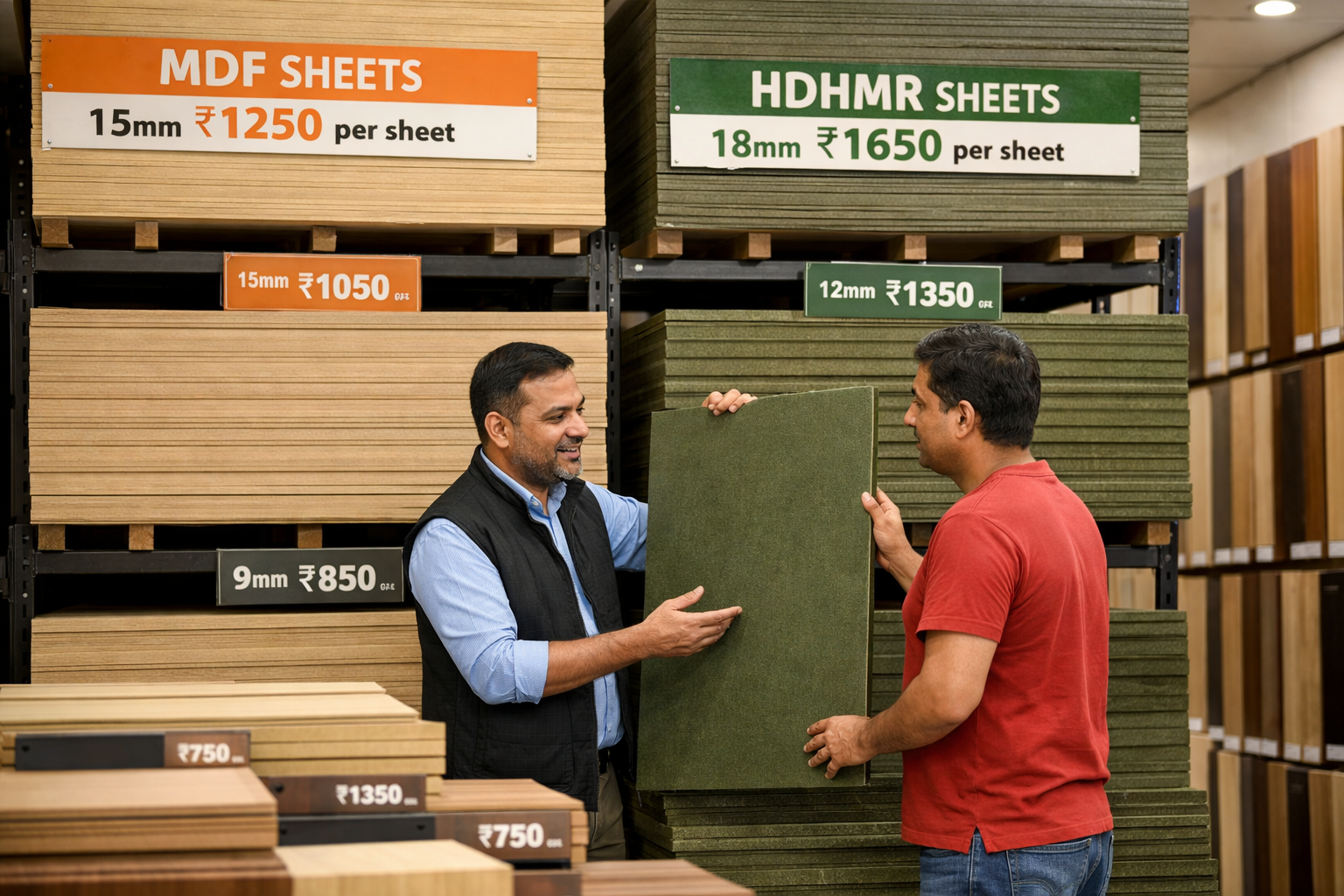
7. Cost: - HDHMR: Mid-High cost. It’s more expensive than MDF for sure – often about 1.5-2x the price of MDF of the same thickness. But it’s usually cheaper than marine plywood. For example, if an 18mm MDF sheet costs X, HDHMR might cost 2X, and BWP Plywood might cost 2.5X. From another angle, HDHMR often is in the range of ₹90–₹110 per sq.ft, whereas MDF might be ₹50, and marine ply ₹130 (exact prices vary). So HDHMR is a considerable investment but not the most expensive. Think of it as paying more for performance in moisture and strength. If your budget allows, using HDHMR can be cost-effective in the long run (less issues, replacements). - Plywood: Variable cost – plywood has the widest cost range. Cheap commercial ply can be cheaper than HDHMR, but high-grade waterproof ply is more expensive. As a broad statement, marine plywood is the most expensive of these materials. Standard MR plywood might be similar or slightly less than HDHMR in cost, depending on brand. So whether plywood is cheaper or costlier than HDHMR depends on the grade. For a fair comparison for similar performance: take BWR plywood (water resistant, good quality) vs HDHMR – their prices might be in the same ballpark, or HDHMR a bit lower. But if someone is comparing with low-cost ply (which we wouldn’t recommend for kitchens), that would be cheaper upfront (and possibly cost more in repairs later). - MDF: Least expensive of the three. MDF is popular largely due to its low cost. It delivers a smooth finish at a fraction of the price of ply or HDHMR. This makes it common for budget furniture or mass-produced items (like certain IKEA products, etc.). If cost is the primary driver and the environment is dry/low-stress, MDF wins. However, one must account for the fact that if MDF furniture gets damaged by moisture or breaks, you may end up spending more to replace it – so initial savings vs long-term value is a consideration.
To sum up the cost/value: MDF = cheapest but lower longevity; Plywood = can be most expensive (especially if going for best quality) but time-tested for durability; HDHMR = middle ground cost with near-plywood durability for interiors.
Comparison Table – Quick Glance:
|
Property |
HDHMR Board |
Plywood |
MDF Board |
|
Composition |
Wood fibers + water-resistant resin, homogeneous (no layers). Very dense. |
Wood veneers in layers (cross-laminated). Quality varies by grade. |
Wood fibers + resin, homogeneous. Medium density (lighter than HDHMR). |
|
Density & Weight |
Highest density (~800+ kg/m³); Heaviest (an 18mm sheet ~55kg). |
Varies (500–700 kg/m³); generally lightest for strength. 18mm sheet ~35-40kg (if softwood core). |
~600-700 kg/m³; weighty (18mm sheet ~45-50kg). Slightly lighter than HDHMR. |
|
Strength & Load |
High strength – very stiff, resists sagging. Great for heavy shelves, cabinets. |
High strength (esp. BWP plywood) – used structurally. Good span strength, less weight per strength. |
Moderate strength – okay for small spans, tends to sag under heavy load. |
|
Moisture Resistance |
Moisture-resistant – handles humidity/spills well. Not for continuous water contact. |
Grade-dependent: Marine/BWP ply is waterproof; MR ply is only somewhat moisture resistant. Untreated ply can warp with moisture. |
Poor – swells and damages with moisture if not sealed. Avoid use in wet areas. |
|
Termite Resistance |
High – resin and density deter pests; many brands treat it. Termite/borer warranties common. |
Variable: Needs chemical treatment. Treated ply can resist termites; untreated can be attacked. |
Moderate – not a preferred food for termites due to chemicals, but not inherently proof. |
|
Screw Holding |
Excellent – dense core holds screws tightly. Great for hinges, mounts. |
Excellent – layers grip screws well, especially on face. Can split if too close to edge without pilot. |
Fair/Poor – screws can loosen, threads don’t hold under heavy stress. Pilot holes and special fasteners needed. |
|
Surface Finish |
Smooth – ideal for paint, laminate, veneer. No grain knots. Needs edging for sides. |
Natural grain on surface – can be stained or veneered. Edges show layers (need lipping). Might have knots on lower grades. |
Smooth – ideal for paint (no grain) and laminate. Edges need sealing. Often used for routed designs due to smoothness. |
|
Weight-to-Strength |
Heavy but very strong – over-engineered for weight in some cases. |
Excellent – strong yet relatively light (why it’s used in construction). |
Heavy relative to its strength – dead weight without proportional strength gain. |
|
Cost |
Medium-High – more expensive than MDF, generally cheaper than marine ply. Good value for performance. |
Broad range – low-end ply can be cheap, high-end ply is expensive. Best quality costs most of the three. |
Low cost – cheapest option, good for tight budgets but comes with trade-offs. |
|
Best Uses |
Kitchen cabinets, bathroom vanities, wardrobe carcasses and doors, partitions in humid areas, furniture that needs durability. |
Anything – from kitchen (if BWP grade) to wardrobes, to structural frames. Plywood is versatile; use marine ply for wet areas, MR ply for dry areas. |
Wardrobe doors (painted), indoor furniture in dry rooms, decorative panels, backing boards, where cost-saving is key and moisture is absent. |
Which is Best for… (some common scenarios)
- Modular Kitchen Cabinets: Here, HDHMR often hits the sweet spot. It provides moisture resistance needed in a kitchen and is cheaper than marine plywood. Plywood (BWR/BWP) is also a top choice for kitchens, but you’ll pay more for that and some say the finish is not as smooth as HDHMR. MDF is not recommended in kitchen carcasses (it might swell or lose strength over time near sink or cooktop moisture). So, HDHMR or BWR Plywood – both are good, with HDHMR being a newer favorite for mid-range budgets. Indeed, many kitchen makers in India now use HDHMR for carcasses and maybe MDF/HDHMR for shutters (shutters could also be MDF if they want intricate designs, but then laminated well). Winner: HDHMR or Waterproof Plywood. If cost is no issue and you want decades-long proven track, use Marine Plywood. Otherwise, HDHMR gives nearly the same functional benefit at a lower cost.
- Wardrobes & Bedroom Furniture: Here the environment is typically dry (AC rooms or normal humidity, not like kitchen). You can use all three materials depending on budget and preference. Plywood (MR grade) has been traditionally used and ensures longevity and the ability to hold heavy clothing, etc. HDHMR will also do excellently and adds termite resistance (useful if that’s a concern) and nice finish for laminates. MDF can be used for wardrobe doors (especially if you want a painted finish with router designs) and for shelves that don’t carry excessive weight. For the main structure, MDF will work but make sure it’s well-supported (e.g., use 18mm MDF for sides and add a solid wood corner or something for strength). However, note that wardrobes can be large – MDF could make them very heavy and slightly less sturdy if overloaded. If budget is tight, one might do the internal carcass in commercial plywood or MDF and just do doors in MDF/HDHMR. If budget isn’t an issue, HDHMR for the entire wardrobe is great because it ensures even if someone leaves a damp cloth inside or in humid monsoons, the wardrobe won’t warp or get moldy as easily. Particle board (though not main focus here) is sometimes used in ready-made wardrobes to cut cost but that’s generally the lowest tier choice.
- Bathroom Vanity Units: Lots of moisture around – HDHMR or BWP Plywood are the only real contenders. MDF would swell and fall apart if any water seepage happens (even if laminated, the steam and occasional splash can be enough to harm MDF over time). Plywood if used should be BWP (boiling waterproof) grade for longevity in a bathroom. HDHMR being moisture resistant and termite proof is a very good choice for bathroom cabinets (just ensure edges especially around sink cut-outs are sealed). So Winner: HDHMR or Marine Ply. Avoid MDF.
- Shelves and Bookcases: If you’re making a long bookshelf, plywood or HDHMR are preferred because of their rigidity under load. MDF shelves will sag in the middle over time if the span is more than ~2-3 feet and loaded with books. Plywood has the advantage of being lighter, so it’s easier to mount a wall shelf made of plywood. HDHMR shelf will be heavy but can hold weight nicely if properly supported on brackets. For a small wall shelf for decor, MDF is okay; for a loaded bookshelf, go for HDHMR or ply. Also consider edge profiles – if you want a decorative routed edge on the shelf, MDF/HDHMR can be shaped, whereas plywood edges look layered and would need a lipping.
- Overall Durability/Lifespan: Plywood (good grade) likely has the longest track record – well-made plywood furniture can last for generations (20-30+ years) if kept dry and maintained. HDHMR is relatively newer but given its properties, it should also last very long in interiors – at least 15+ years, likely more (some sources cite HDHMR boards having a lifespan of 10-15 years, but that may be under heavy usage; they can last much longer if cared for). MDF furniture, realistically, tends to have a shorter lifespan – maybe 5-10 years before it might start showing issues (sagging, joint looseness, or swelling if any moisture finds its way in). So if you want furniture that stands the test of time, MDF is not the best bet. HDHMR and Plywood are both great; plywood might edge out in extreme conditions, but HDHMR should easily meet typical indoor longevity expectations (plus no worry of delamination like plywood if glue fails after decades).
Making the Decision – A Quick Flow: If your project is in a high moisture area (kitchen, bath) and you need top-notch durability – use HDHMR or BWP Plywood (HDHMR for a smoother finish and cost saving, BWP Ply if you prefer tried-and-true and cost isn’t a concern).
If it’s a dry area and you want to save money – you can consider MDF for parts (like drawer fronts, door panels) and maybe a mix with ply for structural parts. If moderate budget – just use HDHMR for everything as it simplifies choices and you know you’re covered in case conditions change (like who knows, maybe that corner of your room actually does get humid).
If you need strength but weight is an issue (like a large piece you have to wall-mount securely), a good plywood might serve better due to lighter weight.
If you want fine furniture or something with a wood grain finish, plywood or even solid wood may be needed because HDHMR/MDF have no grain (though you can always veneer them to mimic wood).
Cost vs Value: Many find that for an important installation like a kitchen, spending a bit more upfront on HDHMR or quality plywood pays off – you avoid issues like swelling cabinets or sagging shelves, which can be costly to fix. For something like a temporary setup or a decorative unit, MDF might suffice and save money.
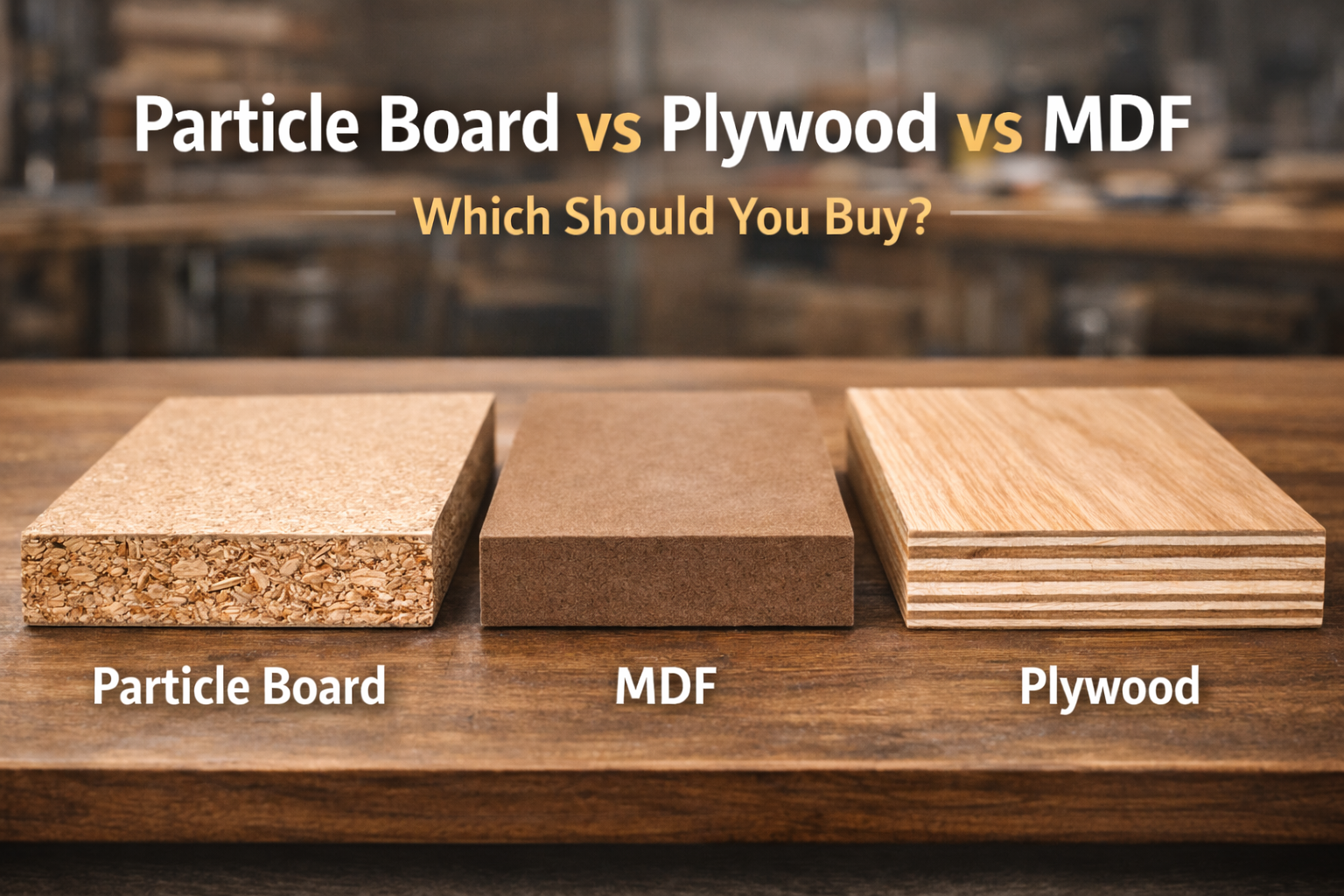
Internal Links: (We’ve dedicated separate guides to Particle Board vs Plywood vs MDF if you want to see where particle board fits in. Also, check our HDHMR Board Price page for an idea of cost differences, and the HDHMR 101 article for detailed pros/cons of HDHMR alone.)
FAQs on HDHMR vs Other Materials:
-
Q1. Is HDHMR better than plywood for kitchen cabinets?
A: In many respects yes, HDHMR is better for modular kitchens – it is highly moisture resistant and termite resistant, which are big advantages in a kitchen. It also has a smooth finish for applying laminates. Plywood (BWR/BWP) is also very good for kitchens and has been used for ages – it’s more proven over the long term especially for load-bearing and if there’s heavy water contact (plywood won’t swell, it may just delaminate if compromised). Practically, many modern kitchens use HDHMR for the carcasses and maybe plywood for specific areas like the countertop base if needed. If you use marine plywood, that’s over-spec (which is fine) but you’ll spend more. If you use commercial plywood, you risk some moisture issues. So, HDHMR hits a sweet spot of performance and price in kitchen cabinets, and numerous experts consider it the smartest choice for modern interiors.
-
Q2. Which is more durable in the long run, HDHMR or MDF?
A: HDHMR is significantly more durable than MDF. HDHMR can handle everyday stress (opening/closing, weight, moisture, pests) much better. MDF tends to be more brittle (edges can get damaged), and if any moisture sneaks in, MDF will swell and never quite return to shape. HDHMR boards are built to last in demanding conditions (e.g., they’re often used in high-traffic commercial interiors too). Expect an HDHMR piece to outlive an MDF piece by many years if both are in the same environment. The only reason you’d choose MDF over HDHMR is cost or if you specifically need something like a very intricately routed design with a paint finish – MDF is a tad easier to mill and cheaper, but HDHMR can be routed too with sharp tools.
-
Q3. For a low-budget project, should I use MDF or particle board or something else?
A: If budget is the overriding factor and it’s for a dry, low-load application, MDF is preferable to particle board for most indoor furniture because MDF is denser and generally stronger than particle board. Particle board is even cheaper but it’s quite weak and very prone to moisture swelling and screw failure. MDF at least gives a smooth finish and some strength (e.g., lots of inexpensive store-bought furniture use MDF or a combination of MDF for doors and particle board for structure). If you can stretch the budget a bit, one strategy is: use particle board for internal parts that won’t bear much load (say the back of a wardrobe or shelves for light items) and use MDF for doors or parts that need a good finish. But beware that both have limitations. If you can afford slightly more, using a mix of plywood and MDF might be better (ply for structure, MDF for finish surfaces). It really depends on context. For a rental property where you just want a few years of use, MDF/particle board could be acceptable to save cost. For your own long-term home, it might be worth investing in better materials like HDHMR or plywood to avoid headaches down the line.
-
Q4. Plywood seems traditional; is HDHMR a proven material or just hype?
A: HDHMR is relatively newer in the consumer market (last decade or so it became popular), but it’s basically an evolution of HDF boards which have been around for a long time (used in flooring, etc.). It has been adopted widely now by furniture makers and has good feedback in general. It addresses some pain points of plywood (like termite issues and inconsistent quality) and of MDF (moisture weakness). Many factories are backing it – e.g., Action Tesa heavily markets HDHMR and its usage has grown in modular furniture industry. So it’s not just hype; it’s an innovation in engineered wood that is here to stay. That said, plywood as a category is extremely broad – there are cheap plywoods that are awful and high-end ones that are stellar. So sometimes when people compare, they might have had a bad experience with a low-grade ply and find HDHMR better, or vice versa. A high quality waterproof plywood will perform amazingly, but you have to ensure you got genuine quality (there are many fakes). HDHMR from a good brand gives a reliable baseline quality (since it’s factory-made with controlled specs). In summary, HDHMR is a proven material for interior use, and not a fad – but always get it from a reputable source for best results.
Disclaimer: This content is provided for general informational purposes based on industry practices and publicly available information. Product specifications, standards, prices, and availability may vary by manufacturer, region, and time. Readers should independently verify details with manufacturers, dealers, or qualified professionals before making purchase or construction decisions.