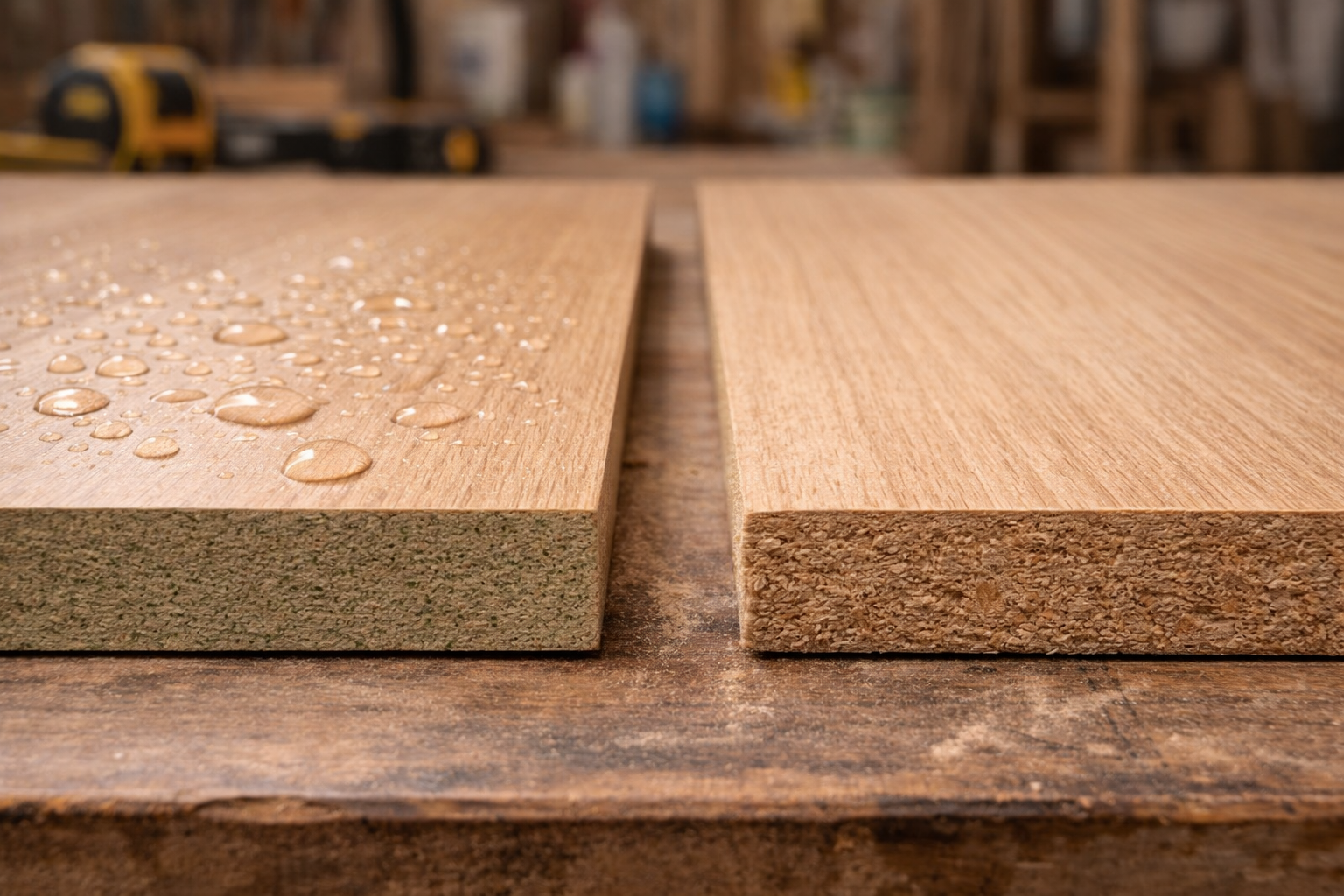
What is an HDWR Board? (And HDHMR Board)
Let’s start with definitions. HDWR stands for High Density Water Resistant board, and HDHMR stands for High Density High Moisture Resistant board. Despite the different names, both refer to advanced engineered wood panels that are densely compressed fiberboards with special resins to resist moisture and termites. In fact, you can think of HDWR and HDHMR as cousins in the same family: - HDHMR board was popularized by companies like Action Tesa in India as a next-generation board better than MDF and standard particle board, intended as a replacement for plywood in many uses. It emphasizes high moisture resistance (hence the name) – meaning it can handle humid conditions very well. - HDWR board is a term used by brands like Greenpanel for a similar product. The focus here is on water resistance (the name suggests resistance to water). Practically, HDWR is Greenpanel’s version of an HDHMR board – they are engineered in a very similar way (high density fiberboard with water-repellent resin).
In simpler terms, HDWR and HDHMR are more alike than different. Both are heavy, strong boards that won’t swell up easily with moisture exposure, and both are treated to be termite and borer resistant. They are used for making cabinets, wardrobes, furniture, and even flooring underlay – anywhere you need a durable wood-based board that can survive in damp or humid environments.
So why the two names? It mostly comes down to branding: - Action Tesa and some other manufacturers use “HDHMR” for their product. - Greenpanel (part of the Greenply family) markets their similar board as “HDWR”. Other companies might use one term or the other, but in the end, if you have a “high density, moisture-resistant board”, you’ve got the right material. The slight differences that do exist are usually in the specific formulations or offerings by each brand, which we’ll cover next.
Comparing HDWR and HDHMR: Differences and Similarities
From a user’s perspective – a carpenter, contractor, or homeowner – HDWR vs HDHMR board performance is nearly identical. However, let’s break down some key points of comparison:
- Moisture Resistance: Both HDHMR and HDWR are made to resist moisture far better than normal MDF or plywood. In lab tests, these boards show very low water absorption and minimal swelling. For example, Greenpanel’s HDWR boards are internally tested to have <11% water absorption after 24 hours (which is excellent for fiberboard), and Action Tesa’s HDHMR is marketed as having about 50% better moisture resistance than standard MR-grade MDF. In practical terms, if you build a kitchen or bathroom cabinet with either board, it will hold up in a humid area or with occasional splashes as long as the edges are sealed. There isn’t a clear winner here – both are highly moisture-resistant. They can be used in kitchens, bathrooms (for vanities or storage), and in coastal climates without warping, provided proper finishing.
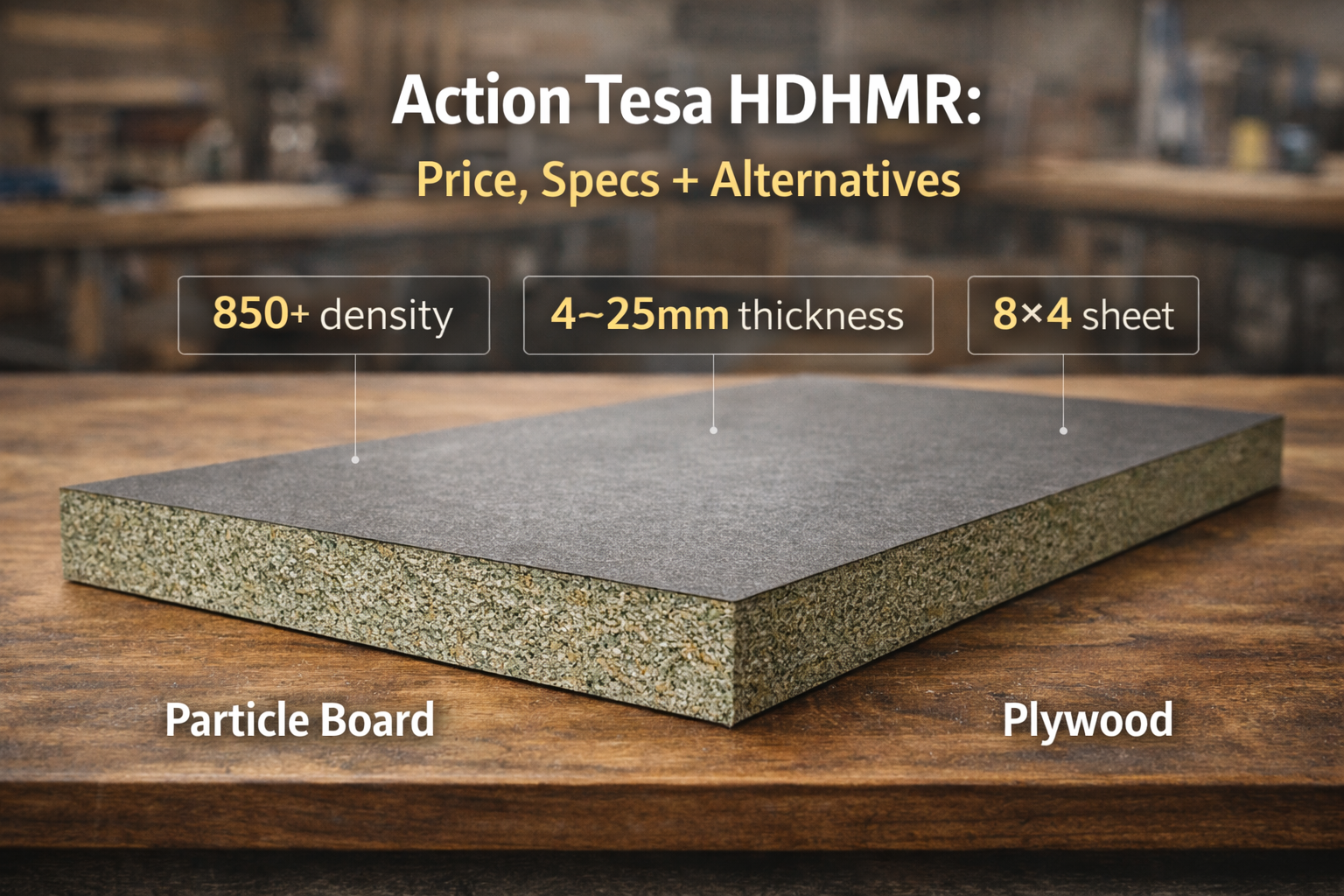
- Strength and Density: These boards are both high density. Typically, HDHMR and HDWR have density in the range of 780–850 kg/m³. HDHMR from Action Tesa is quoted around 800+ kg/m³; Greenpanel HDWR is in the same range (their spec sheets show a similar density, sometimes a tad lower on average, but not significantly). This means both boards can take screws well and have good load-bearing capacity. For a shelf or door made of HDWR vs one of HDHMR of the same thickness, you wouldn’t notice a strength difference – both are quite robust. No notable difference in everyday strength: you can confidently build furniture with either, and it will be sturdy as long as the design is sound.
- Termite & Borer Resistance: Both types are treated with chemicals (and sometimes natural additives like neem) to deter pests. In India, termite resistance is a big selling point. HDHMR boards come with claims of being termite-proof, and Greenpanel HDWR also highlights termite and borer resistance. Users have not reported any stark difference – if you keep furniture made of these boards, termites generally leave it alone (especially compared to normal plywood). Just make sure you’re buying authentic branded material; a fake or low-grade board might not have the proper treatment. In general, both HDWR and HDHMR are highly termite-resistant, which is a major advantage over traditional plywood (that can be feasted on if not treated).
- Maximum Thickness & Sizes: One minor difference is in the range of thickness or sizes offered. Action Tesa’s HDHMR boards are available in thicknesses from 3mm up to 25mm (and they even have large sheet sizes like 8×6 feet in some ranges). Greenpanel’s HDWR boards at present come in thicknesses from about 3mm up to 18mm. So, if you needed a very thick panel (say 25mm for a table top or a special application), you would likely have to go with an HDHMR brand. But for common thicknesses (6mm, 12mm, 18mm etc.), both brands have offerings. In terms of sheet size, the standard 8×4 ft is available in both; Action’s HDHMR line includes an 8×6 ft option which HDWR doesn’t widely offer. For most regular projects, this size difference isn’t a major factor, but it’s good to know if you have a custom need.
- Eco-friendliness and Emissions: Greenpanel often markets HDWR as being made with eco-friendly practices and available in E0 grade (low formaldehyde emissions) options. Action Tesa’s HDHMR is typically E1 (standard acceptable emissions), though they have introduced some anti-fungal and anti-bacterial enhancements in their boards (like a ViroKill technology that supposedly resists bacteria on the surface). So, one could say Greenpanel HDWR focuses on greener manufacturing (and possibly lower emissions), whereas Action Tesa HDHMR touts special features like anti-bacterial surfaces in some variants. If you have a sensitivity to formaldehyde or are aiming for a very green interior, you might lean towards an E0 HDWR board if available.
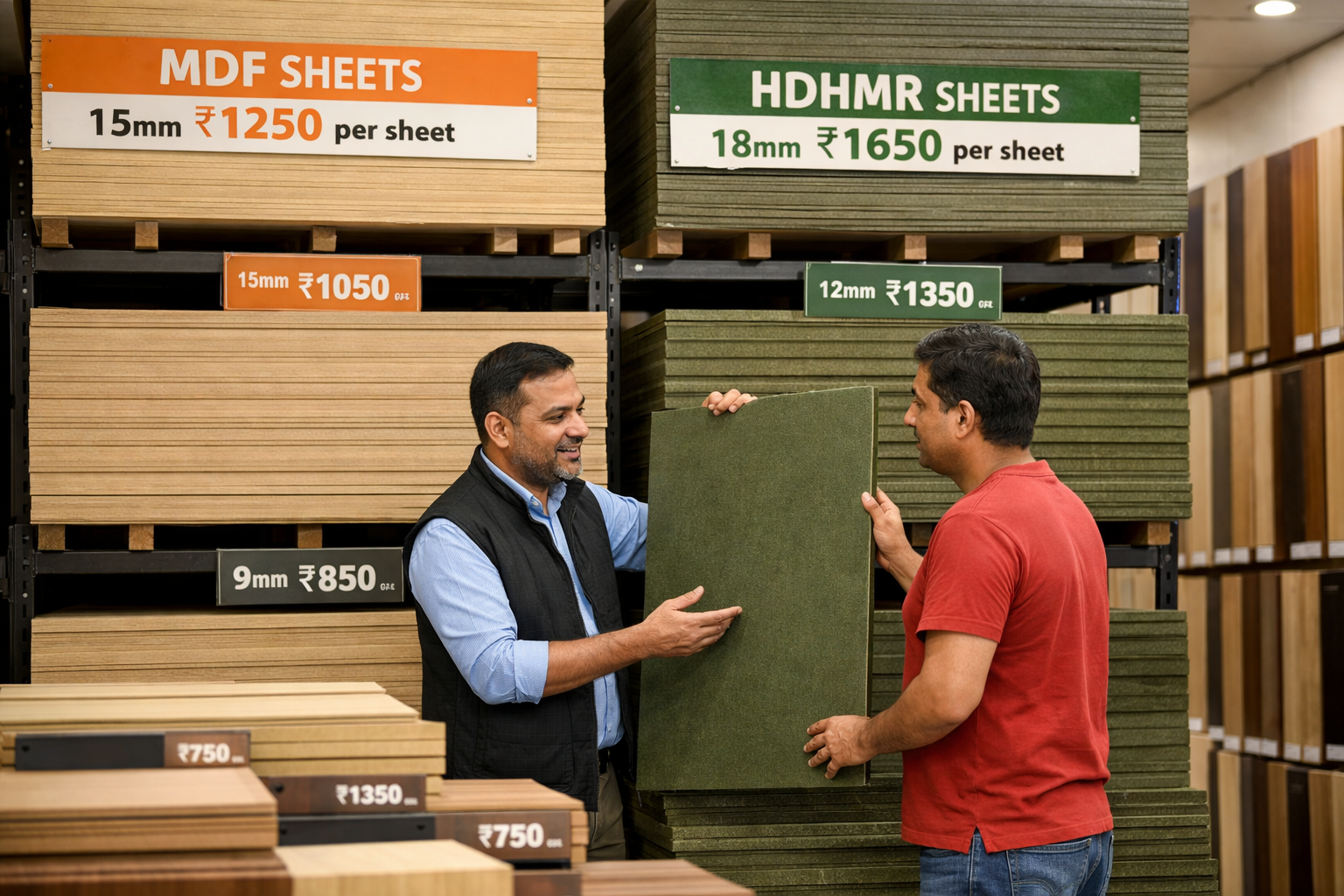
- Cost and Price Points: For many buyers, this is crucial. In general, Greenpanel’s HDWR boards tend to be slightly cheaper per sq.ft than Action Tesa’s HDHMR of equivalent thickness. The difference isn’t huge – often in the range of ₹5–₹10 per sq.ft (for example, if HDHMR 18mm is ₹100/sq.ft, HDWR might be ₹90–₹95/sq.ft in the same market). This isn’t a strict rule, as pricing can vary by region and dealer. But historically, Greenpanel positioned HDWR as a high-quality product at a notch lower price than the established HDHMR brands. So, if budget is extremely tight, you might save a bit going with HDWR. But remember, we are talking about premium boards here – both are more expensive than regular MDF or plywood. The small price gap should be weighed against availability and your trust in the brand’s supply chain (sometimes paying a bit more for HDHMR might be worth it if, say, the dealer support or warranty is better).
- Brand Specific Features: As hinted, each brand has some unique selling points. Action Tesa HDHMR often comes with a warranty (around 10 years) and even bold guarantees like “money back if termites/water damage” in some promotions. They also have a wider range of pre-laminated designs available on HDHMR core. Greenpanel’s HDWR comes with about a 15-year warranty and promotes things like being manufactured using renewable biomass energy and having low formaldehyde. For an end user, these might not drastically affect the furniture’s performance, but it can influence your preference if you value warranties or specific green certifications.
To summarize, here’s a quick recap:
· Core Material: Both are high-density wood fiber boards with moisture-resistant resin – basically the same category of product.
· Moisture & Termite Resistance: Both excellent; no practical difference in normal use.
· Strength: Both high strength; treat them as equivalents (choose thickness wisely for either).
· Available Thickness: HDHMR (Action) up to 25mm; HDWR (Greenpanel) up to 18mm. Common thicknesses available for both.
· Price: HDWR slightly lower cost usually; HDHMR slightly higher (brand premium).
· Extra Features: HDHMR – possible antibacterial additive, broad prelam range, strong market presence; HDWR – eco-friendly branding, E0 low-emission option in “Club Grade”.
· Which to choose: Comes down largely to availability and project needs (see next section).
HDHMR vs Plywood – Which is Better for Your Needs if you also want to see how these advanced boards compare to traditional plywood.
Which One Should You Use for Your Project?
If you’re trying to decide between buying HDHMR or HDWR boards, the good news is that you really can’t go wrong with either for most interior applications. Since their capabilities are so similar, here are a few guiding thoughts: - Go with what’s readily available and genuine: If your local supplier carries Greenpanel HDWR boards in the thickness you need, you can confidently use them. If another supplier offers Action Tesa HDHMR readily, that’s fine too. The priority is to get authentic, branded boards. They often have branding on the edges – look for the stamp or printed code that shows the brand name and type. Do not settle for something that’s unbranded “HMR board” generically, as those could be inferior. So, the choice might simply be made by which brand’s distribution is strong in your city. - Project-specific considerations: Think about the requirements. Do you need very thick panels (above 18mm) or a special size? Action’s HDHMR might serve better there. Are you particularly concerned about formaldehyde emissions for a green building project? Then maybe seek out Greenpanel’s E0 HDWR. For a normal home kitchen or wardrobe, both will perform equally well in terms of durability. - Budget: If you’re getting quotes, you might find HDWR coming slightly cheaper. For large volumes, that can add up. However, ensure the comparison is apples to apples – a well-established dealer selling HDHMR might offer discounts that make it on par with HDWR. So, check prices for both if possible. But don’t sacrifice availability or after-sales support just to save a small amount. For example, if your carpenter is more familiar with a certain board or your dealer will give better service with one brand, that might be worth the extra ₹5/sq.ft. - Warranty & Support: If you’re a contractor promising longevity, you might favor whichever brand gives a documented warranty in writing. Action Tesa HDHMR’s marketing with termite/water guarantees might reassure some clients. Greenpanel’s longer warranty is also solid, though warranties on boards are often subject to many conditions (proper installation, no direct continuous water contact, etc.). In any case, proper installation and finishing (sealing edges, etc.) are key – do that, and either board will last for decades.
Bottom line: HDHMR and HDWR boards can be used interchangeably in almost all cases. They are top-of-the-line choices for moisture-resistant engineered wood. Many professionals actually don’t differentiate between them when building – they just use what brand they have on hand, knowing it will perform. So, focus on getting a quality board from a trusted source.
To further ensure success: - Make sure your boards (HDHMR or HDWR) are properly sealed/laminated on all sides in the final application. - Use the right thickness for the job (e.g., 18mm for a base cabinet, 6mm for backing – see our [Link to: HDHMR Board Thickness Guide] for help on that). - Use good hardware (hinges, screws) because both these boards are strong enough to hold heavy-duty fittings – so pair them with quality hinges and they’ll make excellent cabinets. - Store and handle them correctly on site (keep them flat, don’t let them sit in water puddles – they are moisture-resistant but should be treated as high-end material).
If you follow these practices, whether you chose HDWR or HDHMR, your furniture will be long-lasting, sturdy, and resistant to the common enemies of wood (water and termites).
Frequently Asked Questions
Q: Is HDWR the same as HDHMR board?
A: For practical purposes, yes. HDWR (High Density Water Resistant) is essentially a brand’s version of an HDHMR board. Both are high-density, moisture-resistant fiberboards. The core material and use-case are the same. The differences come from specific manufacturers’ tweaks and what they name the product, but if someone is using HDWR or HDHMR, they are aiming for a moisture-proof, termite-resistant board for furniture. You can treat them as equivalent materials in design and application.
Q: Which is better for a kitchen – HDHMR or HDWR?
A: Both will perform excellently in a kitchen environment. Kitchens have high humidity, occasional water contact, and need durable cabinetry – exactly what these boards are made for. There’s no clear “better” between HDHMR and HDWR in this scenario; what matters is using a good brand, the right thickness (typically 16mm or 18mm for cabinets), and sealing all edges and surfaces with laminates or paint. Many modular kitchen makers use whichever board they have partnerships with. Your choice might boil down to availability and cost in your area, rather than technical performance.
Q: Are there any drawbacks to HDHMR or HDWR boards?
A: The drawbacks are few and common to both: they are heavier than plywood (so handling needs care, and hinges must be sturdy), and they cost more than standard MDF or commercial plywood. Also, neither HDHMR nor HDWR is meant for continuous outdoor use or constant water submersion – they are moisture-resistant, not fully waterproof like marine plywood under boiling conditions. In terms of differences between them, one could say HDHMR’s only “drawback” relative to HDWR might be slightly higher price; HDWR’s could be the slightly lower max thickness available. But these differences are not usually critical. Importantly, ensure your carpenters use sharp tools – both HDHMR and HDWR being hard boards can dull blades faster than regular wood.
Q: Can I mix HDHMR and HDWR boards in the same project?
A: Yes, you can. They are quite compatible. For instance, if HDHMR 18mm sheets are available but you only find HDWR in 6mm for backing, it’s fine to use HDHMR for the main structure and HDWR for backs, or vice versa. They will accept laminates, paints, and hardware similarly. Just keep track of your sourcing for warranty purposes (each brand’s warranty would apply to its own product). But from a construction and finishing viewpoint, mixing them poses no issue – they cut and join in the same ways.
Q: What should I consider when choosing between HDHMR and HDWR?
A: Consider availability (which one can you easily get in the required size/thickness), cost (HDWR might be slightly cheaper), and any specific features (e.g., need for extra thickness or low formaldehyde E0 grade). In most cases, you’ll base your decision on which brand is accessible and trusted, since performance differences are negligible.
Disclaimer: This article is generated using AI-assisted research and is intended for informational purposes only. While we strive for accuracy, readers are advised to verify all technical, pricing, and brand-specific details with official sources. hdhmr.in is not liable for any decisions made based on this content.