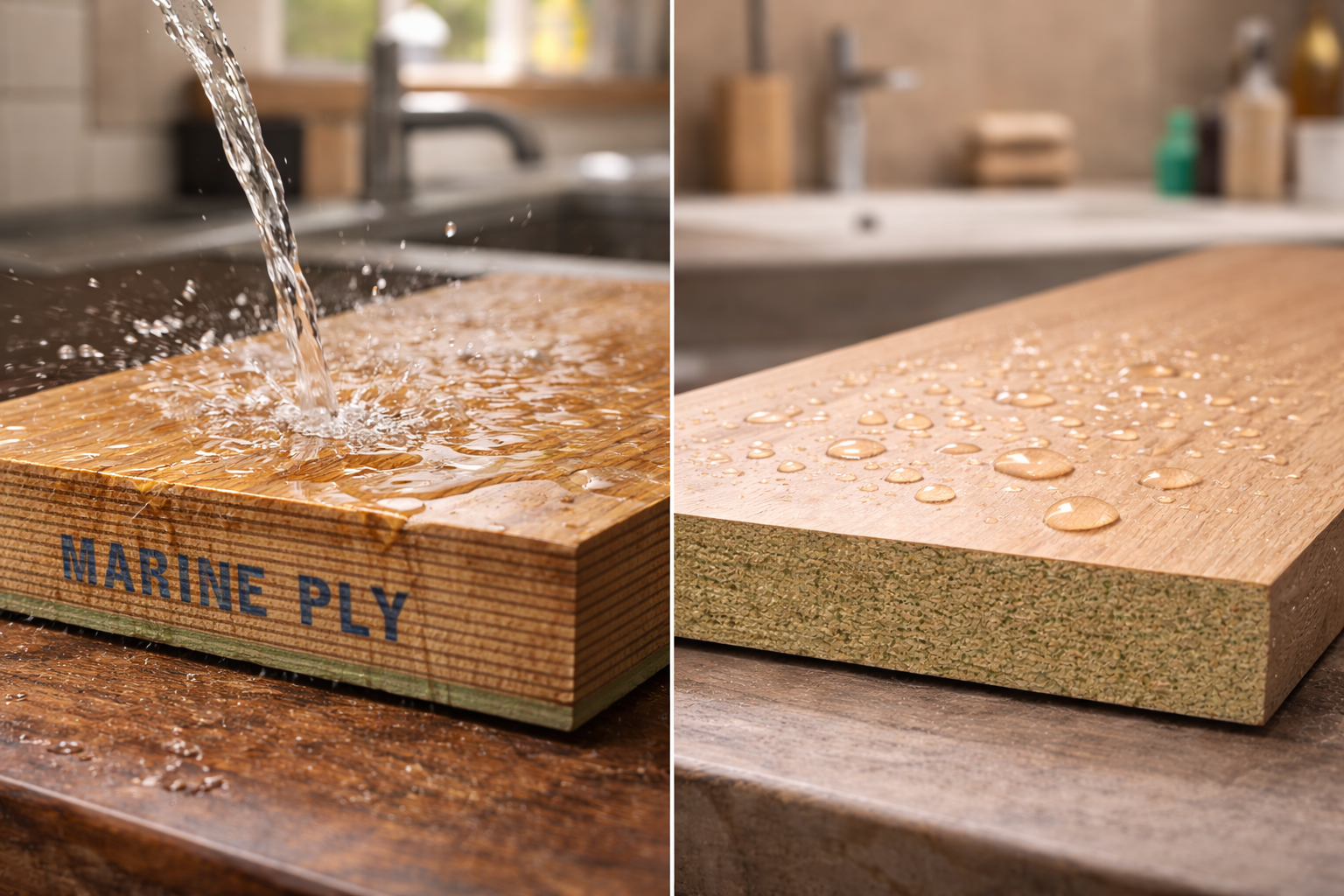
Understanding Marine Plywood (BWP) vs HDHMR Board
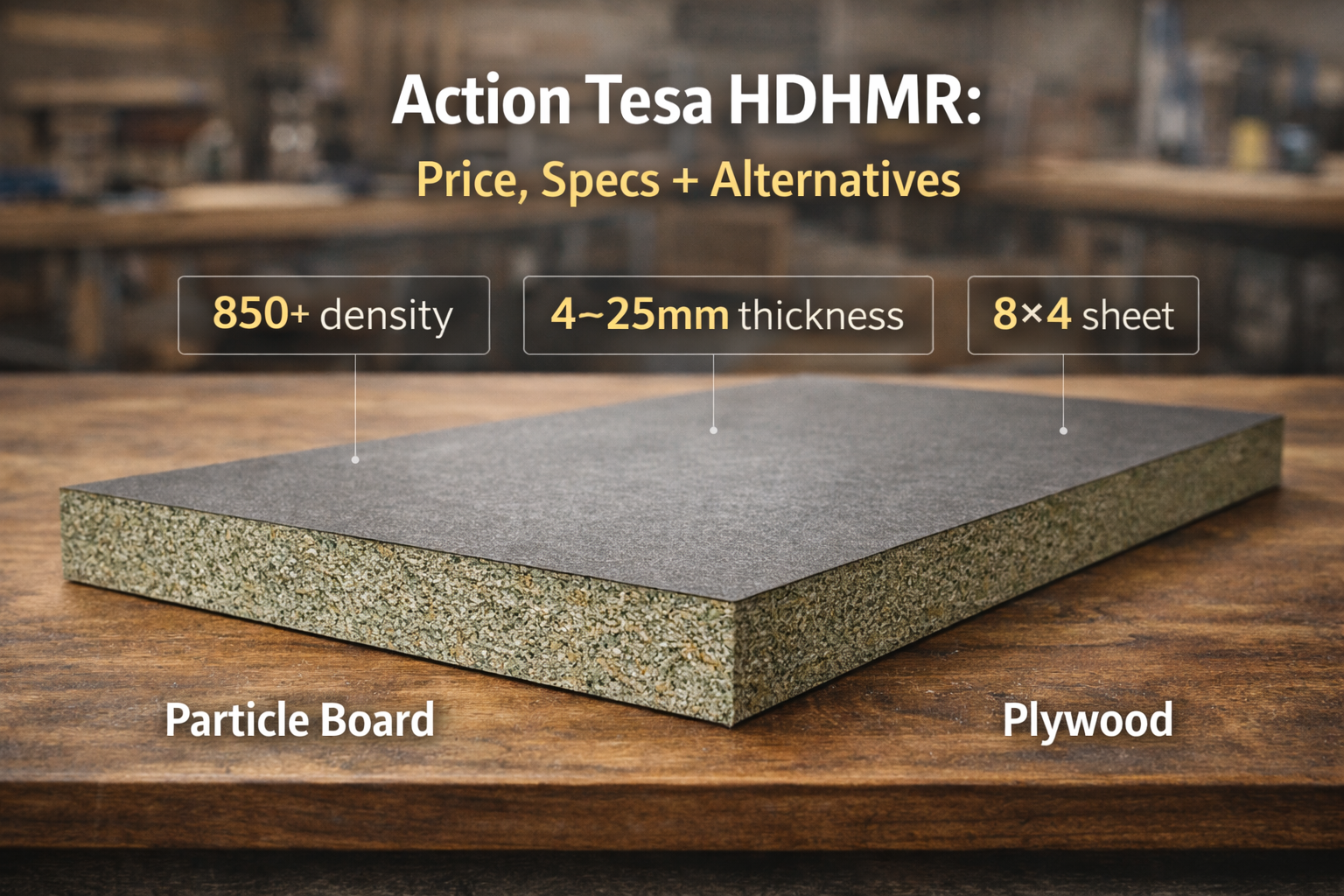
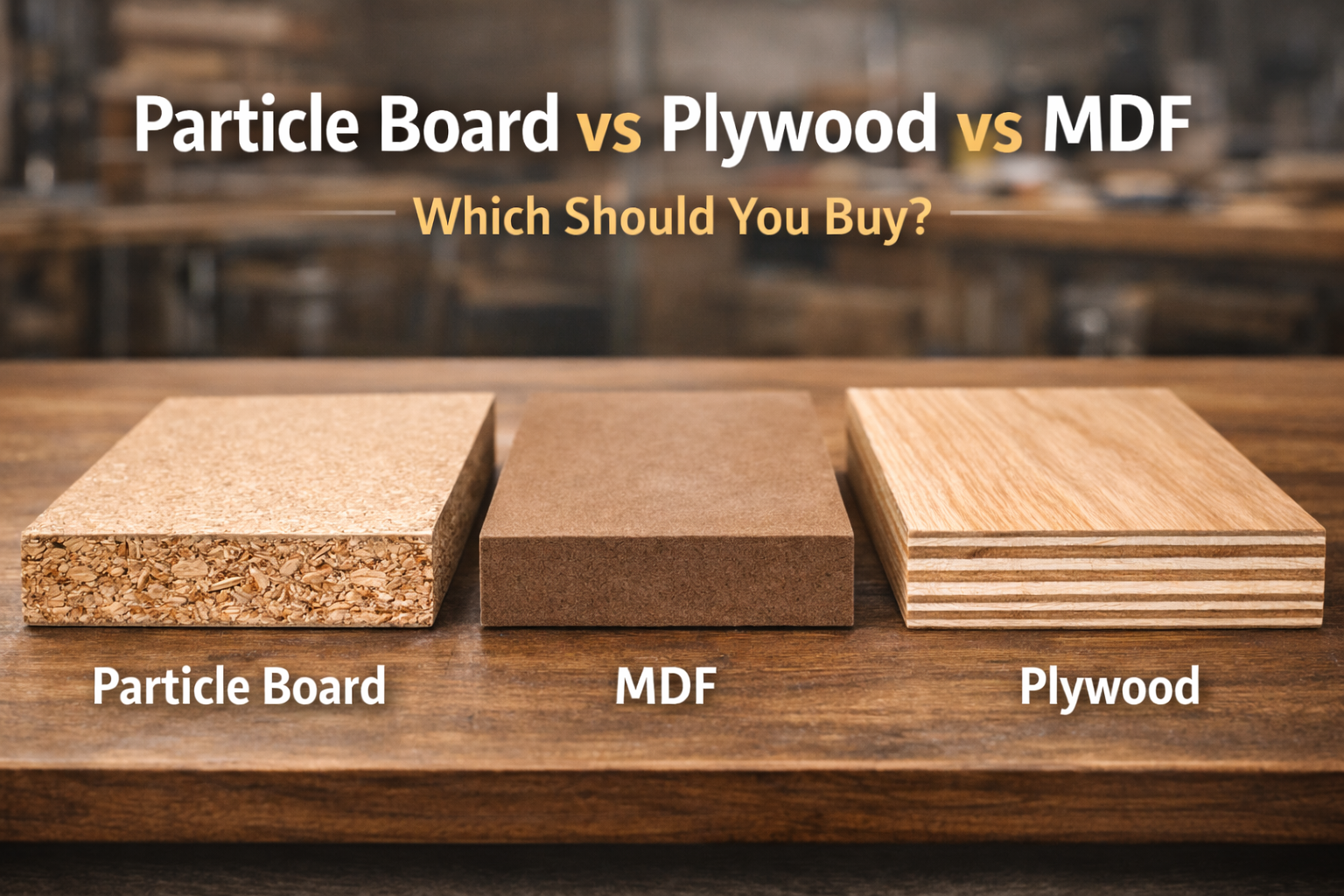
First, a quick intro to the materials: - Marine Plywood: This is a premium grade plywood (often conforming to IS 710 in India) also known as BWP (Boiling Water Proof) plywood. It’s made from multiple layers of wood veneers bonded with undiluted phenolic resin. The result is a plywood that can withstand water exposure and even boiling conditions for a certain period without delaminating. It was originally developed for boat building (hence “marine”) and is often used in kitchens, bathrooms, and other wet areas in homes due to its water-resistant glue line. - HDHMR Board: HDHMR stands for High Density High Moisture Resistant board, an engineered fiberboard made by compressing wood fibers with resin. It’s essentially a type of high-grade HDF with special moisture-resistant properties. HDHMR boards are not layered like plywood; they have a homogeneous structure. They resist moisture uptake far better than standard MDF or particle board, and they’re treated to be termite resistant as well. They’ve emerged in the last decade as a contender for use in kitchen cabinets, vanities, etc., in place of plywood.
At a glance: Marine plywood is known for being water-proof (to a large extent), while HDHMR is known for being moisture-resistant. This means marine ply is engineered to endure much more direct water contact without failing, whereas HDHMR can handle high humidity and the occasional splash, but is not meant to be immersed or continuously wet.
Now, let’s compare them point by point for use in wet areas like kitchens and bathrooms.
Water Resistance and Durability
- Marine Plywood (BWP Grade): Marine ply is as water-proof as wood products get. A true BWP marine ply sheet can be boiled in water for hours without the layers coming apart. It has minimal thickness swelling in water (although if left soaking for days, it can absorb some water, it won’t structurally fail quickly). This makes it excellent for areas that might get very wet – for example, kitchen sink cabinets, bathroom vanities near showers, or even exterior uses like patio furniture (with proper finishing). It’s also quite strong under load and doesn’t deform easily when wet and dried repeatedly. - HDHMR Board: HDHMR is highly moisture-resistant, but not completely waterproof in the way marine ply is. In tests, HDHMR might show slight swelling if kept submerged in water for many hours, and if water penetrates unsealed edges, the fibers can swell. However, in typical indoor scenarios (humidity, occasional splashes, or brief contact with water), HDHMR performs very well. It won’t warp or delaminate simply from humid air or a damp cloth. For instance, an HDHMR bathroom cabinet can easily handle the moisture of daily showers as long as it’s not getting directly doused in water regularly. Where HDHMR may not hold up is if you had a condition like a leak that keeps part of the board wet for days – it can swell at the edges or in localized spots, whereas marine ply might hold out longer in that scenario (though prolonged leakage is bad for any wood-based material). - Bottom Line on Moisture: If you expect continuous or heavy water exposure, marine plywood has the edge because of its phenolic resin and layered structure that resists delamination. If it’s moderate moisture/humidity, HDHMR can do the job well. For example, interior kitchen cabinets (not directly under a sink leak) and general bathroom cabinets that are off the floor are usually safe with HDHMR, provided you seal all cut surfaces and perhaps elevate them a bit from wet floors. Marine ply might be preferred for the cabinet under a sink or for a loft water tank base – places where you anticipate more water contact or a high risk of puddles.
Resistance to Termites and Fungus
- Marine Plywood: Good-quality marine ply is usually made from hardwood species and should be chemically treated for termites and borers. However, plywood (being wood veneers) can still be somewhat susceptible if the chemical treatment is not thorough or wears off, especially at cut edges. Over years, if not checked, termites can start eating the wood layers of plywood if conditions are favorable. Plywood is also an organic material that can develop fungus or rot if kept damp and poorly ventilated over long periods. - HDHMR Board: HDHMR boards are inherently treated and the resin content makes them less appetizing to termites. The manufacturing process often includes termite-resistant chemicals. Many users report that termites ignore HDHMR and go for something else. Additionally, the high-density, resin-heavy composition of HDHMR means it doesn’t catch fungus easily either – there are no voids or grain for mold to take hold, and the moisture content is low. So, for termite resistance, HDHMR likely has a slight advantage (fewer natural wood grains for pests to eat). Keep in mind though, if HDHMR is sandwiched between plywood pieces or other wood that gets infested, it’s not magically protective; but on its own, it’s very resistant.
In practice, both materials, if of good quality, will last decades in a home if kept sealed and reasonably dry. Neither will spontaneously rot or crumble. Marine ply has been used for kitchen cabinets in India for ages and does fine if it doesn’t stay soaked. HDHMR is newer, but we haven’t seen termite or rot issues when it’s used properly and kept finished.
Strength and Load Bearing
- Marine Plywood: Plywood is known for strength. A marine ply sheet, especially if it’s made of quality hardwood veneers, has high tensile strength and can handle heavy loads. Plywood’s layered structure means it’s quite stiff – it doesn’t bend easily along the grain of the outer layers. That’s why for long shelves or heavy countertops, plywood is excellent. If you put a heavy granite slab on a marine ply base (common in kitchen platforms), it will hold up. Also, screws hold well in plywood (though if you screw repeatedly in and out the same spot, the layers can loosen). One thing: plywood can sometimes have slight undulations or warp if not premium quality or if not stored flat; marine ply is usually better, but you still need to check for flatness when buying. - HDHMR Board: HDHMR is very dense and uniform. It has great screw holding capacity (in fact, screws in HDHMR feel very tight and solid). It is also heavy and has good compressive strength. For span strength – say a shelf spanning 3–4 feet – an 18mm HDHMR shelf will likely perform similarly to an 18mm plywood shelf in terms of bending under weight. Some tests by manufacturers claim HDHMR has equal or better modulus of rupture (bending strength) than plywood. However, HDHMR is also heavier, so the load on hinges or wall plugs is more from its own weight. If you’re building a wall-mounted cabinet, an empty HDHMR cabinet will be heavier than an empty ply cabinet, which slightly affects installation but not performance after. Both materials are absolutely strong enough for typical furniture loads if used in the right thickness (we wouldn’t use anything under 15–18mm for a lengthy shelf in either material). - Shock Resistance: Plywood might have a tiny edge in shock or impact resistance – if you drop something extremely heavy on a plywood shelf vs an HDHMR shelf, the plywood’s slight flexibility might absorb it better, whereas HDHMR’s rigidity might crack in a very extreme case (though it’s quite tough too). This is a minor point; normal usage rarely highlights such differences. - Summing Up Strength: Both marine ply and HDHMR create strong cabinets and fixtures. You won’t find your kitchen breaking because you chose one over the other, as long as construction is sound. The differences in strength are not usually the deciding factor here.
Workability & Ease of Use: Both marine ply and HDHMR can be cut and finished to a smooth result. Carpenters are very familiar with plywood (it's lighter and easier to saw by hand), whereas HDHMR's dense structure means it cuts cleanly but requires sharp carbide tools and is heavier to lift. When it comes to finishing, both need their edges sealed – plywood edges need laminate or veneer tape to hide layers, and HDHMR edges need banding to cover exposed fiber. Laminates and paints adhere well to both, though HDHMR’s ultra-smooth surface gives an excellent paint finish (no grain or voids). Plywood is a bit more forgiving to nail or screw without pilot holes; HDHMR holds screws firmly but you should pre-drill to avoid splitting at the edges. In short, traditional plywood might be slightly more convenient to work with due to familiarity and lower weight, but a skilled professional with the right tools can handle HDHMR without issues – just plan for the extra weight during installation.
Cost Comparison
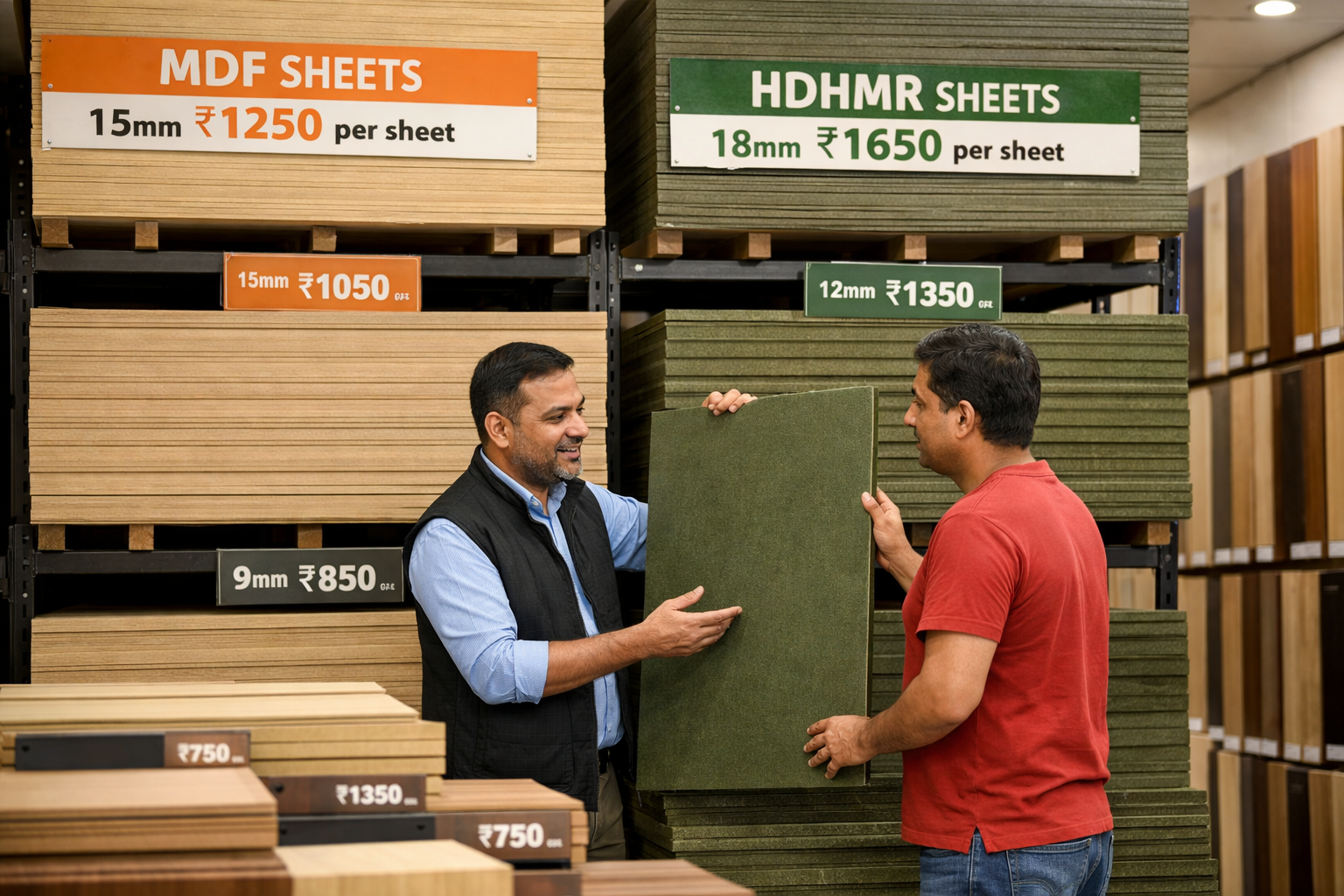
Cost can vary by brand and region, but generally: - Marine Plywood (BWP IS 710): This is one of the most expensive plywood types. A high-quality 18mm marine ply sheet (8×4 ft) from a top brand could cost anywhere from ₹100 to ₹150 per sq.ft (so ₹3200–₹4800 per sheet) as of 2025, depending on brand (Century, Greenply, etc. on the higher end, local brands on the lower). Even generic marine ply tends to be more costly than interior-grade plywood due to the phenolic resin and hardwood used. - HDHMR Board: HDHMR, being engineered, is also not cheap – but often a bit more affordable than top-grade marine ply. For example, 18mm HDHMR might be around ₹90–₹110 per sq.ft (₹2880–₹3520 per sheet) depending on brand (Action Tesa, Century, Greenpanel, etc.). So per sheet, you might save some money with HDHMR compared to premium marine ply. Thinner sheets will scale down similarly (e.g., 12mm marine vs 12mm HDHMR). - There’s also wastage and yield: Both come in standard sheet sizes, so planning cuts can optimize usage similarly. An edge: HDHMR has no core gaps, so you can use every inch; plywood sometimes has to cut around defects, though good marine ply has none or minimal. - Hardware cost: Both require the same quality of hardware; not much difference in associated costs there. - Overall Project Cost: In a kitchen project, for instance, the board material might account for, say, 15–20% of the total cost (with the rest being labor, hardware, finishes). So using HDHMR in place of marine ply might trim a few percentage points off the total cost. If on a tight budget, that could be significant; if budget isn’t a big issue, one might stick with traditional marine ply out of caution or contractor preference.
In summary, marine plywood is usually a bit more expensive than HDHMR for the same thickness. HDHMR offers a cost advantage while delivering similar performance in most indoor scenarios.
Where to Use Each (Best Applications)
To decide between marine ply and HDHMR, consider the specific scenario: - Kitchen Cabinets (Overall): For most of the kitchen (cabinet carcasses, shelves, drawer fronts), HDHMR boards are usually fine and offer good value. Many modular kitchen companies now use HDHMR or similar HDF boards for cabinet boxes and shutters. They may sometimes use marine ply just for the sink cabinet bottom panel as extra insurance. If you are doing a kitchen with a contractor, you could specify marine ply for the sink module and HDHMR for the rest as a hybrid approach. - Under-Sink Cabinets: This area often sees leaks or standing water if plumbing fails. If there’s one spot to use marine ply, it’s here – perhaps for the bottom panel of that cabinet or the entire under-sink unit. Alternatively, some use a PVC board or aluminum tray at the base inside the cabinet as well. HDHMR could work if you’re vigilant about leaks and line the bottom with a waterproof mat, but marine ply provides a bit more peace of mind for this high-risk zone. - Bathroom Vanity Units: A wall-hung vanity in a bathroom, especially if it’s not directly in the shower splash zone, can be made with HDHMR with proper laminate/paint and edge sealing. It will handle the humidity and occasional splashes. If the vanity is likely to get regularly wet (e.g., a kids’ bathroom where water might be sprayed everywhere), marine ply might be safer for the core structure, or ensure the HDHMR is extremely well sealed (and consider raising it off the floor or using legs to avoid water puddle contact). In high-end installations, some contractors use marine ply for carcass and HDHMR for doors to get the best of both worlds. - Outdoor or Semi-Outdoor Use: For things like an outdoor kitchen or a cabinet on an open balcony, marine plywood (with proper exterior-grade coating) is generally more suitable than HDHMR. HDHMR is not rated for continuous UV or rain exposure – it’s meant for interiors. Marine ply, especially if painted or laminated with exterior-grade laminates, can survive better in such settings (though even marine ply should be shielded from direct rain when possible). If it’s a covered balcony that only gets humidity, HDHMR could be okay, but any chance of direct rain – stick to marine or consider WPC boards (wood-plastic composite) which are 100% waterproof. - Heavy Structural Uses: Plywood (including marine ply) is sometimes used in structural elements (like formwork for concrete, or building load-bearing storage platforms) because of its rigidity and nail-holding ability. HDHMR is not used for structure or formwork – it’s too expensive and heavy for that purpose. So for non-furniture structural needs in wet areas (like a built-in loft ledge in a bathroom), marine ply is the default. - Ease of Replacement/Repair: Consider maintenance – if a part might need frequent unscrewing (like an access panel), plywood might hold up to repeated screw in/out a tad better (HDHMR might wear threads if you’re not careful, though using inserts can solve that). Think about whether your plumber or electrician might need to cut into a panel one day – plywood is a known devil for them; HDHMR they can cut too, but it’s harder and will dull their saw quicker.
The Verdict: Can HDHMR Replace Marine Ply in Wet Areas?
In many cases, yes – HDHMR can replace marine plywood for indoor wet-area applications like kitchens and bathrooms, if used correctly. It offers comparable performance in normal conditions and brings termite-proofing as a bonus. However, there are caveats: - If you expect persistent water exposure (continuous contact or high risk of frequent leaks), marine plywood still holds an edge. Think of HDHMR as very moisture-resistant and marine ply as waterproof to a higher degree. - Traditional contractors may lean towards marine ply out of habit and trust. HDHMR is relatively newer in the market, and while its performance has been impressive, it doesn’t have the multi-decade track record in Indian homes that marine ply does. - Sealing and installation quality are crucial with HDHMR. You must seal all edges and cutouts diligently. With marine ply, sealing is also important (especially edges), but if one edge is forgotten, marine ply might forgive a bit more than HDHMR would. - A practical approach is a hybrid usage: use HDHMR where direct water contact is unlikely (cabinet bodies, drawers, wardrobe in a bathroom) and marine ply for the parts that are most water-exposed (under sink base, bottom edges that touch the floor).
Many modern kitchens and baths now successfully use HDHMR throughout, thanks to better awareness and finishing. If budget is a concern, HDHMR can save costs and still deliver a long-lasting result. If you want belt-and-suspenders security in a very high-moisture environment, marine ply might make you sleep better at night for those specific areas.
Ultimately, both materials are excellent when used appropriately. A well-sealed HDHMR cabinet can outlast a poorly finished marine ply one, and vice versa. Pay attention to workmanship. And remember, there are also other materials like WPC and aluminium composite panels for completely waterproof needs, but they come with their own cost and workability issues.
For most homeowners and projects, you can confidently choose HDHMR for your interiors, keeping marine ply in your toolkit for the spots that truly warrant it.
Frequently Asked Questions
Q: Is HDHMR board waterproof?
A: HDHMR is moisture-resistant but not 100% waterproof. It can handle humid conditions and the occasional water splash when properly sealed with laminates or paint. Water will not easily penetrate its surface. However, if an HDHMR board is left in standing water or exposed to heavy rain without protection, it will eventually absorb water and swell. So it’s not meant to be immersed or used outdoors without shelter. Always seal HDHMR surfaces and edges – then it behaves “waterproof” for everyday purposes (e.g., an HDHMR kitchen cabinet won’t be affected by a few drops or steam, whereas an unsealed raw HDHMR edge might swell if water continuously seeps in).
Q: Can HDHMR board be used in bathroom cabinets and will it last?
A: Yes, HDHMR can be used for bathroom cabinets and it can last for many years. It’s important that the cabinet is well-designed to avoid direct water exposure (like not placing it right under the shower spray) and that all the board surfaces are laminated or painted, including edges. Many modern bathroom vanities use HDHMR or similar HMR boards successfully. Just avoid direct, prolonged contact with water (for example, don’t let the cabinet sit in puddles – keep it slightly raised or wall-hung, and use silicone sealant where water might consistently splash). If you anticipate a very wet bathroom floor or wall, you might use marine ply for the carcass for extra safety, but otherwise HDHMR vanities stand up well to general bathroom moisture.
Q: Which is more durable in wet areas, marine plywood or HDHMR?
A: Marine plywood has a slight edge under continuous or heavy water exposure due to its boiling waterproof glue and layered construction that resists delamination. HDHMR is very durable under high humidity and light water exposure but can swell if water penetrates unsealed areas for extended periods. In practice, both materials are durable for years in kitchens/bathrooms; the better choice depends on how much direct water contact is expected. For most kitchen cabinets and bathroom storage that aren’t constantly wet, HDHMR will hold up great. For areas that might stay wet (like a cabinet base where water accumulates), marine ply is safer.
Q: Is marine plywood more expensive than HDHMR?
A: Generally, yes. Marine grade plywood (BWP) costs more than HDHMR board of similar thickness. HDHMR is a premium engineered board but tends to be slightly cheaper than top-brand marine ply. For instance, an 18mm marine ply might cost 15–30% more per square foot than 18mm HDHMR. Prices vary by brand and region, so get local quotes. Keep in mind, using HDHMR could lower your project cost a bit, but factors like labor and hardware remain the same.
Q: Can HDHMR completely replace marine plywood in kitchens?
A: For most of a kitchen, yes – HDHMR can replace marine ply for cabinets, shelves, and shutters if properly sealed. It offers similar performance against moisture and brings termite resistance, which marine ply doesn’t inherently have (unless chemically treated). Many homeowners now use HDHMR across their kitchen. However, some professionals still prefer marine ply for critical areas like the sink cabinet floor or cabinets very close to water sources, just as extra insurance. It really depends on the specific design and your comfort level: in a typical modular kitchen with good sealing and maybe a plastic mat under the sink, HDHMR should serve you as well as marine ply.
Disclaimer: This article is generated using AI-assisted research and is intended for informational purposes only. While we strive for accuracy, readers are advised to verify all technical, pricing, and brand-specific details with official sources. hdhmr.in is not liable for any decisions made based on this content.