Why MDF Dominates Design-Driven Interiors in 2026
Walk into any newly designed apartment in Mumbai, Bengaluru, or Delhi-NCR and you'll notice something striking: intricate wall patterns, precisely carved jali screens, furniture with flawless painted finishes. Wall paneling has become a popular choice in modern interior design, offering a balance of functionality and aesthetics. Among the numerous materials available, MDF boards have emerged as a favourite for their versatility, durability, and cost-effectiveness.
The reason is straightforward—MDF provides a smooth, uniform surface with no grain direction, cuts cleanly with lasers or CNC routers, and there are no knots, voids, or grain patterns to work around. This makes it the go-to substrate when design complexity matters more than structural load-bearing.
Furniture applications dominate with 54.62% market share in 2025, but construction is the fastest-growing segment at 8.45% CAGR. In practical terms, MDF is moving beyond cabinet doors into accent walls, room partitions, ceiling panels, and decorative facades—areas where its machining precision creates distinct advantages over plywood or solid wood.
MDF Wall Panel Designs: The 2026 Aesthetic Playbook
Modern MDF panel boards for walls are no longer limited to flat, smooth finishes. Modern designs now incorporate intricate textures and patterns that add depth and character to any space—from geometric shapes to nature-inspired motifs.
3D Textured Wall Panels
3D MDF panel boards for walls are a major trend in modern interiors. These panels feature raised patterns and three-dimensional effects that create a dramatic visual impact. Whether used for an accent wall or a full-room transformation, 3D MDF paneling sheets are sure to leave a lasting impression—from wave-like patterns to hexagonal designs.
The key advantage of 3D MDF panels over alternatives like PVC or gypsum: MDF holds CNC-carved details with sharper edge definition, and it accepts paint uniformly without the colour variation issues that affect natural wood.
Geometric and Fluted Panels
Designers are layering laminated MDF boards in geometric patterns or grooved motifs to lend dimension to otherwise bland interiors. Fluted panels—vertical grooves cut at regular intervals—create light-and-shadow effects that make walls appear more textured without excessive depth.
Fluted MDF works particularly well in:
- TV unit backdrops where horizontal lines create width illusion
- Entryway accent walls where vertical grooves add height perception
- Bedroom headboard walls where soft textures complement fabric furnishings
- Commercial reception areas where clean lines convey professionalism
Minimalist Smooth Panels
Sleek and minimalist MDF board design for walls is a go-to trend for contemporary homes and offices. The clean lines and smooth surfaces of these panels make them ideal for spaces with a modern aesthetic. Whether painted in neutral tones or finished with a high-gloss lacquer, MDF paneling sheets deliver a polished and sophisticated look.
Wood-Grain Laminated Panels
Wood grain texture is the most popular for MDF laminate boards, which render a natural look and feel to wooden cupboards and furniture items. Moreover, this texture of real wood grains matches well with all interior décors, providing a cozy and modern look to the interior space.
For those who love the warmth and elegance of wood but want a more affordable and sustainable option, MDF wood paneling for walls with natural wood-like finishes is the perfect solution. These panels mimic the texture and appearance of real wood, offering the same luxurious feel at a fraction of the cost.
CNC Cutting Patterns: What's Trending in 2026
CNC cutting designs have completely changed the way we style our homes today. Whether we talk about fancy wall paneling, a stylish room divider, or a decorative door, CNC work gives it that perfect modern touch without trying too hard.
How CNC Transforms MDF Design
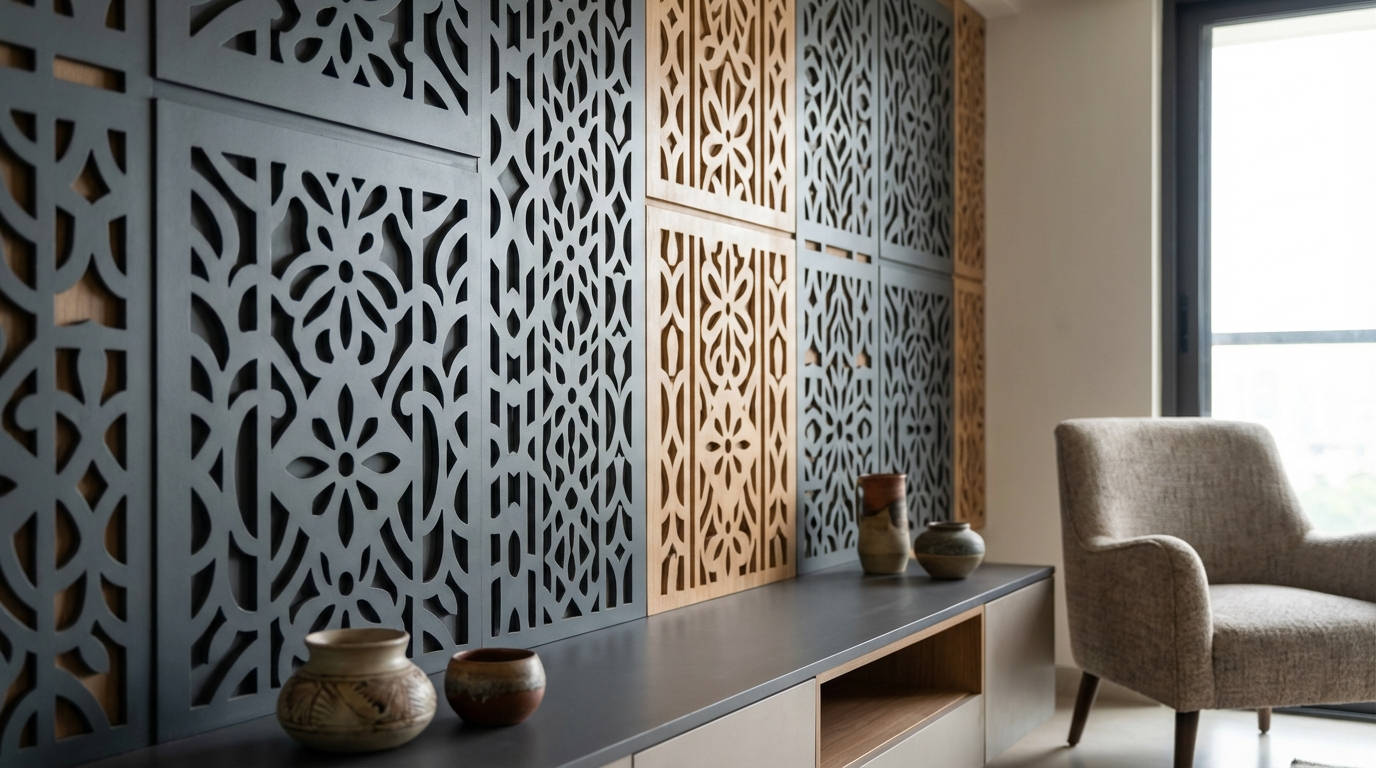
MDF CNC cutting uses a CNC router to carve detailed designs on medium-density fiberboard. It's perfect for jali panels, doors, partitions, and decorative wall features.
With CNC, even the most intricate designs can be brought to life on MDF board. This capability opens doors to personalised designs, intricate patterns, and detailed engravings that would be challenging to achieve manually.
Popular CNC Pattern Categories
| Pattern Style | Best Applications | Design Complexity | Typical MDF Thickness |
|---|---|---|---|
| Geometric (hexagons, triangles, chevrons) | TV units, accent walls, office partitions | Low to Medium | 12–18mm |
| Floral/Organic (leaves, vines, lotus) | Pooja rooms, bedroom headboards, door panels | Medium to High | 12–18mm |
| Traditional Jali (Mughal, Kashmiri, Moroccan) | Room dividers, mandir screens, window accents | High | 12–18mm |
| Abstract/Wave Patterns | Reception areas, commercial spaces, art installations | Medium | 18–25mm |
| Linear/Striped Grooves | Wardrobe shutters, cabinet fronts, ceiling panels | Low | 8–12mm |
CNC vs Laser Cutting for MDF
Laser cutting is ideal for fine, detailed work, while CNC router cutting works better for thicker materials and deeper patterns, especially in wood or MDF.
For most Indian interior applications, CNC routing remains the preferred method because:
- It handles 12–25mm thickness that jali partitions typically require
- Production costs are lower for medium-complexity patterns
- Edge quality on thicker boards is cleaner with CNC routing
- Laser cutting leaves burn marks on MDF edges that require additional finishing
MDF Jali Designs: From Partitions to Pooja Rooms
Many homeowners are giving MDF jali design for partitions a try. It is unique, easy to install and an affordable home interior design element. MDF jali partitions are used in living room interiors to divide a large area into two and create the illusion of more space.
Jali Applications in Indian Homes
CNC jali designs offer versatility and customization with traditional, floral, or modern patterns, ensuring a clean, sharp finish. They are lightweight but impactful, adding beauty to doors, partitions, and walls while allowing natural light and airflow. Made from strong materials like MDF, PVC, or metal, CNC jalis are low maintenance, long-lasting, and work well in any space—be it pooja rooms, kitchens, or balconies.
Pooja Room Jali Designs
While jali offers aesthetic simplicity, MDF provides durability. An MDF jali design for mandir is a holistic combination of beauty and functionality, perfect for your pooja room.
Generally, MDF jali designs for mandirs are inspired by geometry or nature. In warm states or metro cities with limited home square feet, an MDF design for a mandir is used for ventilation and cooling, making the space visibly wide and welcoming.
Popular mandir jali motifs include:
- Lotus and floral patterns symbolising purity
- Om and Shree Yantra sacred geometry
- Bell and temple arch silhouettes
- Kashmiri and Mughal-inspired lattice work
- Simple geometric grids for minimalist mandirs
Room Partition Jali Designs
Circular or decorative MDF jali designs add an element of style and panache to the otherwise contemporary and simplistic living space with colorful or all-white eclectic patterns. These ground-to-slab designs go well with any interior style, serving as not only a partition but also merging well with ceiling patterns.
In compact spaces, use lightweight MDF or PVC jali panels as partitions, wall decor, or backlit accents to add style without overwhelming the area. Opt for vertical or geometric patterns to enhance the sense of space and light.
MDF Furniture Designs: Wardrobes, Cabinets, and Beyond
Furniture applications take the biggest share of pre-laminated MDF at 54.62% in 2025. Ready-to-use panels come with high-gloss UV, acrylic, and embossed finishes. This cuts out extra lamination steps in production.
Why Designers Choose MDF for Furniture Shutters
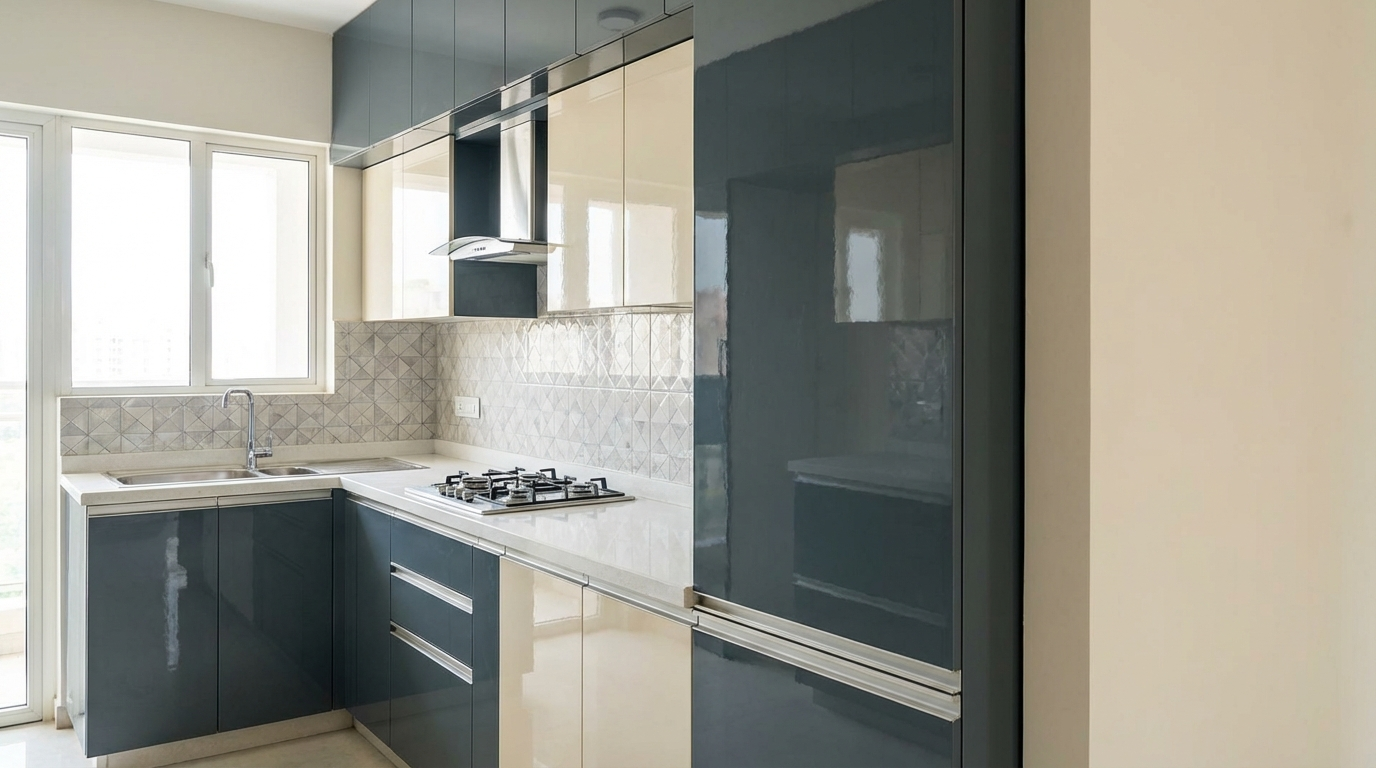
MDF is considered ideal for painted or laminate furniture. Every modern kitchen unit in pastels or high-gloss white cabinets in city flats are pulled off with MDF.
Whether you need detailed CNC work in the wall panel or an actual Indian mandir-like back panel, MDF is going to deliver everything, paired with clean edges and precise detailing.
MDF Wardrobe and Cabinet Design Trends
MDF (Medium-Density Fiberboard) is a popular choice for modular wardrobes due to its smooth surface, easy paintability, and low cost. It offers a smooth finish perfect for painted or lacquered wardrobes, is great for modern designs with curves and minimal thickness, and is affordable and easily available.
Current wardrobe design directions using MDF:
- High-gloss acrylic finish shutters — Mirror-like surfaces that make bedrooms feel larger
- Matte lacquered panels — Fingerprint-resistant and sophisticated
- Wood-grain laminated fronts — Natural aesthetics without the cost of veneer
- Handle-less profile shutters — Clean lines with push-to-open mechanisms
- CNC-routed decorative fronts — Geometric or floral patterns as wardrobe focal points
Kitchen Cabinet Applications
MDF has a very smooth surface, so it's great if you're planning to paint or want intricate designs. Plywood has a more natural grain and works well with laminates or wood veneers. Go with MDF for a sleek, uniform look, and choose plywood if you prefer a natural wood feel.
MDF is a popular choice for kitchen cabinet doors because of its smooth surface, which makes painting easy and gives a clean, modern look. But for the cabinet boxes or areas that might get damp, plywood is the better pick because it's more resistant to warping and holds screws more securely.
MDF vs Plywood: Making the Right Design Choice
This is the question Indian homeowners and contractors ask most frequently. The answer depends entirely on application, budget, and environmental exposure.
Quick Comparison Table
| Parameter | MDF | Plywood |
|---|---|---|
| Surface Smoothness | Excellent—no grain, knots, or voids | Variable—depends on grade and veneer |
| Paint Finish Quality | Superior—uniform absorption | Requires more prep work |
| CNC Machining | Excellent edge definition | Can splinter on intricate cuts |
| Moisture Resistance | Poor unless MR-grade or sealed | Good (MR/BWR/BWP grades available) |
| Screw Holding | Moderate—edges may split | Strong—cross-grain layers grip well |
| Weight-Bearing Capacity | Low to moderate | High |
| Cost | 30–40% lower than equivalent plywood | Higher, especially for premium grades |
| Best For | Decorative panels, painted finishes, CNC work | Structural furniture, wet areas, heavy loads |
When to Choose MDF
Choose MDF for cost-effective decorative elements, panelling, CNC detailing, and furniture that won't carry heavy loads.
MDF is excellent for intricate laser-cut jalis, wave panels, architraves, and feature walls.
When to Choose Plywood
Choose Plywood if the space is high-moisture (kitchens, bathrooms), or the furniture is weight-bearing (wardrobes, beds).
Plywood is strong, so it's chosen for parts that need to carry weight, like bed bases or cabinet frames. MDF is easier to cut and finish, so it's common in doors, panels, or decorative touches. A lot of modular furniture actually uses a mix of both to balance cost, function, and style.
The Hybrid Approach Most Contractors Use
Plywood delivers under pressure—literally. MDF brings finesse where form matters more than load. When in doubt, specify both: Plywood for the core build, MDF for surface styling.
This hybrid strategy is now standard in Indian modular furniture manufacturing:
- Wardrobe carcass in 18mm BWR plywood; shutters in 18mm pre-laminated MDF
- Kitchen cabinet boxes in 19mm BWP plywood; doors in painted MDF or acrylic MDF
- TV unit structure in plywood; back panels and decorative shelves in CNC-cut MDF
Finish Options for MDF Design Projects
Laminate Finishes
The matte finish of MDF laminate boards is the modern trend, as light is not reflected from such surfaces. Moreover, fingerprints and other stains are much less visible on MDF boards with a matte finish. Therefore, MDF laminate boards with a matte finish are preferred due to their elegant look that suits commercial interiors.
Gloss finish is mostly used on MDF boards that are mounted in kitchens and other small-sized rooms of residential houses, as this type of finish renders a spacious look by reflecting light.
Paint Finishes
Designers appreciate that the face finish looks clean and is easy to customize with paint, vinyl, engraving, tooling, or scoring.
Paint finish options on MDF:
- PU (Polyurethane) paint — High durability, available in matte/gloss, premium pricing
- Duco paint — Budget-friendly, good finish, less durable than PU
- Lacquer finish — Ultra-smooth, factory-applied, consistent quality
- Acrylic finish — Mirror-like gloss, scratch-resistant, requires factory application
Veneer and Membrane Finishes
For homeowners wanting wood aesthetics with MDF's machining advantages:
- Natural wood veneer over MDF—achieves real wood look with CNC-compatible substrate
- PVC membrane wrapping—heat-formed over CNC-routed MDF for seamless 3D coverage
- Decorative paper foil—cost-effective wood-grain alternative for budget projects
Design Ideas by Room
Living Room MDF Applications
A CNC-cut grey panel in MDF or metal sitting behind the TV screen, abstract waves or geometric patterns, adds depth without trying too hard. The white keeps things honest and minimal; the grey provides just enough drama.
Living room MDF design opportunities:
- TV unit back panels with geometric CNC patterns
- Accent walls with 3D wave or hexagonal textures
- Display shelving with integrated LED backlighting
- Room dividers with backlit jali designs
- False ceiling border panels with carved detailing
Bedroom MDF Applications
There's something deeply calming about wood grain—the way walnut or maple catches light. Imagine that as your headboard wall, but elevated with CNC-cut patterns: flowing abstracts, maybe bamboo-inspired lines, subtle enough not to shout but present enough to matter.
Bedroom MDF applications:
- Headboard accent walls with fluted or upholstered MDF panels
- Wardrobe shutters with handle-less profiles
- Dresser cabinets with high-gloss acrylic MDF fronts
- Ceiling cove panels for ambient lighting integration
Pooja Room MDF Applications
The carved MDF jali design for mandir adds an artistic appeal to the pooja room and unifies it with the overall design theme.
A CNC-cut floral false ceiling does wonders for a contemporary mandir unit. Use laser-cut wood panels or PVC overhead—delicate Om motifs on the cupboard doors below, warm LED backlighting creating that golden-hour glow.
Entryway and Foyer MDF Applications
Vertical lines are secret weapons in narrow hallways—they pull eyes up, make ceilings feel miles away. Run floor-to-ceiling CNC-cut panels in MDF or PVC, slender and elegant, perhaps with backlighting that creates a glow at dusk. Use them as semi-dividers, maintaining that sight line to the living room while establishing gentle boundaries.
Thickness Selection Guide for MDF Designs
The thickness a CNC machine can cut depends on the material and the machine's capabilities. For wood and MDF, CNC machines typically handle thicknesses up to 100mm, while the precision of the cutting tool allows for clean, detailed cuts, even at greater thicknesses.
Practical thickness recommendations for Indian projects:
| Application | Recommended MDF Thickness | Reasoning |
|---|---|---|
| Wall cladding panels | 8–12mm | Lightweight, easy installation, sufficient for flat panels |
| 3D textured wall panels | 18–25mm | Depth needed for 3D carving without breakthrough |
| Jali partitions | 12–18mm | Balance between structural stability and weight |
| Cabinet/wardrobe shutters | 18mm | Industry standard, compatible with hinges and edge banding |
| Door panels | 25–30mm | Sufficient rigidity and heft for door feel |
| Furniture carcass (if using MDF) | 18mm | Adequate strength for non-load-bearing applications |
| Decorative mouldings | 12–18mm | Depends on profile depth required |
Moisture Considerations for Indian Climates
MDF absorbs water and will swell or warp if exposed to moisture. For outdoor use or wet environments, consider HDPE, acrylic, or polycarbonate.
For Indian conditions with high humidity and monsoon exposure:
- Standard MDF — Use only in air-conditioned or dry interior spaces
- MR-grade MDF — Acceptable for normal humidity but not direct water contact
- HDHMR (High-Density High Moisture Resistance) — Better option for kitchen cabinets and semi-humid areas
- Exterior-grade boards like Tricoya MDF — Tricoya MDF boards are not only resistant to fungi but also extremely water-repellent. They are suitable for outdoor use, for example for facades, window parts, doors, garden furniture or playground components. For bathrooms and wellness facilities, they are ideally suited for indoor use.
Sustainability and Indoor Air Quality
The use of low-emission adhesives and coatings in MDF production is gaining traction. The World Health Organization reported that improving air quality indoors can reduce health risks, making zero-formaldehyde and VOC-free products more appealing. Recent studies indicate that nearly 75% of consumers prefer products that assure better indoor air quality.
When specifying MDF for residential projects in India:
- Request E0 or E1 emission-grade boards to minimise formaldehyde off-gassing
- Allow newly installed MDF furniture to off-gas in ventilated conditions before occupancy
- Consider CARB Phase 2 compliant boards for children's rooms and bedrooms
- Seal all edges and surfaces with paint or laminate to reduce emission exposure
How to Choose the Right MDF Design for Your Project
Decision Framework
Choose MDF wall panels if:
- You want intricate CNC patterns that would be impossible in plywood
- The wall will be painted rather than veneered
- Budget is a primary constraint
- The space is climate-controlled or has low humidity
Choose MDF furniture shutters if:
- You want high-gloss, matte lacquer, or membrane-wrapped finishes
- The furniture won't bear heavy loads
- Modern, handle-less designs are desired
- CNC-routed decorative patterns are part of the design
Choose MDF jali/partition designs if:
- You need light and ventilation to pass through
- Visual privacy without complete separation is the goal
- Traditional or geometric patterns are required
- The partition is decorative rather than structural
Avoid MDF (choose plywood or alternatives) if:
- The application involves direct water exposure
- Heavy load-bearing is required (wardrobe shelves with heavy items)
- Strong screw-holding near edges is necessary
- The space has high humidity without climate control
Vendor Selection Checklist
When sourcing MDF for design projects in India:
- Verify the emission grade (E0, E1, or E2) with test certificates
- Check density specifications—higher density (700+ kg/m³) means better machining
- Request sample cuts to evaluate edge quality
- Confirm moisture resistance rating if humidity is a concern
- Compare pre-laminated vs raw MDF pricing for your specific finish requirement
- Factor in edge banding costs for exposed edges
Cost Considerations for MDF Design Projects
MDF sits at the affordable end of the spectrum and is a popular choice for this reason. But if you want to really make a statement, materials like hardwoods, metals, or stone will have your wallet feeling considerably lighter.
CNC cutting costs may vary based on design complexity, material, and size. Simple MDF jali designs are usually budget-friendly, while detailed metal or stone work can cost more.
Budget planning factors for MDF design projects:
- Raw MDF board cost — Varies by thickness, grade, and brand
- CNC cutting charges — Typically charged per running foot or per design complexity tier
- Finishing cost — Paint, laminate, or membrane application adds 40–100% to raw material cost
- Edge banding — Essential for exposed edges, adds per-linear-foot cost
- Installation — Wall panels and partitions require professional fitting for clean results
- Hardware — Hinges, handles, and fittings for furniture applications
Buyer's Checklist: Before You Order MDF Designs
- Define the application clearly — Wall panel, partition, furniture shutter, or structural component
- Assess moisture exposure — Standard MDF fails in humid conditions; specify MR-grade or HDHMR if needed
- Choose thickness based on function — Thinner for wall cladding, thicker for 3D carving and doors
- Specify emission grade — E0 or E1 for residential interiors, especially bedrooms
- Select finish before CNC work — Some finishes require specific MDF grades
- Get pattern samples first — Especially for complex CNC designs; see actual cut quality before full order
- Factor in lead time — Custom CNC work takes 7–15 days depending on complexity
- Plan edge treatment — All exposed edges need banding or painting
- Confirm installation requirements — Wall panels may need backing support; heavy partitions need floor/ceiling anchoring
- Budget for contingency — Allow 10–15% buffer for fitting adjustments and touch-ups
Disclaimer: This content is provided for general informational purposes based on industry practices and publicly available information. Product specifications, standards, prices, and availability may vary by manufacturer, region, and time. Readers should independently verify details with manufacturers, dealers, or qualified professionals before making purchase or construction decisions.