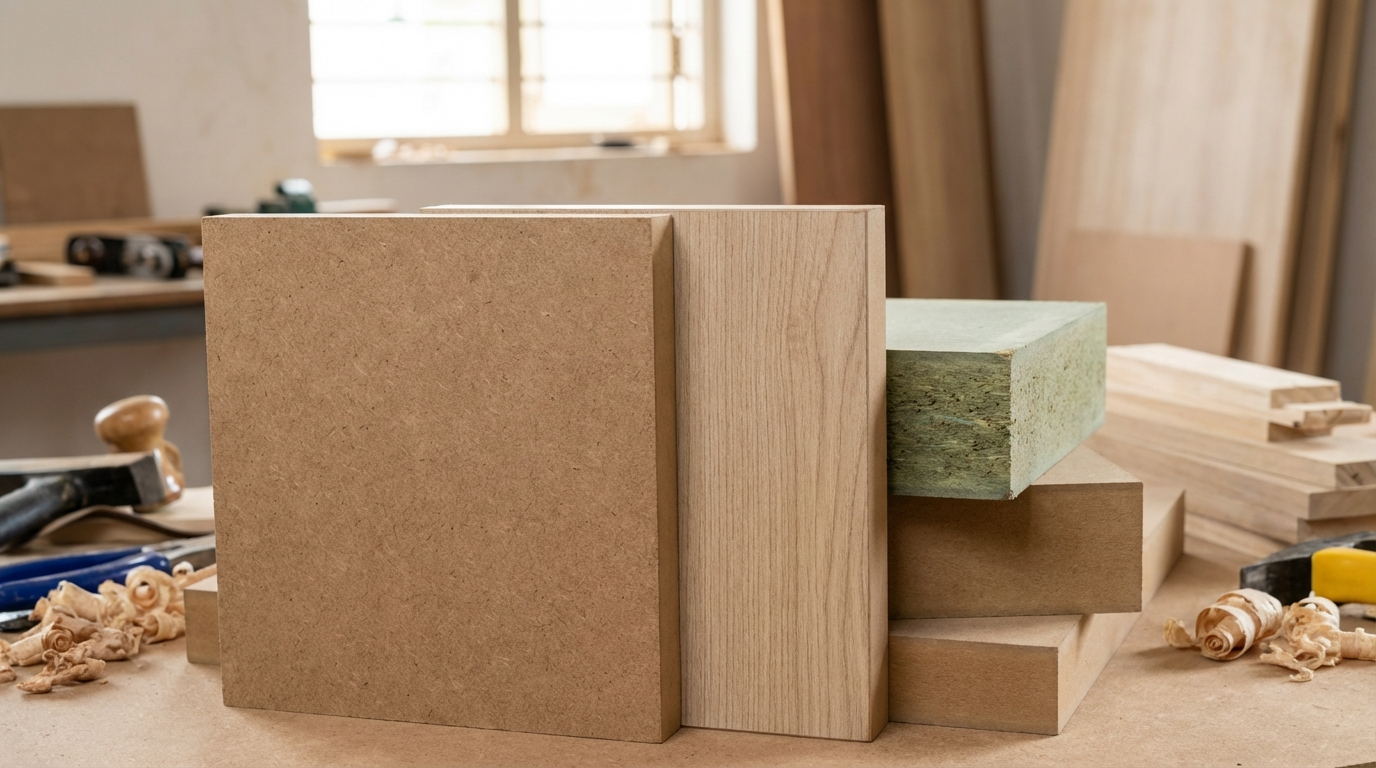
What Makes MDF Board a Go-To Choice for Indian Interiors?
Walk into any modern Indian apartment, and you'll likely encounter MDF without realising it. Those sleek wardrobe shutters, the intricate jali work on your partition, the smooth TV unit backing—there's a strong chance they're all MDF. Yet despite its ubiquity, most buyers conflate MDF with plywood, HDHMR, or particle board, leading to costly mismatches between material and application.
MDF (Medium Density Fibreboard) is an engineered wood panel manufactured by breaking down hardwood or softwood residuals into fine fibres, combining them with wax and resin binders, then forming panels under high temperature and pressure. The result is a dense, smooth, grain-free board that machines beautifully—but comes with specific limitations Indian buyers must understand before purchasing.
This guide cuts through the marketing noise. You'll learn exactly which MDF type suits your project, what realistic prices look like across Indian markets in 2026, which manufacturers actually deliver on quality claims, and crucially—when MDF is the wrong choice entirely.
Understanding MDF Board: Technical Fundamentals
Before diving into types and prices, grasping MDF's core characteristics helps you evaluate whether it belongs in your project at all.
How MDF Differs from Solid Wood and Plywood
MDF contains no wood grain, knots, or natural variations. This uniformity is both its greatest strength and limitation. Unlike plywood (which comprises thin wood veneers glued in alternating grain directions), MDF uses wood fibres processed into a homogeneous mass. This means:
- Surface consistency: MDF presents an utterly smooth face, ideal for lacquer finishes and intricate CNC routing
- Edge quality: Cut edges are dense and uniform—no voids or layering visible
- Dimensional stability: MDF expands/contracts uniformly, unlike solid wood which moves more across the grain
- Structural limitation: Without grain structure, MDF lacks the tensile strength that makes plywood suitable for load-bearing applications
Density and Its Practical Implications
Standard MDF maintains a density between 600–800 kg/m³. This places it firmly between particle board (lower density, weaker) and HDF/HDHMR (higher density, stronger). For Indian buyers, density directly correlates with:
- Screw holding capacity: Higher density boards grip fasteners better, though all MDF performs poorly compared to plywood
- Machining quality: Denser boards produce cleaner routed edges without chipping
- Weight: An 18mm MDF panel weighs approximately 12-14 kg per square metre—significantly heavier than equivalent plywood
Types of MDF Board Available in India
Indian manufacturers and importers offer several MDF variants, each engineered for specific environments. Selecting the wrong type remains the most common buyer mistake.
Standard Interior Grade MDF
The baseline product suitable only for climate-controlled, dry interior applications. Standard MDF uses urea-formaldehyde resin, which provides adequate bonding but offers no moisture protection. In India's humid climate, this grade works reliably only in air-conditioned spaces or regions with low humidity like parts of Rajasthan and interior Maharashtra.
Best applications: Bedroom furniture, living room panelling, decorative screens in dry environments, false ceiling components in AC spaces.
Moisture Resistant MDF (MR Grade)
MR-grade MDF incorporates melamine-enhanced resins and sometimes wax additives to improve water tolerance. However, "moisture resistant" doesn't mean waterproof—a distinction that trips up many Indian buyers. MR MDF can handle ambient humidity and occasional indirect moisture exposure but will still swell if water pools on its surface.
Best applications: Wardrobe carcasses in non-bathroom areas, kitchen cabinet shutters (not carcasses), office furniture in moderately humid environments.
High Density HMR/HDHMR Boards
Technically a step beyond standard MDF, HDHMR (High Density High Moisture Resistant) boards combine increased density (800–900 kg/m³) with superior moisture-resistant resins. While manufacturers sometimes market HDHMR under the MDF umbrella, it's functionally a different product category with significantly better performance.
Key difference: HDHMR costs 60-100% more than standard MDF but offers genuinely improved moisture resistance and structural strength, making it suitable for kitchen carcasses where standard MDF would fail within 2-3 years.
Pre-Laminated MDF
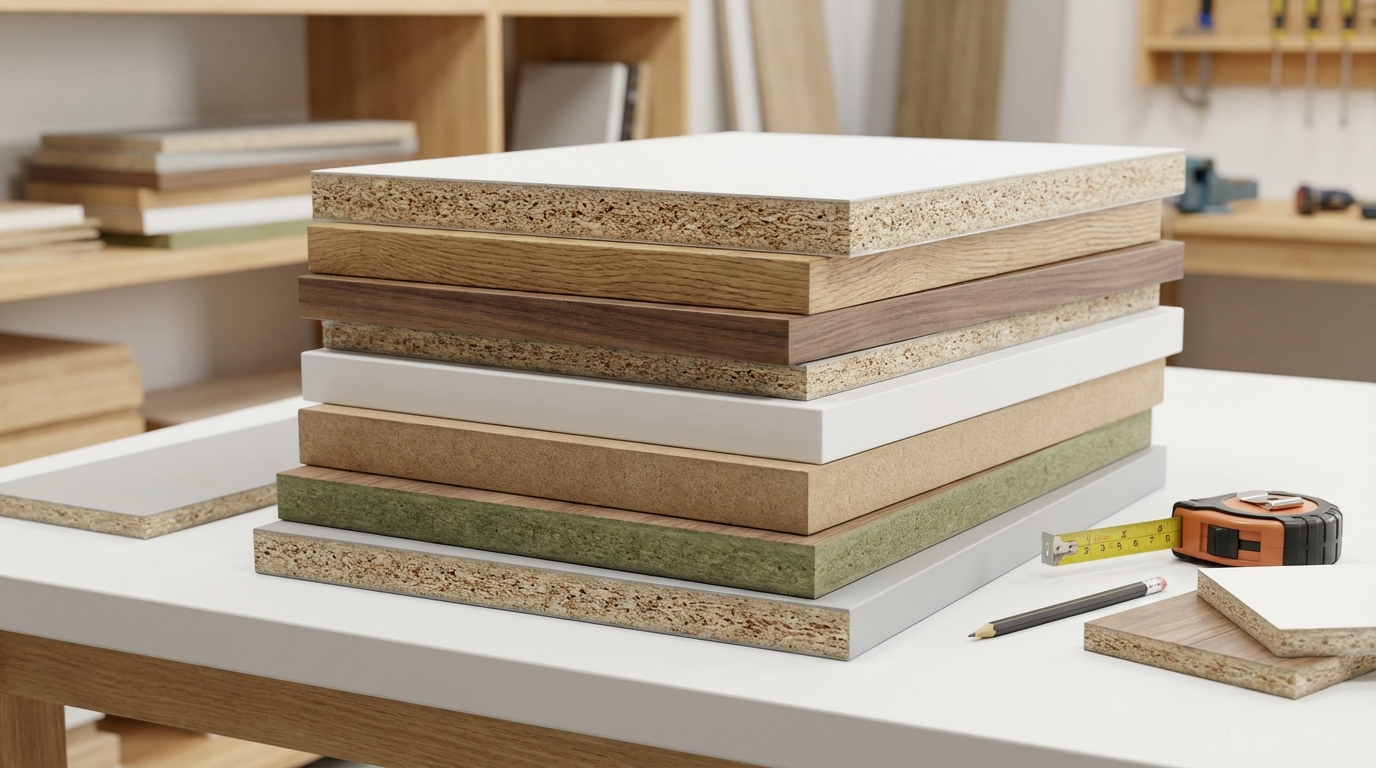
Factory-finished boards with decorative surfaces (solid colours, wood grain patterns, textured finishes) already applied. Pre-laminated MDF saves on-site finishing time and ensures consistent quality, but limits design flexibility. Available in both standard and MR grades.
Consideration for Indian buyers: Pre-laminated boards from reputable manufacturers typically use melamine paper or PVC foil. Cheaper variants may use paper laminates that peel in humid conditions.
Fire Retardant MDF
Treated boards that slow flame spread, required by fire safety codes for commercial buildings, multiplexes, and certain residential high-rises. Fire-retardant MDF typically carries Class 1 or Class 2 fire ratings and costs 40-70% more than standard MDF.
Zero-Emission / E0 Grade MDF
Standard MDF releases formaldehyde, a volatile organic compound (VOC) that can cause respiratory irritation. E0 and E1 ratings indicate formaldehyde emission levels, with E0 representing the lowest emissions. For homes with children, elderly residents, or anyone with respiratory sensitivities, E0-rated boards are worth the premium.
| MDF Type | Density (kg/m³) | Moisture Resistance | Price Range (₹/sq ft, 18mm) | Best Use Cases |
|---|---|---|---|---|
| Standard Interior | 600-750 | Poor | ₹32-48 | Dry interior furniture, decorative panels |
| MR Grade | 650-780 | Moderate | ₹45-65 | Wardrobes, office furniture |
| HDHMR | 800-900 | High | ₹75-110 | Kitchen cabinets, bathroom vanities |
| Pre-Laminated | 650-750 | Varies | ₹55-90 | Ready furniture, commercial fixtures |
| Fire Retardant | 680-780 | Moderate | ₹70-100 | Commercial spaces, public buildings |
| E0 Low Emission | 650-780 | Varies by grade | ₹55-85 | Children's rooms, healthcare spaces |
MDF Board Price in India: 2026 Market Reality
Pricing varies significantly based on manufacturer, grade, thickness, and your purchasing location. Rather than stating absolute prices that become outdated quickly, here's how to evaluate MDF costs intelligently.
Price Drivers You Must Understand
Thickness impact: MDF sheets commonly range from 2.5mm to 30mm. The relationship between thickness and price isn't linear—18mm boards cost proportionally more per millimetre than 6mm boards because the thicker sheets serve structural applications demanding higher quality control.
Brand premium: Established manufacturers like Greenply, Action Tesa, and Century command 15-30% higher prices than regional brands. This premium typically reflects better quality control, more consistent density, and reliable moisture resistance in MR grades.
Regional variation: MDF prices in Mumbai, Delhi, and Bangalore run 10-20% higher than in tier-2 cities due to transportation costs and real estate overheads for dealers. However, metro dealers often stock better grade variety.
Purchase volume: Buying full sheets (standard 8×4 ft) from dealers costs less per square foot than purchasing cut pieces. Contractors purchasing 50+ sheets typically negotiate 8-15% discounts.
Realistic Price Ranges for 2026
For planning purposes, expect these approximate ranges per square foot for 18mm sheets from reputable brands:
- Standard Interior MDF: ₹32-50
- MR Grade MDF: ₹45-70
- HDHMR: ₹75-120
- Pre-laminated (basic finishes): ₹55-80
- Pre-laminated (premium finishes): ₹80-120
Important context: These prices exclude GST (18%), transportation, and cutting charges. Final landed cost typically runs 25-35% higher than base sheet prices.
MDF vs Alternatives: Cost Comparison
Pure price comparison misleads buyers because longevity and application suitability differ dramatically:
| Material | Price Range (₹/sq ft, 18-19mm) | Lifespan in Typical Use | True Cost Consideration |
|---|---|---|---|
| Standard MDF | ₹32-50 | 5-10 years (dry conditions) | Cheapest upfront; may need replacement |
| MR Grade MDF | ₹45-70 | 8-12 years | Better value for moderate humidity |
| HDHMR | ₹75-120 | 12-18 years | Premium but justified for wet areas |
| Commercial Plywood (MR) | ₹70-110 | 15-20 years | Higher strength, better screw holding |
| BWP Plywood | ₹120-200 | 20-25+ years | Best for structural, wet applications |
| Particle Board | ₹22-38 | 3-7 years | Cheapest; shortest lifespan |
Leading MDF Manufacturers in India
The Indian MDF market features both domestic manufacturers and importers. Quality consistency varies significantly, making brand selection crucial.
Action Tesa
One of India's largest engineered wood manufacturers, Action Tesa operates multiple plants producing MDF, HDHMR, and particle board. Their HDHMR range enjoys strong market reputation, though their standard MDF competes on price rather than premium positioning. Available through extensive dealer networks in most Indian cities.
Greenply Industries
A diversified wood panel manufacturer offering MDF alongside their flagship plywood products. Greenply's MDF range includes interior, MR, and HDHMR grades, manufactured using their proprietary PROD-IQ technology that claims better fibre uniformity. Their distribution network reaches even smaller towns, making after-sales support more accessible.
Century Plyboards
Known primarily for plywood, Century's MDF offerings have expanded significantly. Their positioning emphasises quality over aggressive pricing. Century's dealer network provides reasonable availability, though MDF selection may be limited compared to their plywood range in smaller markets.
Merino Industries
Better known for laminates, Merino also manufactures MDF boards. Their advantage lies in coordinated laminate-MDF combinations where colour matching matters. Merino's distribution is concentrated in metros and major tier-1 cities.
Rushil Décor
Their VIR MDF and HDHMR range has gained traction in western and southern India. Rushil positions on competitive pricing while maintaining reasonable quality standards. Worth considering if Action Tesa or Greenply pricing seems high in your region.
Imported MDF
Chinese, Malaysian, and European MDF enters India through various importers. European boards (particularly from Germany and Austria) command premium prices but offer superior consistency and lower emissions. Chinese and Malaysian boards compete on price but quality varies dramatically between suppliers.
MDF Applications: Where It Excels and Where It Fails
MDF's smooth surface and machining properties make it exceptional for certain applications—and entirely wrong for others. Understanding this distinction prevents expensive mistakes.
Ideal MDF Applications
CNC-routed decorative panels: MDF's homogeneous structure produces clean, intricate cuts impossible with plywood. Jali work, geometric patterns, and detailed carvings emerge crisp and consistent.
Painted furniture: No grain telegraphing through paint, no surface inconsistencies—MDF accepts paint finishes beautifully. For modern minimalist interiors demanding smooth lacquered surfaces, MDF outperforms alternatives.
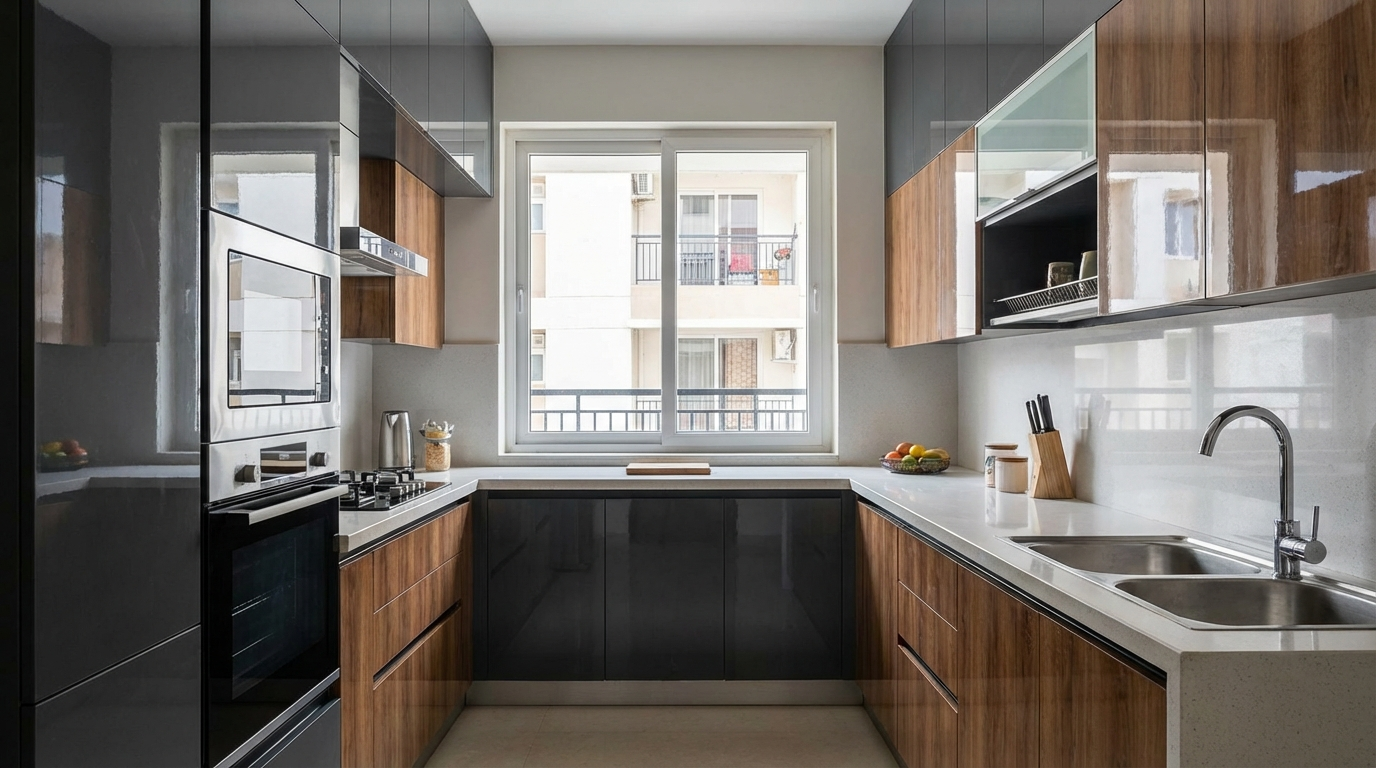
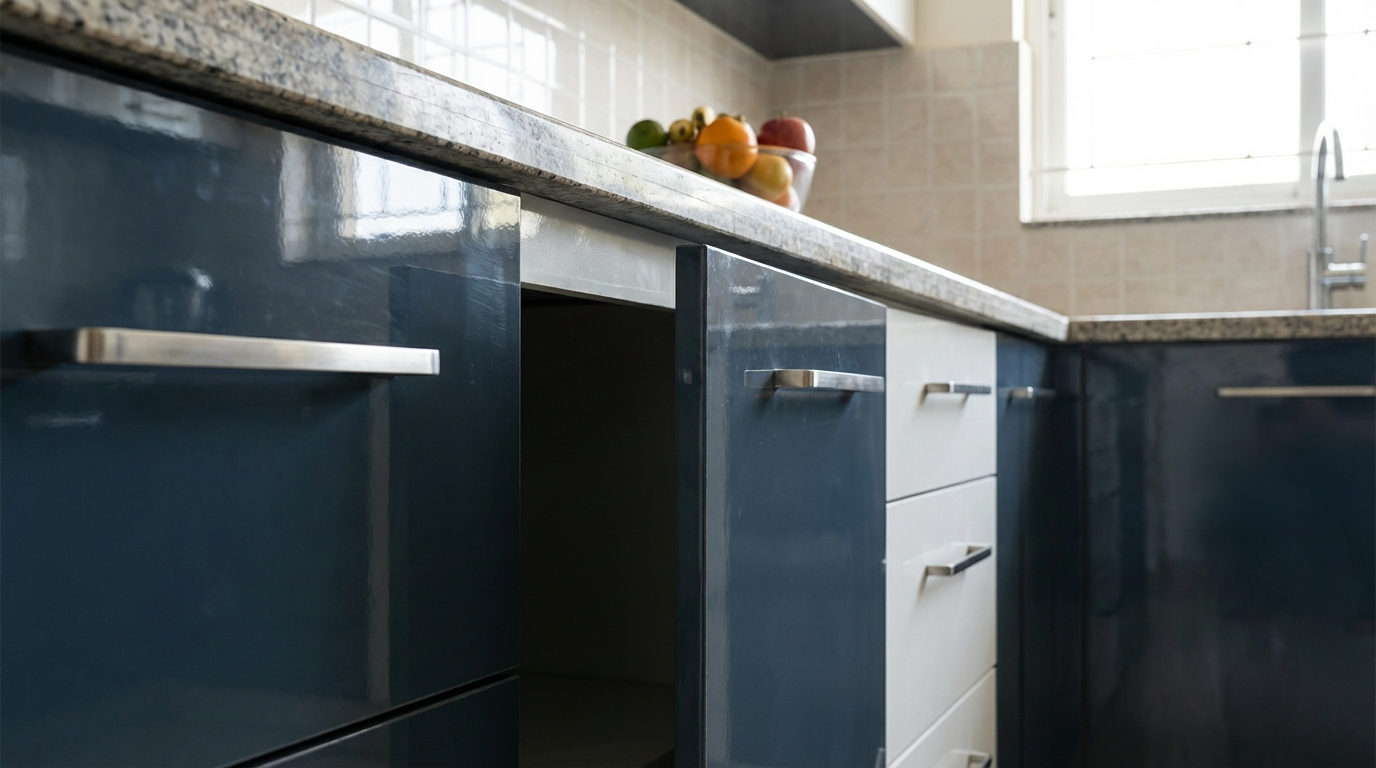
Cabinet doors and drawer fronts: Shutter faces don't bear structural loads. MDF's dimensional stability prevents warping that can affect solid wood doors, while its smooth surface works perfectly with membrane press finishes.
Wall panelling in dry spaces: Decorative wall applications in air-conditioned living rooms or bedrooms benefit from MDF's consistent surface and competitive pricing.
False ceiling components: Lightweight decorative ceiling elements, especially in AC environments, leverage MDF's easy workability.
Applications Where MDF Fails
Kitchen cabinet carcasses: Standard MDF swells irreversibly when exposed to water splashes, steam, or plumbing leaks—all common in Indian kitchens. Even MR-grade MDF struggles here. Use HDHMR or marine plywood instead.
Bathroom furniture: The moisture levels in Indian bathrooms (often lacking exhaust ventilation) destroy standard MDF within 2-3 years. Only HDHMR with proper edge sealing survives.
Load-bearing shelves: MDF sags under sustained weight over long spans. A 600mm wide MDF shelf will visibly bow within months if supporting books or heavy objects. Plywood handles these loads significantly better.
Exterior applications: Even fire-retardant or MR-grade MDF cannot withstand direct weather exposure. No MDF variant suits outdoor use in India.
Furniture frames and structural components: Bed frames, sofa structures, or any application requiring screw holding strength and impact resistance demands plywood, not MDF.
Working with MDF: Practical Considerations
If you're supervising a carpentry project using MDF, these practical factors affect outcomes:
Cutting and Machining
MDF cuts cleanly with standard woodworking tools but generates extremely fine dust. This dust poses respiratory hazards and requires proper masks—not the thin cloth masks common on Indian construction sites, but N95-rated protection. Dust extraction systems significantly improve both air quality and finish quality.
Tungsten carbide tipped (TCT) blades maintain sharpness longer than standard steel blades, which MDF dulls quickly. Budget an extra 10-15% for blade wear when estimating project costs.
Joining and Fastening
MDF holds screws poorly, especially at edges where the material tends to split. Pre-drilling is mandatory—not optional. Confirm screws are at least 25mm from any edge, and use screws with coarse threads designed for particle board/MDF.
For critical joints, consider:
- Dowel joints with wood glue provide stronger connections than screws alone
- Biscuit joints work well for panel-to-panel connections
- Metal cam locks and barrel nuts (like those in flat-pack furniture) distribute load better than screws
Edge Treatment
Untreated MDF edges absorb moisture rapidly—a serious concern in Indian humidity. All edges should receive one of these treatments:
- Edge banding: PVC or ABS edge strips applied with hot-melt adhesive seal edges effectively
- Paint/primer sealing: Multiple coats of primer seal porous edges but may not prevent moisture ingress at joins
- Veneer edging: Adds aesthetic value while providing some moisture protection
Finishing Options
Painting: Sand surfaces with 180-grit paper, apply MDF-specific primer (regular wood primer absorbs unevenly), then topcoat. Two primer coats prevent raised fibres.
Lamination: High-pressure laminates (HPL) adhere well with contact cement. Ensure surfaces are clean and dust-free.
Veneer: Natural wood veneer transforms MDF into what appears solid wood. Requires skill and proper preparation for lasting adhesion.
Membrane/vacuum press: PVC film wrapped under heat creates seamless, water-resistant surfaces—popular for modern kitchen shutters.
How to Choose the Right MDF for Your Project
Use this decision framework to match MDF type to application:
Step 1: Assess Moisture Exposure
Air-conditioned spaces with no water contact: Standard interior MDF suffices
Ambient humidity but no direct water: MR-grade MDF provides adequate protection
Kitchens, bathrooms, or high-humidity areas: Skip MDF entirely—use HDHMR or waterproof plywood
Step 2: Evaluate Structural Requirements
Decorative panels, doors, drawer fronts: MDF works excellently
Shelving under 400mm span: MDF acceptable with adequate support
Long-span shelving or load-bearing elements: Choose plywood instead
Step 3: Consider Finish Requirements
Painted finishes: MDF provides the smoothest base
Natural wood appearance: Veneered MDF or plywood with natural veneer
Ready-to-use surfaces: Pre-laminated MDF saves finishing time
Step 4: Factor Health Considerations
Children's rooms, bedrooms, healthcare spaces: Specify E0 or E1 emission-rated boards
Well-ventilated commercial spaces: Standard emission ratings typically acceptable
Step 5: Balance Budget Against Longevity
Cheapest upfront doesn't mean cheapest over 10 years. Standard MDF in a kitchen saves money today but costs replacement, labour, and disruption within 3-5 years. Investing in appropriate materials initially almost always proves more economical.
Quality Checks Before Purchasing MDF
Don't rely solely on brand reputation. Verify these aspects before purchasing:
- Surface consistency: Check for rough patches, depressions, or thickness variations by running your hand across the surface
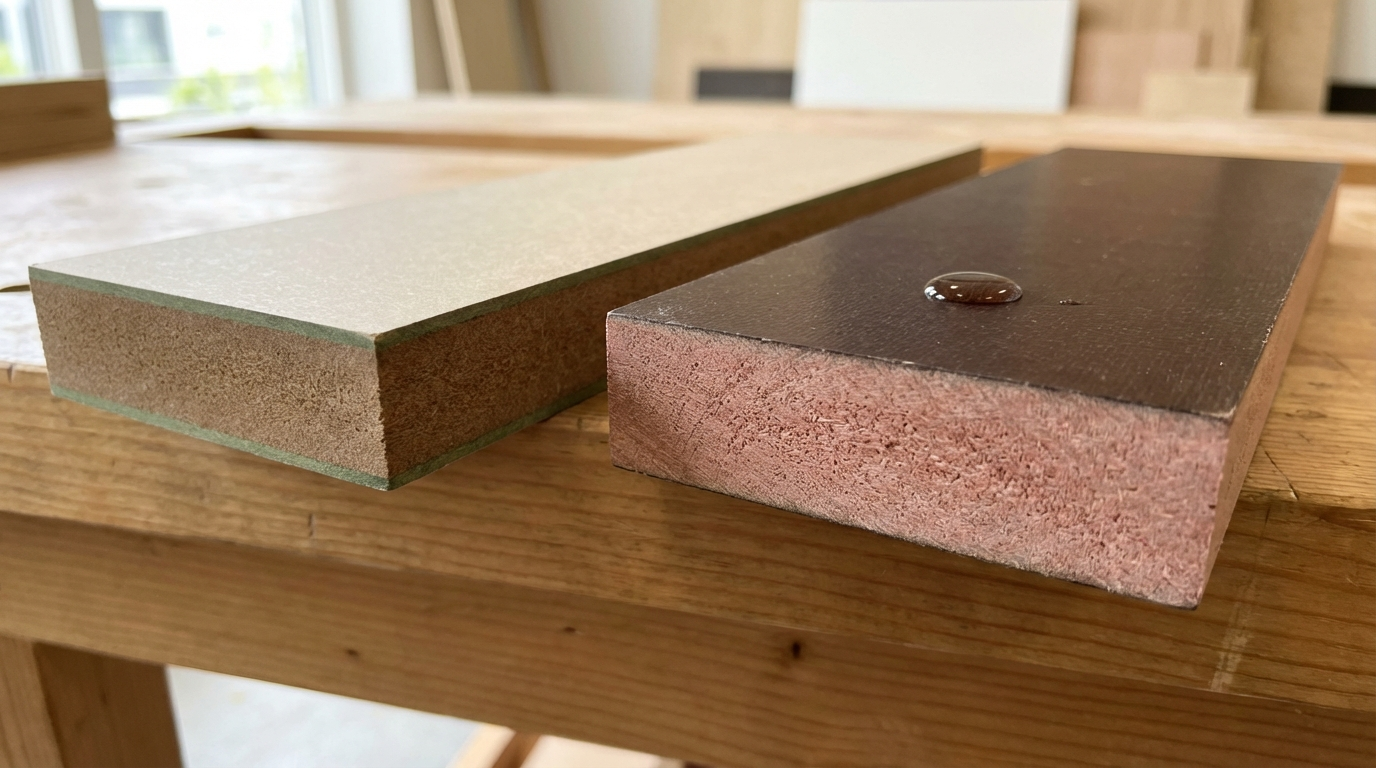
- Edge density: Examine sheet edges for voids or loose material—quality boards have uniformly dense edges
- Weight: Unusually light sheets indicate lower density and inferior performance
- Moisture testing: For MR-grade boards, ask dealers for test certificates or conduct a water drop test on sample pieces
- Emission certification: Request documentation for E0/E1 claims—reputable manufacturers provide test certificates
- Thickness accuracy: Measure actual thickness against stated specifications; variations beyond 0.5mm suggest poor quality control
Frequently Asked Questions
Is MDF board waterproof?
No. Standard MDF absorbs water and swells irreversibly. MR-grade MDF resists humidity but is not waterproof. Only HDHMR offers genuine moisture resistance suitable for wet environments, and even HDHMR requires proper edge sealing.
Can MDF be used for kitchen cabinets?
Standard MDF should never be used for kitchen cabinet carcasses due to moisture vulnerability. MDF cabinet doors (shutters) can work if finished properly with membrane press or laminate, but carcasses require HDHMR or marine plywood to survive Indian kitchen conditions.
How long does MDF furniture last?
In appropriate dry environments with proper care, MDF furniture lasts 8-12 years. In humid conditions or with water exposure, standard MDF may fail within 3-5 years. Application suitability affects lifespan more than the material itself.
Is MDF cheaper than plywood?
Yes, standard MDF typically costs 30-50% less than equivalent-grade plywood. However, for applications requiring moisture resistance or structural strength, the cost gap narrows significantly, and plywood often provides better value.
Does MDF release harmful chemicals?
Standard MDF uses formaldehyde-based resins that emit VOCs, particularly when new. E0 and E1-rated boards minimise emissions to safe levels. Proper ventilation during initial weeks after installation helps dissipate any off-gassing.
Can MDF be painted directly?
MDF requires primer before painting. Its porous surface absorbs paint unevenly, resulting in blotchy finishes without proper preparation. MDF-specific primers seal the surface for consistent topcoat results.
Making Your MDF Purchase Decision
MDF serves specific purposes exceptionally well—smooth painted furniture, decorative panels, CNC-routed elements, and cabinet doors in dry environments. It fails equally spectacularly when misapplied to wet areas, structural applications, or load-bearing situations.
For Indian buyers, the practical approach involves:
- Confirm your application genuinely suits MDF's characteristics
- Select the appropriate grade (standard, MR, or upgrade to HDHMR) based on moisture exposure
- Purchase from established manufacturers with consistent quality records
- Ensure proper fabrication techniques—pre-drilling, edge sealing, appropriate fasteners
- Specify E0/E1 emissions for sensitive spaces
When in doubt between MDF and plywood for a particular application, plywood typically offers greater versatility and forgiveness for Indian conditions. Save MDF for applications where its smooth surface and machining properties genuinely add value—and use appropriate alternatives everywhere else.
Disclaimer: This content is provided for general informational purposes based on industry practices and publicly available information. Product specifications, standards, prices, and availability may vary by manufacturer, region, and time. Readers should independently verify details with manufacturers, dealers, or qualified professionals before making purchase or construction decisions.