Is Particle Board Furniture Worth Buying in 2026?
Particle board furniture fills showrooms across India — from budget wardrobes in rental apartments to laminated office desks in corporate setups. Yet the material remains surrounded by confusion. Some dismiss it as "cheap and weak," while others quietly build entire kitchens with it. The truth sits somewhere between these extremes, and understanding where particle board succeeds (and where it fails) can save you thousands of rupees in wrong purchases.
Particle board is an engineered wood product made by compressing wood chips, sawdust, and resin under high pressure and heat. Unlike solid wood or plywood, it contains no natural grain structure — its strength comes entirely from the binding resin and compression process. This manufacturing method makes it the most affordable engineered wood option available, but also introduces specific limitations that buyers must understand before committing.
Whether particle board furniture is "good" depends entirely on your application, budget constraints, and realistic expectations about longevity. A particle board bookshelf in a dry study room might serve you well for a decade. The same material in a bathroom vanity could fail within months. This guide breaks down exactly when particle board makes sense, when it doesn't, and how it compares against alternatives you might be considering.
What Exactly is Particle Board? Understanding the Material
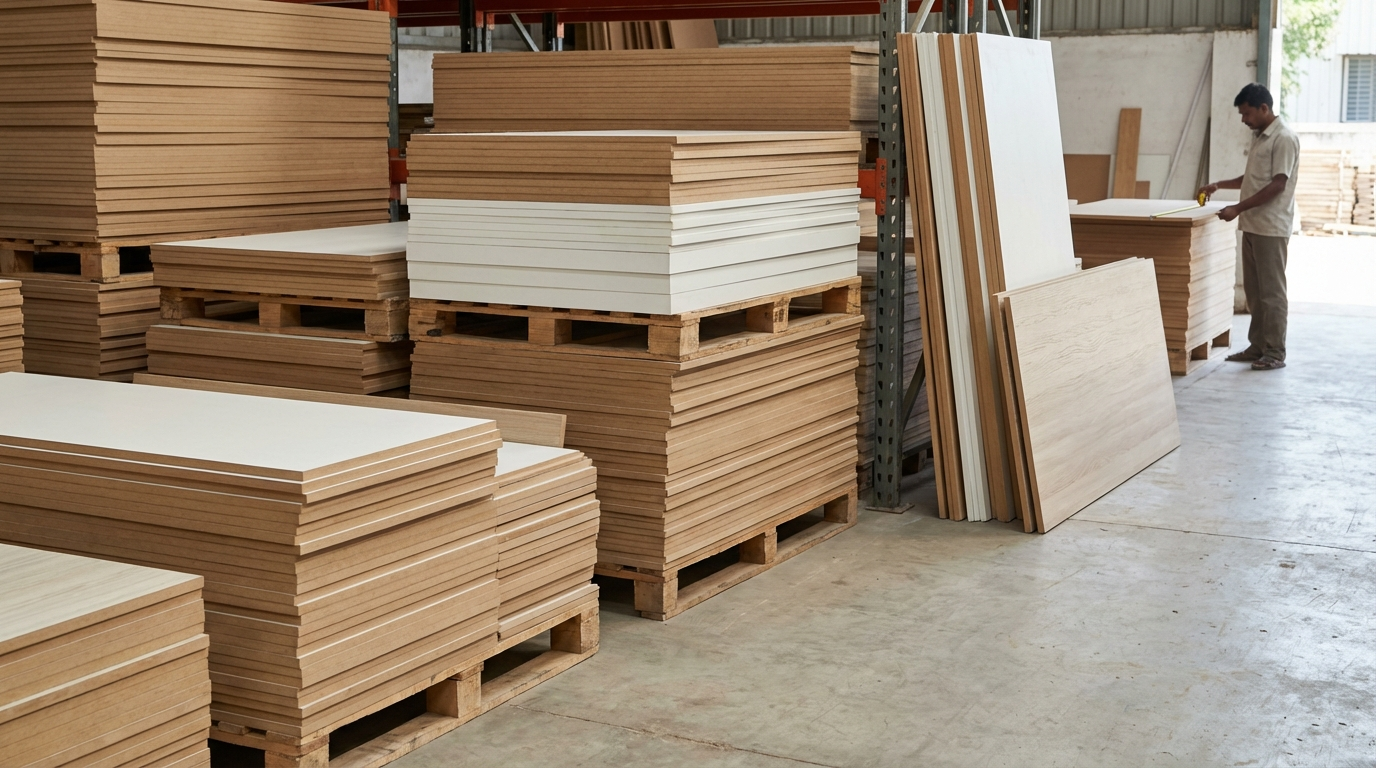
Particle board belongs to the engineered wood family, but sits at a fundamentally different end of the spectrum compared to plywood or HDHMR. The manufacturing process involves collecting wood waste — sawdust, wood shavings, chips from sawmills — mixing it with synthetic resin (typically urea-formaldehyde), and pressing the mixture into flat sheets under heat and pressure.
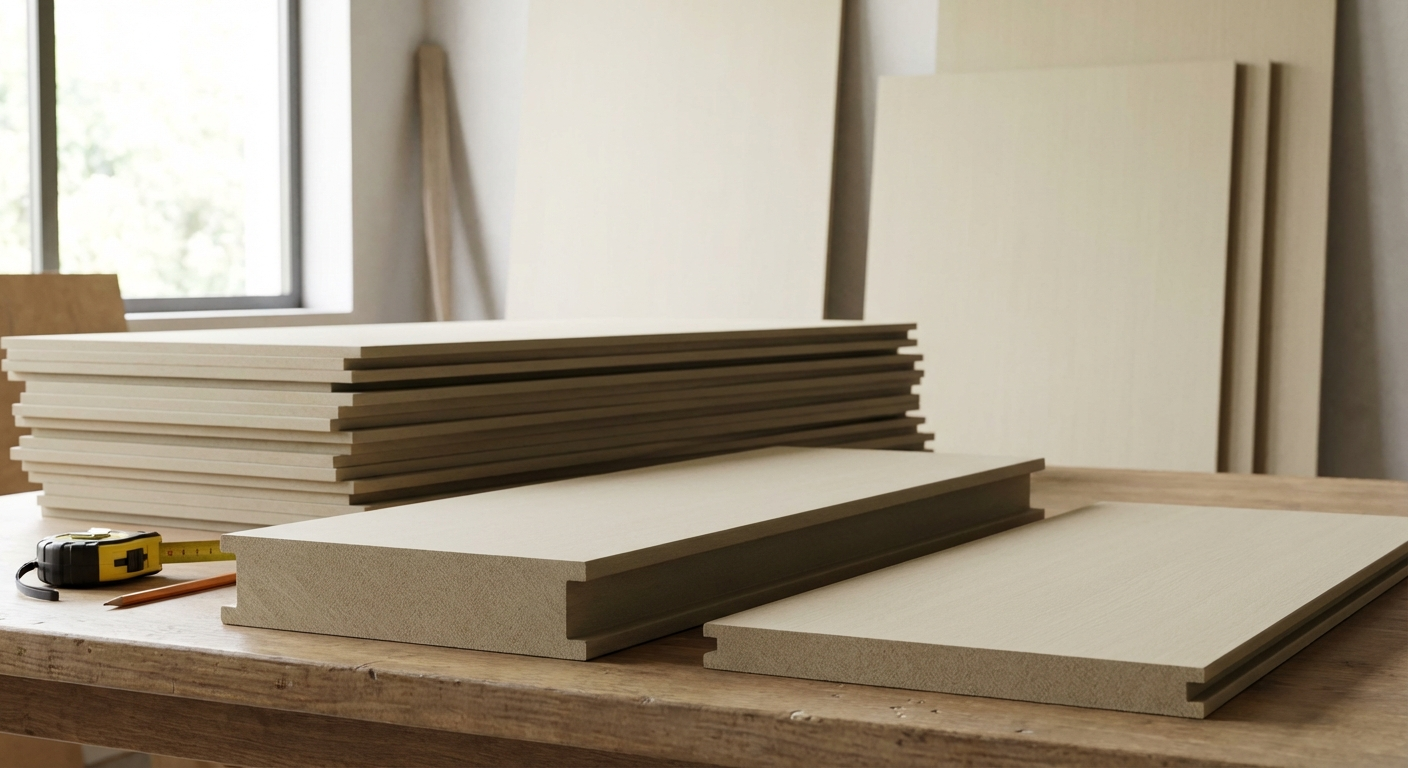
The resulting board has a distinctive appearance: a uniform, somewhat coarse texture without any visible wood grain pattern. When you look at a raw particle board edge, you'll see small wood particles of varying sizes suspended in the resin matrix. This structure creates both the material's advantages and its weaknesses.
Key Physical Properties
Standard particle board density ranges from 600-680 kg/m³ — significantly lower than HDHMR (850+ kg/m³) or marine plywood (700-750 kg/m³). This lower density directly affects:
- Screw holding capacity: Screws grip less firmly because they're anchoring into compressed particles rather than continuous wood fibers
- Load-bearing ability: Shelves longer than 60cm tend to sag over time under moderate weight
- Edge durability: Corners and edges chip easily during handling, transport, and daily use
- Moisture absorption: The particle structure creates tiny air pockets that absorb water rapidly
However, the same composition makes particle board exceptionally easy to cut, shape, and machine. It accepts laminates and veneers readily, creating the smooth, finished surfaces you see in most ready-to-assemble furniture.
Types of Particle Board Available in India
Not all particle board performs identically. Manufacturers produce several grades, and understanding these distinctions helps you make smarter purchasing decisions.
Standard Particle Board (Regular Grade)
The most common and cheapest variant, standard particle board uses basic urea-formaldehyde resin with no moisture-resistant additives. Suitable only for completely dry environments with minimal humidity fluctuation. You'll find this in budget office furniture, temporary display units, and the internal components of some modular furniture.
Moisture-Resistant (MR) Particle Board
Manufacturers add melamine or other water-repellent chemicals to the resin mixture, improving resistance to humidity and occasional moisture exposure. MR particle board typically has a green-tinted core (from the added chemicals) and costs approximately 15-25% more than standard grades. While "moisture-resistant" sounds promising, this doesn't mean waterproof — prolonged water contact will still cause swelling.
Fire-Retardant Particle Board
Treated with fire-inhibiting chemicals, this variant meets specific safety standards for commercial buildings, hospitals, and public spaces. Rarely used in residential furniture due to higher cost and the fact that most home applications don't require fire certification.
Laminated Particle Board (Pre-Laminated)
Factory-finished with decorative laminate on one or both surfaces, pre-laminated particle board arrives ready for furniture fabrication without additional finishing. Popular for kitchen shutters, wardrobe panels, and office furniture. The laminate layer provides some surface protection but edges remain vulnerable unless separately sealed.
Veneered Particle Board
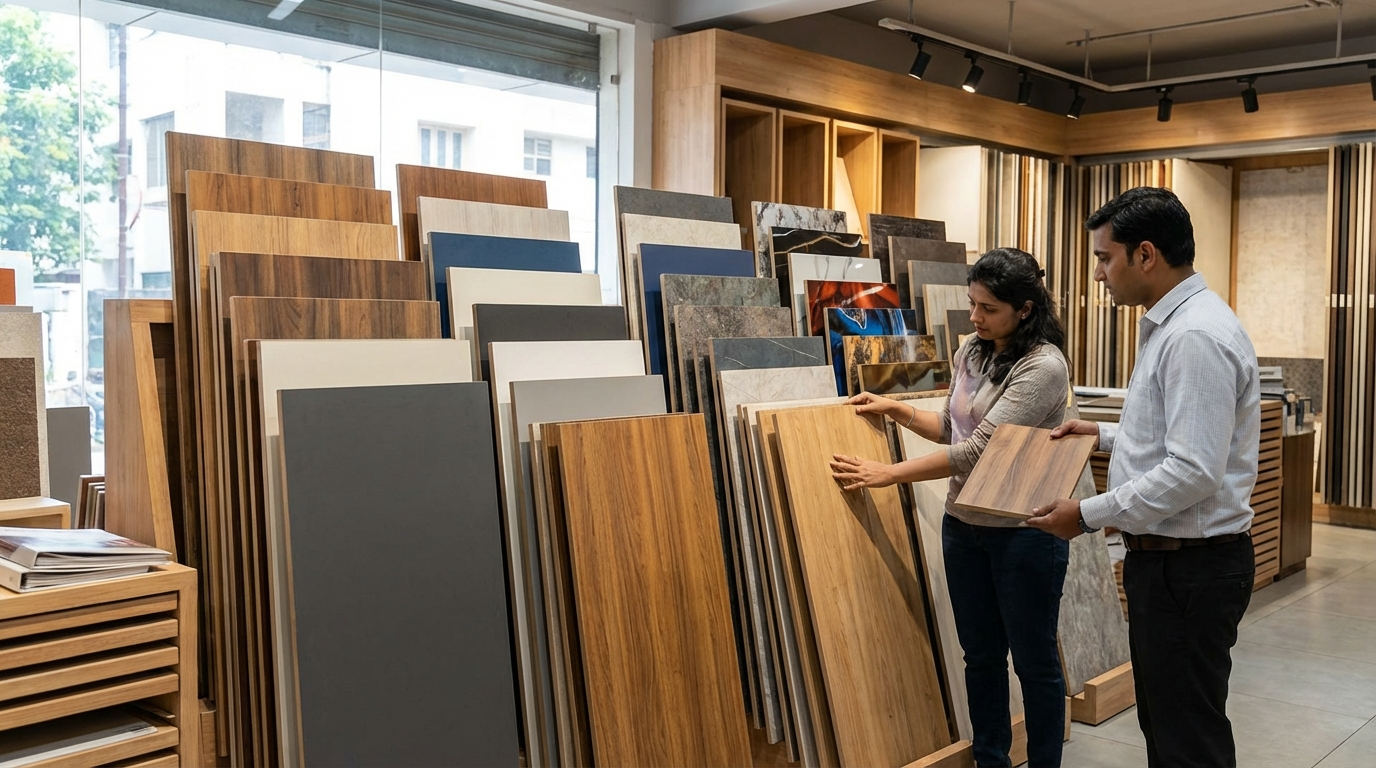
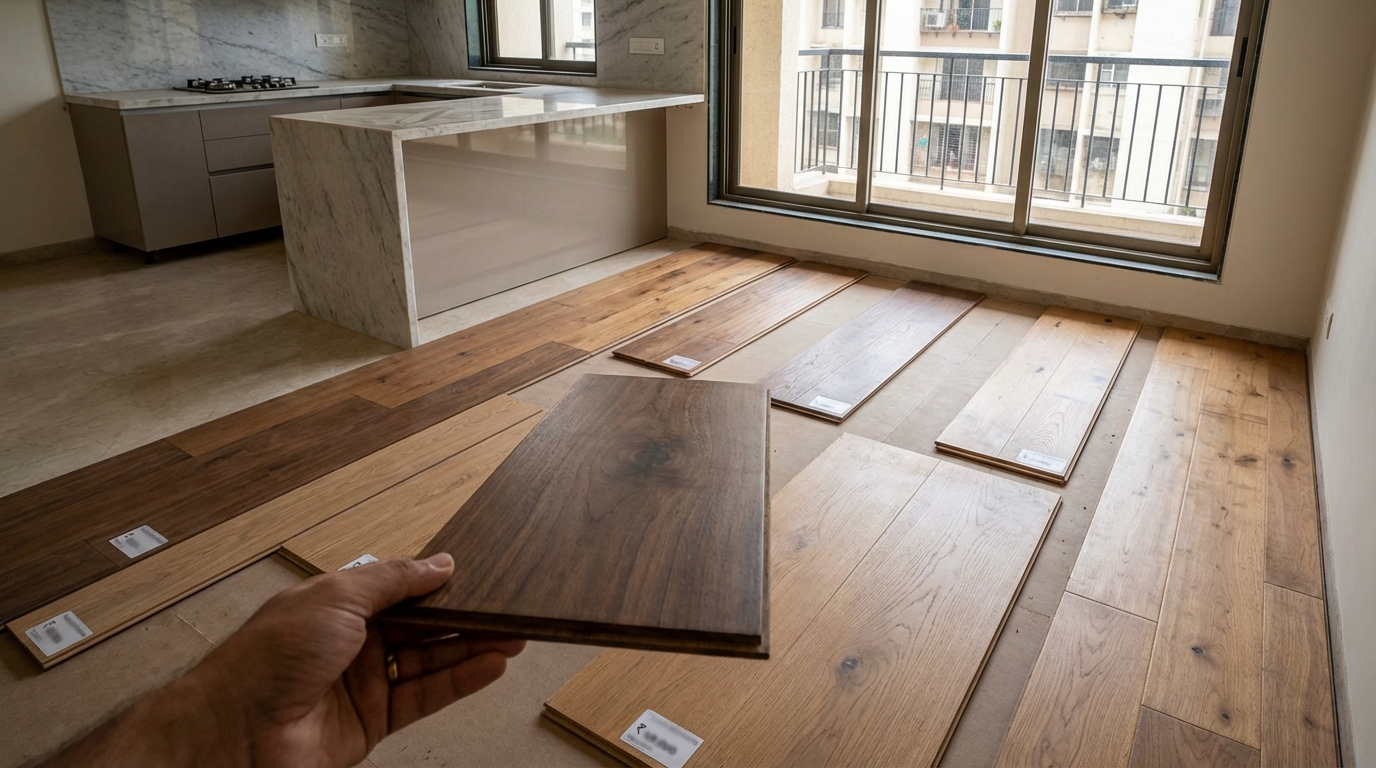
Thin natural wood veneer applied to particle board core creates furniture that looks like solid wood at a fraction of the cost. Common in furniture showrooms where visual appeal matters more than structural demands. The veneer itself is genuine wood — only the core is particle board.
| Particle Board Type | Best Applications | Moisture Resistance | Approximate Price (₹/sq.ft) |
|---|---|---|---|
| Standard Grade | Dry interiors, temporary furniture, backing panels | Poor | 22-35 |
| MR Grade | Kitchen cabinets (non-sink areas), wardrobes | Moderate | 28-45 |
| Fire-Retardant | Commercial spaces, hospitals, schools | Moderate | 40-60 |
| Pre-Laminated | Cabinet doors, shelving, office furniture | Varies by base | 45-75 |
| Veneered | Decorative furniture, tabletops, display units | Varies by base | 55-90 |
Particle Board Furniture Price Guide 2026
Price remains particle board's strongest selling point. For budget-conscious buyers, the cost difference between particle board and alternatives can be substantial — sometimes 40-60% less than equivalent plywood furniture.
Raw Material Costs
In the Indian market, particle board prices typically range from ₹22-55 per square foot for raw boards, depending on thickness and grade. Compare this against:
- Commercial plywood: ₹45-80 per sq.ft
- MDF (Medium Density Fiberboard): ₹40-70 per sq.ft
- HDHMR: ₹65-100 per sq.ft
- BWR plywood: ₹70-120 per sq.ft
Finished Furniture Price Expectations
A standard 6x4 feet two-door wardrobe in particle board with laminate finish typically costs ₹12,000-20,000 in metros. The same design in commercial plywood runs ₹22,000-35,000, while HDHMR construction pushes toward ₹28,000-45,000. For budget-constrained buyers — rental apartments, student housing, starter homes — this price gap is significant.
Kitchen cabinets tell a similar story. Particle board modular kitchen units typically cost ₹800-1,200 per square foot fully installed, compared to ₹1,400-2,000 for plywood and ₹1,600-2,400 for HDHMR alternatives.
Hidden Cost Considerations
The initial savings don't tell the complete story. Factor in:
- Replacement frequency: Particle board furniture in moderately humid areas may need replacement in 3-5 years, while plywood or HDHMR alternatives last 10-15 years
- Repair limitations: Damaged particle board rarely repairs well — swollen sections can't be restored, and re-screwing stripped holes requires special anchors
- Resale value: Unlike solid wood or quality plywood furniture, particle board pieces have essentially zero resale value
Honest Pros and Cons of Particle Board Furniture
Advantages That Actually Matter
Affordability without compromising appearance: When covered with quality laminate or veneer, particle board furniture is visually indistinguishable from more expensive alternatives. For purely aesthetic purposes in dry environments, it delivers excellent value.
Consistent, uniform surface: Unlike plywood, particle board has no knots, grain variations, or natural defects. This uniformity makes it ideal for large flat surfaces that need to look absolutely smooth under laminate.
Environmental efficiency: Particle board utilizes wood waste that would otherwise be discarded — sawdust, chips, shavings from other manufacturing processes. This reduces raw timber demand compared to plywood production.
Easy machinability: Fabricators find particle board easier to cut, drill, and shape than most alternatives. Complex curves and custom dimensions are achievable with standard woodworking tools, keeping labor costs down.
Wide availability: Nearly every timber market and furniture manufacturer in India stocks particle board. You won't face sourcing difficulties or long wait times.
Disadvantages You Cannot Ignore
Catastrophic moisture vulnerability: This is particle board's fundamental weakness. When water penetrates the surface — through spills, leaks, or even sustained high humidity — the wood particles absorb moisture and swell irreversibly. The damage isn't cosmetic; the structural integrity fails completely. No sealing method makes particle board truly waterproof.
Limited structural strength: Particle board cannot handle significant loads over spans. Bookshelves wider than 60cm will eventually sag. Hinges on heavy doors gradually pull loose. This isn't a defect — it's an inherent material limitation.
Poor screw retention: Once a screw hole strips in particle board, the damage is essentially permanent. Unlike solid wood or plywood where screws bite into continuous fibers, particle board screws grip only compressed particles. Repeated assembly/disassembly (common with modular furniture during shifting) accelerates this problem.
Edge fragility: Exposed particle board edges chip, crumble, and deteriorate quickly. Quality furniture uses edge banding to protect these areas, but the protection isn't permanent and corners remain vulnerable to impact damage.
Formaldehyde emissions: Standard particle board uses urea-formaldehyde resin, which releases formaldehyde gas over time (off-gassing). While modern E1 and E0 grade boards minimize this, it remains a consideration for bedrooms, children's furniture, and poorly ventilated spaces.
Particle Board vs Plywood vs MDF vs HDHMR: Detailed Comparison
Understanding how particle board stacks up against alternatives helps clarify when each material makes sense.
| Property | Particle Board | MDF | Plywood (Commercial) | HDHMR |
|---|---|---|---|---|
| Density (kg/m³) | 600-680 | 700-800 | 500-700 | 850-900 |
| Moisture Resistance | Poor | Poor-Moderate | Moderate (BWR better) | High |
| Screw Holding | Poor | Good | Excellent | Excellent |
| Load-Bearing | Low | Moderate | High | Very High |
| Surface Finish Quality | Fair | Excellent | Good (varies by grade) | Very Good |
| Paintability | Poor | Excellent | Good | Very Good |
| Termite Resistance | Low | Low | Low (unless treated) | High (treated) |
| Cost (relative) | Lowest | Low-Medium | Medium | Medium-High |
| Typical Lifespan | 3-5 years | 5-8 years | 10-15 years | 12-20 years |
When Particle Board Wins
Particle board remains the logical choice for:
- Rental accommodation furniture where you won't recover investment on quality materials
- Temporary or short-term use furniture (less than 3 years)
- Extremely dry environments with climate control (air-conditioned offices, dry-climate cities)
- Non-structural components: backing panels, internal drawer bottoms, shelf liners
- Budget-constrained projects where appearance matters more than longevity
When to Avoid Particle Board
Choose alternatives for:
- Kitchen sink cabinets and areas near water sources
- Bathroom furniture of any kind
- Coastal cities with high humidity (Mumbai, Chennai, Kochi, Visakhapatnam)
- Heavy-use furniture: bookshelves holding significant weight, bed frames, dining tables
- Long-term home furniture where you expect 10+ years of service
- Children's furniture requiring durability against rough handling
How to Identify Quality Particle Board Furniture
If you decide particle board suits your needs, these checks help you avoid the worst products:
Check the Core
Ask the seller to show you a sample edge or cut section. Quality particle board has:
- Uniform particle distribution without large voids or gaps
- Consistent density throughout the cross-section
- Clean, smooth laminate adhesion without bubbling or lifting
Verify the Grade
For any area with potential moisture exposure, insist on MR (Moisture Resistant) grade with the characteristic green-tinted core. Standard grade particle board in Indian humid conditions is asking for problems.
Inspect Edge Treatment
Quality furniture uses proper edge banding — PVC or ABS strips sealed to all exposed edges. Run your finger along edges checking for gaps, lifting, or incomplete coverage. Poor edge sealing dramatically shortens furniture life.
Hardware Quality Matters More
Since particle board's screw holding is inherently weak, the hardware quality becomes critical. Look for:
- Cam locks and dowels rather than direct screwing for assembly
- Metal reinforcement plates at hinge points
- Quality soft-close hinges with proper mounting brackets
Making Particle Board Furniture Last Longer
If you've chosen particle board furniture, these practices maximize its functional life:
Keep it dry: This cannot be overstated. Wipe spills immediately. Use coasters. Never place particle board furniture directly on potentially damp floors — use leg caps or small risers.
Avoid overloading: Distribute weight evenly across shelves. For bookshelves, place heavier items on lower shelves closer to vertical supports. Never load beyond the middle section of unsupported spans.
Minimize disassembly: Each time you unscrew and reassemble particle board furniture, the screw holes degrade. If moving houses, consider whether furniture is worth relocating or if replacement makes more sense.
Seal exposed edges: If you notice any edge banding peeling or exposed particle board, seal it immediately with wood edge tape or even clear nail polish as a temporary measure. Moisture enters through edges first.
Climate control helps: In humid cities, running air conditioning or using dehumidifiers in rooms with particle board furniture noticeably extends its lifespan.
Quick Decision Guide: Should You Buy Particle Board Furniture?
Choose particle board if:
- Budget is your primary constraint and appearance matters more than longevity
- You're furnishing a rental property where long-term investment doesn't make sense
- The furniture will be used in air-conditioned, climate-controlled spaces
- You live in dry-climate regions (Delhi NCR, Rajasthan, parts of Maharashtra interior)
- The application is low-stress: TV units, decorative shelving, office workstations
Choose MDF instead if:
- You need painted finishes (MDF takes paint far better)
- Budget allows 15-20% more spend for better durability
- The furniture involves decorative work, routing, or detailed edges
Choose plywood or HDHMR if:
- Kitchen cabinets, especially near sink or cooking areas
- Wardrobes and storage in coastal or high-humidity regions
- Any furniture expected to last 10+ years
- Load-bearing applications: bookshelves, beds, dining tables
- You can invest upfront for lower long-term replacement costs
Final Buyer Advice
Particle board furniture isn't inherently bad — it's a solution optimized for cost at the expense of durability. The material serves specific purposes well when buyers understand its limitations and deploy it appropriately.
Before purchasing, honestly assess: How long do you need this furniture to last? What environment will it live in? Can you protect it from moisture consistently? If you're buying for a rental apartment you'll vacate in two years, particle board makes perfect economic sense. If you're furnishing a home you own and expect to use the furniture for a decade, the initial savings become false economy when you're replacing swollen wardrobes after five monsoons.
For kitchen and bathroom applications specifically, particle board — even MR grade — should be approached with extreme caution. The consequences of moisture damage in these areas aren't just cosmetic; they create hygiene issues and potentially structural failures. Investing in HDHMR or BWR plywood for water-adjacent furniture is almost always the wiser choice.
Whatever you decide, inspect before buying, verify the grade matches your needs, and implement proper care practices. Particle board furniture with realistic expectations and appropriate use can deliver genuine value — just don't expect it to perform like materials costing twice as much.
Disclaimer: This content is provided for general informational purposes based on industry practices and publicly available information. Product specifications, standards, prices, and availability may vary by manufacturer, region, and time. Readers should independently verify details with manufacturers, dealers, or qualified professionals before making purchase or construction decisions.