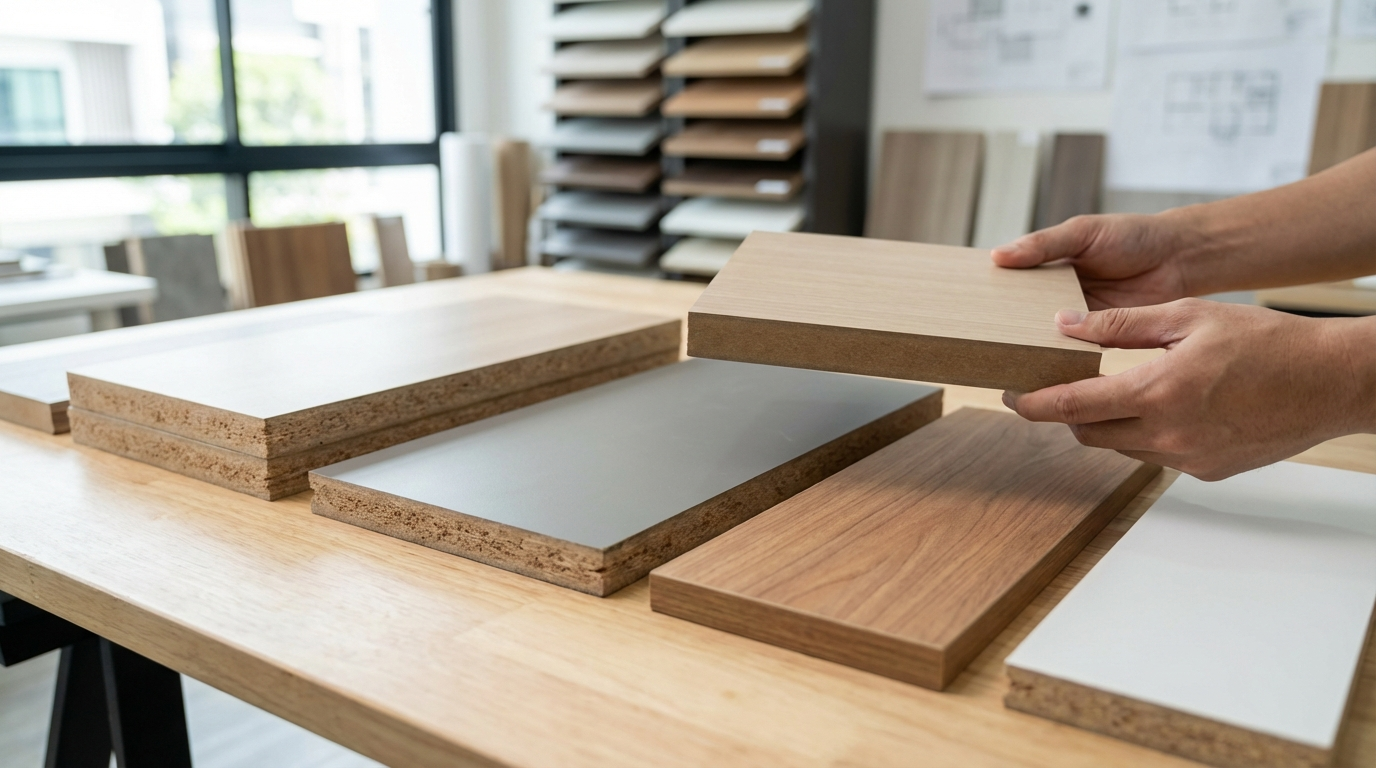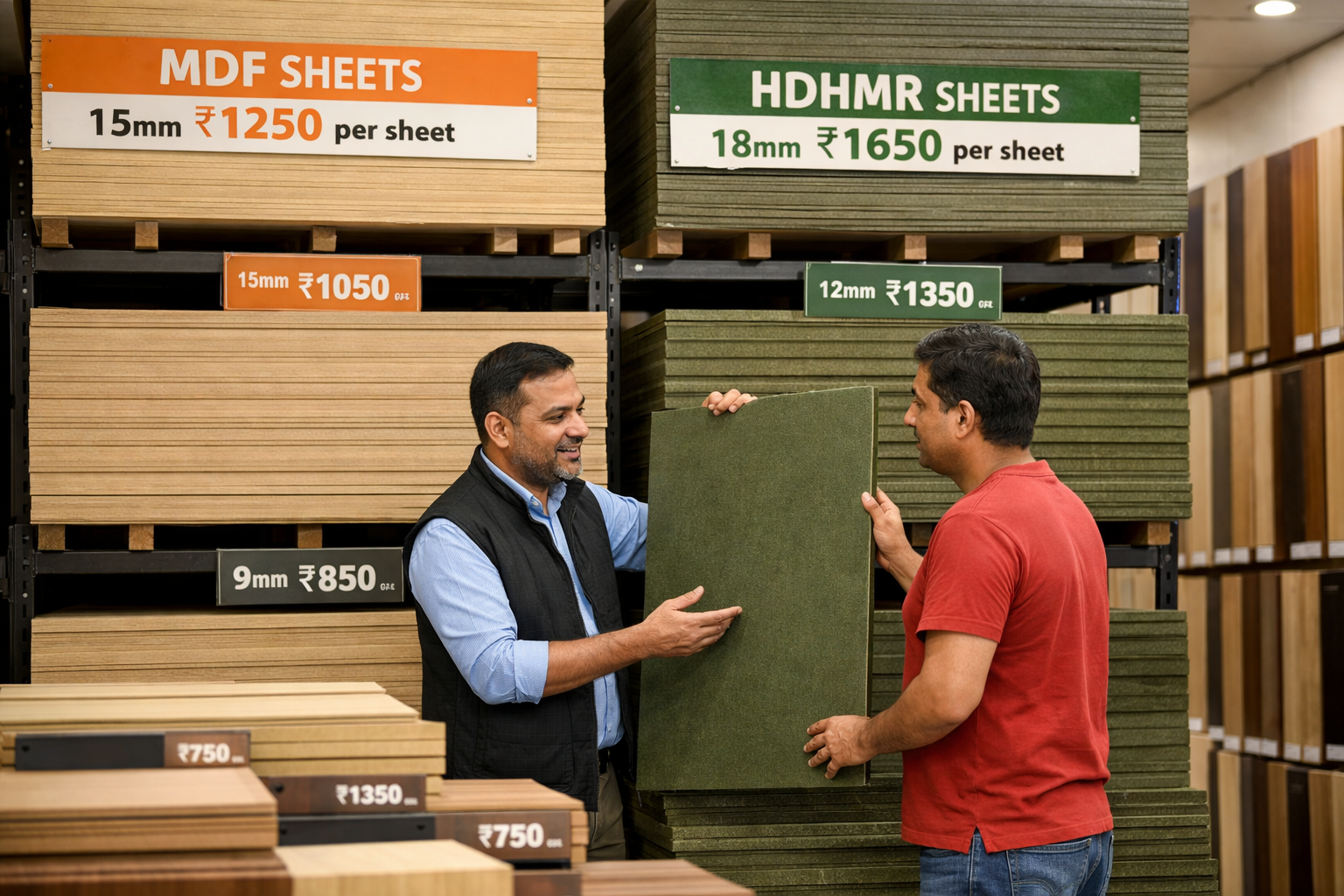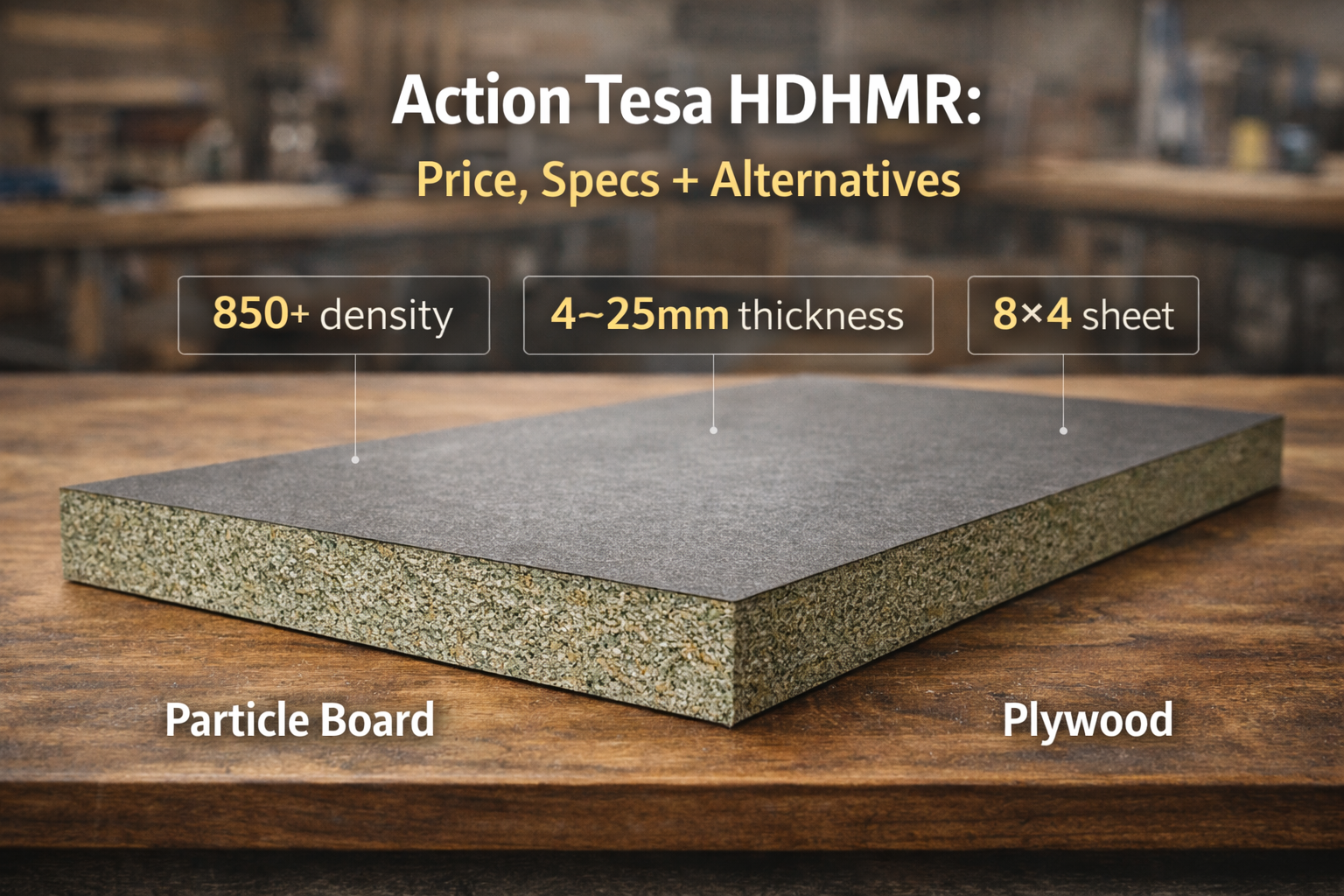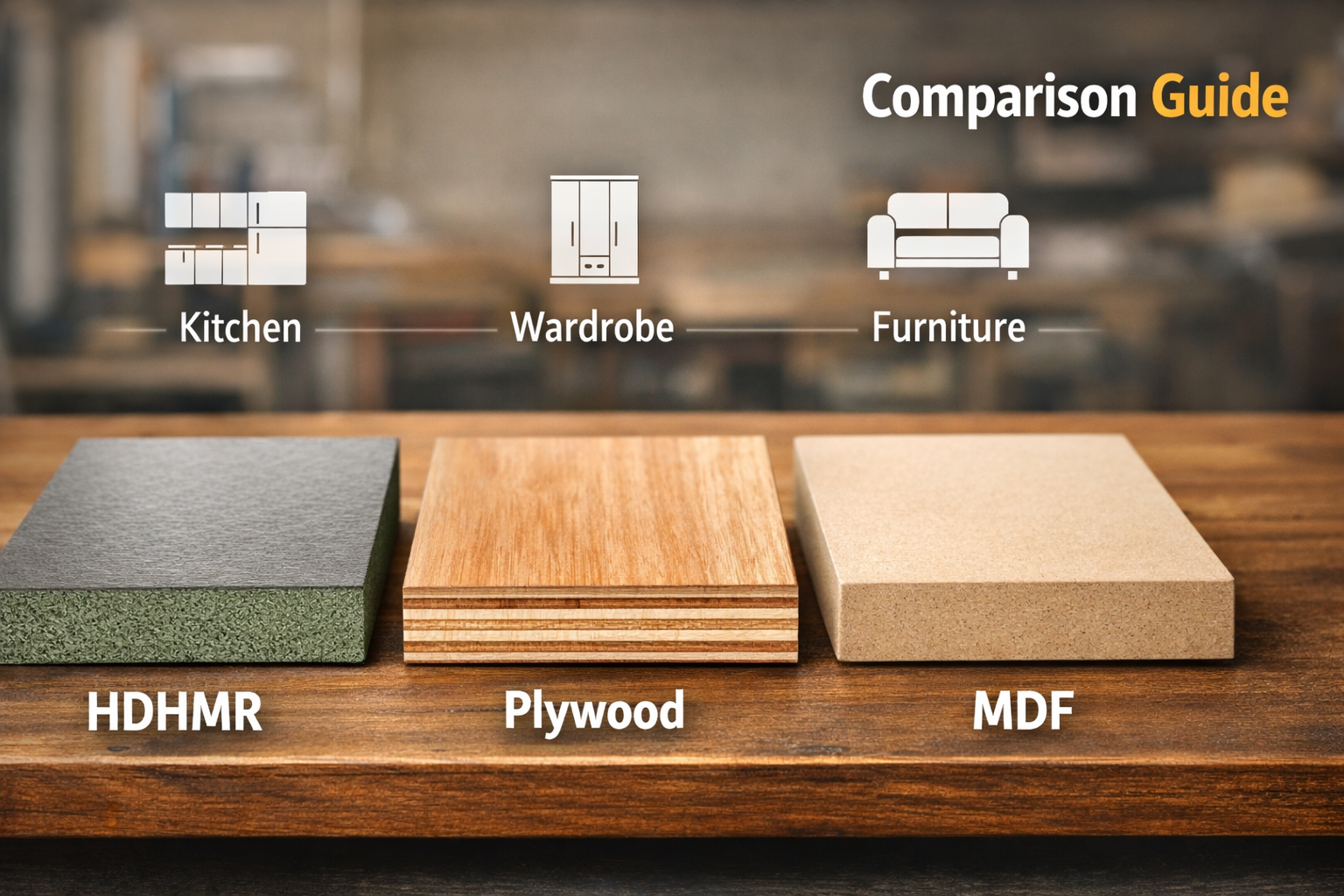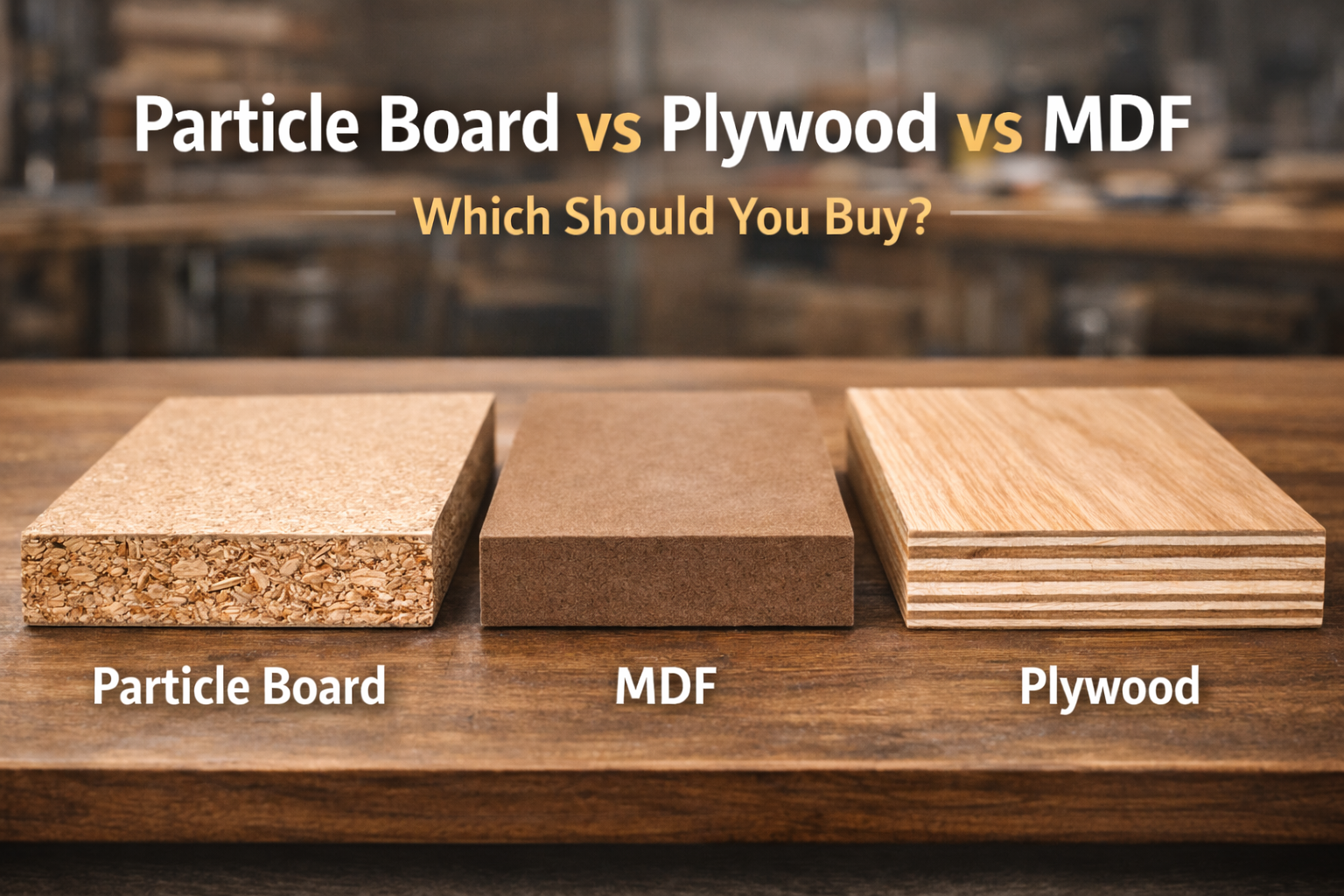
If you’re trying to decide among particle board, plywood, or MDF for your furniture or project, it can be confusing to weigh the trade-offs. In this section, we’ll directly compare these three popular panel materials, looking at their pros/cons in a consolidated way, and provide recommendations based on budget, durability, and use-case. By understanding how particle board, plywood, and MDF stack up, you can make an informed choice for your needs.
Quick Overview of Each: - Particle Board: Lowest cost, made of wood chips & sawdust with resin. Lowest strength and durability of the three. Lightweight. Best for short-term or low-load use where cost is primary concern. - MDF (Medium Density Fiberboard): Mid-level cost, made of fine wood fibers and resin. Smooth surface, good for painting, more dense and stronger than particle board but still not great with moisture. Often used for budget-friendly yet better-quality furniture than particle board. - Plywood: Highest cost (depending on grade), made of layered wood veneers. High strength, can handle moisture if proper grade, good screw holding. The traditional choice for quality furniture and construction, with a range from low-grade to marine-grade quality.
Let’s break down key comparison points:
Structural Strength & Load Capacity: - Plywood is the strongest. A well-made plywood panel can bear significant weight without bending. Plywood has grain structure (layers) that give it rigidity. It’s used even in structural subfloors, wall sheathing, etc. In furniture, plywood shelves or frames can hold heavy loads reliably. - MDF is moderately strong. It’s quite dense, so it’s stiff and can hold some weight, but it will sag more than plywood under the same load. For example, an MDF shelf will start to bow with heavy books over time unless short or supported, whereas a similar plywood shelf might stay straighter longer. MDF has no grain, so it’s uniform but also not as stiff as plywood which has cross-laminated grain for strength. - Particle Board is weakest. It has low bending strength – long pieces will sag or break under much lower weight. It’s also brittle – can snap if a lot of force is applied quickly. It’s fine for small spans or supported applications, but you wouldn’t want a long unsupported span of particle board with something heavy on it. In practical terms, think of it this way: If you were to make a 6ft long bookshelf, plywood could likely hold a full load of books with minimal support, MDF would need maybe a center support to be safe, and particle board would definitely need multiple supports or it will bow/break.
Resistance to Moisture: - Plywood (especially BWR/BWP grades) is best for moisture. Plywood can be made waterproof (marine ply). Even standard plywood (if not the cheapest kind) usually tolerates occasional humidity better than the other two. However, if plywood gets truly soaked, it can delaminate unless it’s marine grade. But it won’t swell into a sponge-like shape; it tends to stay dimensionally more stable and then dry out (glue might weaken though). Plywood also can be chemically treated to resist rot. - MDF is very susceptible to water. When exposed to moisture, MDF swells and crumbles at the edges. There is moisture-resistant MDF (often colored green), which can handle humidity in a bathroom better than standard MDF, but still, if water sits on it or it’s in a very damp area, it’s going to get damaged. MDF absolutely must be sealed (painted or laminated) on all sides in any area where moisture is present. - Particle Board is even more susceptible to moisture (in most cases). It swells quickly and dramatically if water penetrates the laminate or gets to an unsealed edge. And once swollen, it loses almost all integrity – it can disintegrate. Some particle boards are marketed as moisture-resistant (MR Particle board) which perform a bit better (maybe they swell a little less, or slower), but none can handle direct water or high humidity well. In a contest of worst enemy = water, particle board loses the quickest.
So, for any application that might get wet, plywood is the only real choice among the three (or skip wood and use PVC/WPC boards, but that’s another category). If it’s a dry area, MDF and particle board are usable, with MDF being a safer middle ground in case of minor moisture.
Screw & Fastener Holding: - Plywood excels in holding screws and nails. Because it has layers of real wood, screws bite in and have decent long-term holding, especially if you screw perpendicular to the face (not too close to edges). You can also nail plywood (carpentry nails), and it holds nails reasonably well (though screws are still better for really tight hold). - MDF holds screws in the face well but not in the edge as well. MDF’s density gives it initial holding power, but if any lateral force or over-tightening happens, the screw can strip. And once a screw hole is stripped in MDF, it doesn’t hold if you put the screw back – the fibers are pulverized. There are tricks like using glue or toothpicks to fill the hole for another try, but it’s a weak point. Also, screws near the edge of MDF tend to split the fiber or bulge out – pre-drilling is a must. - Particle Board has the poorest hold. Screws strip out very easily from particle board, especially if any force is applied or if the screw is removed and reinserted even once. This is why particle board furniture often uses cam-lock fasteners or wooden dowels with cam locks – those spread the load a bit and don’t rely on threads biting into the board as much. If you must screw into particle board, it’s best to use something like a confirmat screw (designed for particle materials) and drill a proper pilot hole. But even then, you can’t expect it to hold high loads (like a door hinge in particle board – it’ll loosen fairly soon). Nails don’t hold at all (they’ll just pull out). Staples can be used to attach backs on cabinets (like thin hardboard backs) to particle board, but again, not load-bearing.
Surface Finish & Appearance: - Plywood: Has wood grain on its surface. High-grade plywood can be attractive and finished with varnish or stain, giving a natural wood look. However, lower grades have patches and knots that you’d cover with laminate or veneer. Plywood edges show layers, which many consider aesthetically undesirable unless you’re going for an industrial look (some designers do expose plywood edges as a design element, but generally you cover them with edge band or molding). - MDF: Smooth, no grain, perfect for painted finishes or for thin laminates/veneers. MDF is often used for cabinet doors that are painted because it yields a flawless finish with no grain texture. It also can be routered to create patterns (like shaker style or other routed designs) and then painted – something that’s much harder to do with plywood. MDF edges are smooth-ish but also absorb a lot; they need sealing before painting. If veneering, MDF provides an excellent flat substrate. - Particle Board: Usually not left exposed – it needs a laminate or veneer because the surface, while flat, has visible wood chip texture and often some small voids. It’s also not great for painting directly – it would soak up paint unevenly and chips might show. So particle board is almost always pre-laminated or painted with some thick paint in industrial settings. Once laminated, it can look just as good as MDF or plywood laminated, at least initially. The quality of laminate pressing might be a bit inferior (as particle board can sometimes telegraph a slight unevenness or absorb glue differently), but generally if you see a laminated board, you can’t tell from the outside if it’s PB or MDF or ply core, until you see the inside or pick it up (weight differences).
Weight: - Particle Board is lightest, because it’s low density (lots of air in it). This can be an advantage if weight is a concern – e.g., you don’t want a super heavy piece of furniture. - MDF is heavier than particle board, since it’s denser. Often, an MDF piece weighs almost as much as a plywood piece (sometimes more, depending on ply type). - Plywood weight varies by ply type: some softwood plywoods are very light, lighter than MDF of same thickness; some hardwood plywoods can be heavier. But generally, standard ply is lighter than MDF of same thickness.
This means from a handling perspective, large MDF panels are cumbersome due to weight, whereas particle board panels are a bit easier to maneuver. Plywood’s lighter weight for the strength it offers is a plus in many construction uses.
Longevity & Durability: - Plywood (good quality) furniture or elements can last decades. It’s inherently a more durable material – it doesn’t crumble, it can survive a bit of rough handling, you can re-tighten screws, etc. Think of old houses with plywood subfloors or roofs – they last a long time. In furniture, a well-made plywood cabinet can be moved multiple times and stay solid. - MDF has a moderate lifespan. If kept dry and not heavily stressed, MDF furniture can last quite a while (10-15 years isn’t unreasonable for, say, an MDF cabinet in a living room). But it’s more prone to sag and joint issues over the long run. With care (and occasional tightening of fittings), it can serve decently. Edges or corners might ding (MDF corners can blunten or crush if banged). It’s not heirloom quality, but it’s acceptable for many years for typical use. If moisture intrudes (like a spill that isn’t noticed), that can severely shorten its life. - Particle Board has the shortest lifespan. It’s more likely to fail at joints or sag badly within a few years. Many people find that cheap particle board furniture becomes wobbly or a shelf breaks after 5 years or so – sometimes sooner if loaded or moved around. It’s truly a material meant for low-cost, temporary solutions. If cared for and lightly used, it can last longer, but generally, it’s rare to see particle board pieces in fine condition after a decade.
Cost Consideration: (Note: costs mentioned are relative and can vary by region – but generally: Particle board < MDF < Plywood in cost.)
· Particle Board: ~30-50% cheaper than MDF, and significantly cheaper than plywood (maybe half or one-third the price of good plywood). This is why it’s tempting. If you need to make a lot of furniture cheaply, particle board saves a lot of money. Also the fact that it often comes pre-laminated in standard colors saves on finishing costs too.
· MDF: Mid-range. It’s more expensive than particle board, but still generally about 50-60% the cost of equivalent thickness good plywood. Example: If an 18mm ply is ₹80/sqft, MDF might be ₹50, and particle board ₹30 (just an illustrative ratio). For manufacturers, MDF might increase material cost somewhat but still allow a product to be affordable while improving quality.
· Plywood: Can range from moderately expensive to very expensive depending on grade. The cheapest commercial ply can approach MDF’s price, but it will be of much lower quality (and probably not even uniformly thick, or may have voids). The better plywood (and one usually wants at least moisture-resistant branded ply for furniture) will cost more than MDF and definitely more than particle board. With plywood, you’re also often paying for a brand and certification (like ISI marks, etc., in India). Plywood also usually needs veneer or laminate finishing which adds to cost (MDF and PB also need finishing, but many times MDF is also laminated or painted – so finishing cost is similar for all when you want them to look nice).
Given cost differences: if you are on a tight budget but can stretch a little, often a mix is chosen: e.g., use plywood for carcass, MDF for doors, or MDF for carcass, particle board for non critical parts. Or use MDF/particle board for internals and use plywood for structural support pieces. Many mass manufacturers do combinations to save cost – e.g., an MDF table with a particle board core in some places.
When to choose which? (Recommendations): - If budget is extremely low and furniture is not expected to last long or bear much weight, Particle Board could be an option. Examples: A student’s rental apartment furniture for 2-3 years, or a quick display fixture for a shop that might be changed soon, or interior of a wardrobe that won’t be heavily loaded. Even then, try to ensure it’s laminated and edges sealed to avoid accidental water ruin. - If budget is moderate and you want better quality but still savings, MDF is often the go-to. It’s especially good for painted furniture, indoor cabinets, shelves with supports, etc. Also if you want a nicer finish or curves/moldings, MDF is suitable where particle board isn’t. So, for most indoor built-ins (in dry areas) where plywood is too costly, MDF is a common compromise. - If strength, durability, or moisture are factors (e.g., kitchen, bathroom, long shelves, heavy usage furniture), Plywood is worth the cost. Use plywood particularly where you need structure (like frames, long spans, or pieces that get moved a lot or screwed together). Plywood is also a must for any outdoor exposure (neither MDF nor PB can be used outside, whereas exterior grade ply can). - Many projects use a combination: e.g., carcass in plywood, door in MDF (for a smooth painted finish) – quite common in modular kitchens: they’ll use HDHMR or plywood for cabinet body and MDF or HDF for the door if it’s a painted one. For a low budget variant, one might do carcass in particle board (laminated) and doors in MDF or ply.
Durability vs Cost Trade-off: You really get what you pay for here: - Particle board furniture is cheapest but most likely to get damaged or need replacement – so if you think long-term, a piece that breaks means buying again, which could nullify initial savings. - MDF furniture costs a bit more but stands up better, and often looks nicer (because of smoother finishes). It’s a balance – many customers choose MDF in mid-range ready-made furniture because it feels like a good compromise. - Plywood furniture costs the most but can last decades if well made. It’s often worth it in places like kitchen cabinets (where the cost of failure is high due to potential water damage, inconvenience, and repair costs). For something like a wardrobe in a bedroom, many might go with MDF or particle board to save money because that’s a less harsh environment.
Environmental & Health Note: Plywood, MDF, and particle board all can have formaldehyde emissions if made with UF glue. Plywood can be made with phenolic which is lower emission (especially marine ply), and there are E0/E1 grades for MDF/PB as well. If indoor air quality is a concern, look for boards that specify low emission. Otherwise, at least ensure proper sealing/laminating to reduce off-gassing, and let new furniture air out.
FAQs:
-
Q1. Can I mix materials in one piece of furniture (e.g., MDF and plywood)?
A: Absolutely, and it’s often a very smart approach. Each material can be used where it’s most appropriate:
o For example, a wardrobe: you could make the main structure (sides, top, bottom) out of plywood for strength and ability to hold screws for hinges. Then you could use MDF for the doors if you want a smooth painted finish or routed design. Inside the wardrobe, maybe the shelves could be particle board laminated to save cost, as long as they’re not too long or are supported with a center divider. This way you spend money on ply only where needed.
o Another example, kitchen cabinets: use a mix of ply/HDHMR for carcass (since it deals with mounting, weight, moisture) and MDF or particle board for drawer boxes or non-critical partitioning inside (some manufacturers do use particle board for drawer sides with a laminate). However, in kitchens one has to be cautious with any particle board because of moisture.
o A bookshelf: you might use plywood for the long horizontal shelves for strength, but use MDF for the sides/top if you plan to paint it, to get a nice finish and because those parts can be MDF without issue.
The key when mixing is to account for the slight differences in thickness (e.g., an 18mm MDF and 18mm ply should both be 18 nominally, but sometimes there’s a 0.2-0.5mm difference, not big deal usually) and how you join them (screwing MDF to ply is fine, screwing PB to ply fine if gentle, etc.). Also, finishing – if one part is ply and you want to show wood grain and another is MDF which has no grain, that might affect the aesthetic plan (unless everything is laminated or painted uniformly). But structurally and cost-wise, mixing is often optimal.
-
Q2. I want to build a large, cheap bookshelf. Should I use MDF or particle board?
A: If it’s large and will hold many books (heavy load), neither MDF nor particle board are ideal for long unsupported spans. But if plywood is out of budget, MDF is the better of the two because it’s stronger and stiffer than particle board. I would suggest using MDF for the shelves, but you must add some reinforcement: either a solid wood strip along the front of each shelf to stiffen it, or vertical dividers so that no shelf span is too long (keep spans maybe under 3 feet to avoid sag). Particle board shelves of any significant length will sag quite quickly and could even break if severely overloaded. If you do use particle board, definitely have vertical supports or metal brackets in the middle for support. Additionally, consider using thicker material: 3/4 inch (18mm) is standard, but you might go for 1 inch (25mm) MDF for the shelves for extra stiffness if available (or double up two 18mm sheets laminated together for a ~36mm thick shelf). This will reduce sag considerably. It adds cost, but still cheaper than plywood in that thickness. And don’t forget to finish/paint or laminate the MDF to avoid moisture and make it look nice. Also, fasten the shelf properly to the wall (for a free-standing shelf, ensure you have a back panel to prevent racking; a back panel of even thin plywood or hardboard will add a lot of rigidity to an MDF/particle board bookcase).
-
Q3. Plywood vs MDF for making speaker boxes or cabinets?
A: This comes up often in DIY. For speaker enclosures, many audiophiles prefer MDF because its density and uniformity produces a better acoustic dampening (less resonance) and it’s easier to cut precise openings for drivers. MDF’s smooth surface is also easier to veneer or paint nicely for a speaker cabinet. That said, MDF is heavy (speakers will be weighty) and if they might get moved around a lot or face potential moisture (outdoor gigs, etc., then void-free birch plywood is often used for professional speaker cabinets because it’s strong, lighter than an equivalent MDF box, and handles being moved and banged around). For home speaker projects, MDF is usually the go-to for sound quality reasons, then veneered or painted for finish. Plywood might introduce some resonance unless it’s very thick and well-braced (though high quality plywood can be fine too and is used in some high-end speakers). Particle board would be the last choice for speakers – it was used in very cheap systems in the past, but it doesn’t hold screws for the driver mounts well and can crumble with the vibration over time. For general cabinets or furniture, if the item needs to support weight or have very secure joinery, plywood is safer, but if it’s more about finish and moderate load, MDF is fine.
-
Q4. Which is more eco-friendly: particle board, MDF, or plywood?
A: It’s a bit nuanced:
o Particle board uses recycled materials (sawdust, chips), which is great in terms of not wasting wood. However, it often uses a lot of formaldehyde-based resin, which is not eco-friendly and can off-gas. It’s also not durable, meaning it may end up discarded sooner, contributing to waste.
o MDF also uses wood fibers (which can be from waste or from dedicated fiber sources like eucalyptus) and similar resin issues. There are some MDF products now using formaldehyde-free binders (like MDI resin) which are more eco-friendly and have almost no emissions – those would be best. The density of MDF means it’s more material per volume than particle board (so more wood and resin used per sheet compared to PB), but it’s still maximizing wood use (no big offcuts like plywood veneer production).
o Plywood uses larger wood veneers, which typically come from logs – sometimes high-quality plywood uses slower-growing hardwood logs (environmental impact depends on source, e.g., tropical hardwoods vs plantation wood). It may use phenolic or urea formaldehyde glues (phenolic is actually more stable and emits less formaldehyde after curing). Plywood generally lasts longer, which is a big eco advantage (you don’t have to make another to replace it soon). However, any wastage (like cutting shapes out of a sheet) results in scrap that might not be reusable (though that scrap can become particle board later!).
o Additionally, disposal: Plywood will rot away like wood eventually (especially if not treated), whereas MDF and PB are so full of resin that decomposition is slower and could release chemicals if burned.
If one uses certified sustainable wood for plywood and uses it for a long time, that’s eco-friendly in terms of resource use. Particle board’s recycling of waste is eco-friendly in production, but its short life and chemical content is a downside. MDF is in-between. If concerned, look for E1 or E0 grade panels (low formaldehyde) and from manufacturers who manage sustainable sourcing. Also consider the product life – a bookshelf that lasts 20 years is more eco-friendly than one that goes to landfill in 5, even if the latter used recycled content initially.
-
Q5. How do I identify if a piece of furniture is made of particle board, MDF or plywood?
A: If it’s already finished, it can be tricky:
o Weight: Lift it – particle board furniture is lighter than MDF typically. Plywood vs MDF – plywood will be lighter too (unless it’s a heavy hardwood ply).
o Knock test: Knock on a surface – MDF and particle board sound a bit dull and “thin”, plywood might sound a tad more solid (though this is subtle).
o Look at unfinished areas: Remove a drawer or look at the back. The cut edges or unlaminated back side will reveal the core. Particle board will show coarse chips. MDF will show a smooth, fine fiber texture (kind of like cardboard-like texture, no chips). Plywood will show layered veneers. If you see an edge under the laminate with layers, it’s plywood; if you see a single-layer but grainy bits, particle board; a single-layer but very fine smooth, MDF.
o Hardware holding: If you can find where screws are, for example hinge screws: if they are tight and seem to hold firm, likely plywood or maybe HDHMR. If they are a bit loose or there are plastic inserts (like for cam locks), likely particle board or MDF.
o Brand/label: Sometimes the product label or description (if from a retailer) might state “Engineered Wood” as mentioned – which likely means PB or MDF. If it proudly states “Made of Birch plywood” or “solid wood”, then it’s not PB/MDF. Price can also hint – extremely cheap usually means particle board.
Often, drawer boxes in cheaper furniture are dead giveaways: Many use a thin particle board bottom. If you see the bottom panel of a drawer is like 1/4" thick and has a speckled look, that’s particle board. High-end will use plywood for drawer bottoms.
Now, to conclude, here’s a quick decision guide:
· For a long-lasting, sturdy piece (money no object): Choose Plywood (or even solid wood if desired, but among these, plywood).
· For a balance of cost and quality for indoor use: MDF or a mix (MDF with some plywood reinforcement). Use MDF when you want a better finish or more strength than PB but can’t afford full plywood.
· For ultra budget, short-term use: Particle Board, accepting its limitations, and try to design around them (keep pieces small, support them well, seal them).
· For wet areas: Only Marine Plywood or HDHMR/HDF (MDF/PB are out; we mention HDHMR because it's a newer alternative, but between PB/MDF/Ply, only ply is viable in wet conditions).
· For painted fancy finishes: MDF is usually the top choice due to smoothness. Plywood can’t give a super smooth paint finish without lots of prep, and PB is too rough and crumbly for fine finishing.
(For further reading, our HDHMR vs Plywood vs MDF article adds the HDHMR angle, and our Particle Board Guide above covers particle board in depth. If you’re considering cost, our Price in India guides also give specifics on current rates.)
Disclaimer: This content is provided for general informational purposes based on industry practices and publicly available information. Product specifications, standards, prices, and availability may vary by manufacturer, region, and time. Readers should independently verify details with manufacturers, dealers, or qualified professionals before making purchase or construction decisions.