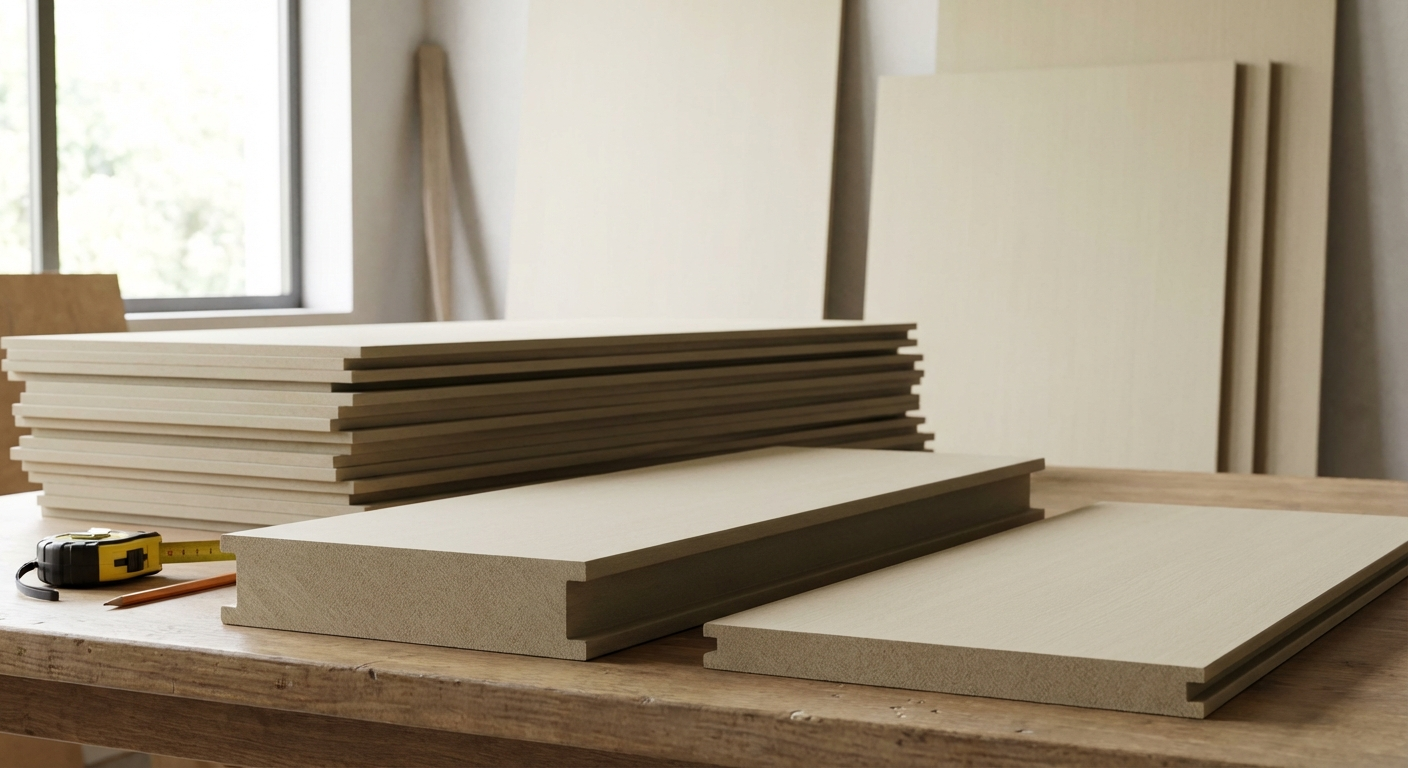
WPC Sheet 8x4 Price in India 2026: What You'll Actually Pay
A standard 8x4 feet WPC sheet in India costs between ₹5,760 and ₹11,200 per sheet in 2026, depending on thickness, brand tier, and core composition. That translates to roughly ₹180 to ₹350 per square foot — significantly higher than HDHMR or marine plywood, but justified by WPC's complete waterproofing and zero-maintenance promise.
Here's the reality most dealers won't tell you upfront: WPC pricing varies by nearly 90% across brands for the same thickness. A budget 18mm WPC sheet might cost ₹5,800, while a premium equivalent touches ₹9,500. Understanding these gaps prevents overpaying and helps you match the right product to your actual requirements.
WPC Board Price Per Square Foot by Thickness (2026 Market Rates)
WPC (Wood Plastic Composite) sheets are priced primarily by thickness and density grade. Unlike plywood where adhesive grade matters most, WPC pricing hinges on the polymer-to-wood ratio and manufacturing density.
| Thickness | Price Range (₹/sq ft) | 8x4 Sheet Price (₹) | Primary Applications |
|---|---|---|---|
| 6mm | ₹80 – ₹140 | ₹2,560 – ₹4,480 | Wall cladding, false ceiling backing, lightweight partitions |
| 8mm | ₹105 – ₹165 | ₹3,360 – ₹5,280 | Decorative panels, cabinet backs, bathroom wall panels |
| 12mm | ₹140 – ₹220 | ₹4,480 – ₹7,040 | Furniture carcasses, shelving, modular components |
| 18mm | ₹180 – ₹280 | ₹5,760 – ₹8,960 | Kitchen cabinets, wardrobe shutters, bathroom vanities |
| 25mm | ₹250 – ₹350 | ₹8,000 – ₹11,200 | Door cores, tabletops, heavy-duty partitions, outdoor furniture |
Important pricing note: These figures exclude GST (18%) and represent dealer rates in metro cities. Tier-2 and tier-3 cities may see 8-15% variation based on transport costs and local demand patterns.
What Exactly is WPC and Why Does It Cost More Than Plywood?
WPC stands for Wood Plastic Composite — an engineered material combining wood fibres (typically 50-60%) with thermoplastic polymers like PVC or polyethylene (40-50%), along with bonding agents and stabilizers. The manufacturing process involves high-temperature extrusion that fuses these components into a homogeneous, non-porous board.
The cost premium over plywood and HDHMR comes from three factors:
- Raw material costs: Virgin PVC and polymer resins cost significantly more than wood veneers and urea-formaldehyde adhesives used in conventional boards
- Manufacturing complexity: Extrusion machinery requires higher capital investment and energy consumption than plywood pressing
- Performance ceiling: WPC delivers properties that wood-based boards simply cannot match — true waterproofing, zero termite vulnerability, and dimensional stability across humidity extremes
The price-to-benefit equation favours WPC in specific scenarios: persistently wet environments, outdoor applications, and projects where replacement costs would exceed the initial premium.
Brand-Wise WPC Sheet Prices: Century, Greenply, Action Tesa, and Others
The Indian WPC market features three tiers: premium national brands, mid-range challengers, and regional/unbranded options. Your choice impacts not just initial cost but warranty coverage, surface consistency, and long-term performance.
Century Starke WPC Boards
Century's Starke range dominates the premium WPC segment with three density variants:
| Century Starke Variant | Density Grade | 18mm Price (₹/sq ft) | Best For |
|---|---|---|---|
| Starke Neo | Standard | ₹200 – ₹225 | Interior furniture, wardrobes in dry zones |
| Starke Select | Medium-High | ₹230 – ₹250 | Kitchens, bathrooms, humid areas |
| Starke Prime | Highest | ₹265 – ₹288 | Outdoor applications, commercial wet zones |
Century also offers ready-made WPC doors under the Starke Doors range — Select variant at ₹387-471/sq ft and Grey variant at ₹130-202/sq ft for thinner profiles.
Greenply Green Platinum WPC
Greenply positions its WPC range in the mid-premium segment, competing directly with Century Select. Expect pricing around ₹190-240/sq ft for 18mm sheets. Greenply's distribution strength means better availability in Eastern and North-Eastern India compared to competitors.
Action Tesa WPC Boards
Action Tesa, primarily known for HDHMR and MDF, has a smaller WPC portfolio. Their 18mm WPC typically prices between ₹175-220/sq ft — positioned as a value alternative to Century. However, variant options are limited compared to dedicated WPC specialists.
Hardy Smith HARDYPLAST WPC
This Ahmedabad-based manufacturer offers competitive pricing in the ₹150-210/sq ft range for 18mm boards. Their focus on polymer-heavy formulations makes them suitable for resort furniture and weekend homes in coastal areas.
Regional and Unbranded WPC Options
Budget WPC sheets from regional manufacturers and trading houses range from ₹120-160/sq ft for 18mm thickness. While tempting for cost-conscious projects, these often use recycled polymers, have inconsistent density, and offer minimal or no warranty. For bathroom and kitchen applications where failure means expensive remediation, the savings rarely justify the risk.
WPC vs HDHMR vs Marine Plywood: Price and Performance Comparison
Before committing to WPC's price premium, understand where alternatives might serve you equally well at lower cost:
| Parameter | WPC (18mm) | HDHMR (18mm) | Marine Plywood (18mm) |
|---|---|---|---|
| Price per sq ft | ₹180 – ₹280 | ₹90 – ₹110 | ₹120 – ₹180 |
| 8x4 sheet cost | ₹5,760 – ₹8,960 | ₹2,880 – ₹3,520 | ₹3,840 – ₹5,760 |
| Waterproof rating | 100% waterproof | Moisture resistant (not waterproof) | Boiling water resistant (IS 710) |
| Termite resistance | Completely immune | Treated (not immune) | Treated (requires maintenance) |
| Screw holding | Moderate (requires technique) | Excellent | Excellent |
| Weight (18mm sheet) | 38-45 kg | 32-38 kg | 35-42 kg |
| Lifespan in wet zones | 15+ years | 5-8 years | 10-12 years |
The decision logic:
- Choose WPC if the installation faces continuous water exposure or outdoor elements — bathroom cabinets, kitchen sink units, balcony furniture, swimming pool areas
- Choose HDHMR if the area has occasional humidity but no direct water contact — bedrooms in coastal cities, AC room wardrobes, office furniture
- Choose marine plywood if you need superior screw holding and structural strength with good moisture resistance — load-bearing shelves, kitchen carcasses in well-ventilated spaces
Hidden Cost Factors That Affect Your Final WPC Budget
The sheet price represents roughly 60-70% of your total material cost. Account for these additional expenses when budgeting:
Edge Banding and Finishing
WPC's closed-cell structure means exposed edges look acceptable without banding, but finished edges still look more professional. PVC edge banding adds ₹15-30 per running foot. For a standard wardrobe with 80-100 running feet of edges, that's ₹1,500-3,000 additional.
Hardware Compatibility
WPC requires pre-drilling for screws — the material doesn't grip self-tapping screws like wood. Budget for appropriate hardware (specifically designed plastic anchors or longer screws) and potentially higher carpenter labour charges if they're unfamiliar with WPC.
Wastage Calculations
WPC cuts cleanly with carbide-tipped blades, but plan for 8-12% wastage on complex furniture designs. The material cannot be edge-joined reliably like plywood, so offcuts have limited reuse value.
Transportation and Handling
WPC sheets are heavier than equivalent plywood and more susceptible to edge damage during transit. If ordering from a distant dealer, factor in ₹500-1,500 per order for careful handling and delivery.
City-Wise WPC Price Variations Across India
Manufacturing clusters in Gujarat (Ahmedabad, Vadodara) and South India mean proximity affects pricing:
| City/Region | Price Index (vs Base) | Notes |
|---|---|---|
| Ahmedabad, Vadodara | Base price | Manufacturing hub, maximum options |
| Delhi NCR, Gurgaon | +5-8% | Strong dealer network, competitive |
| Mumbai, Pune | +8-12% | High demand, premium positioning |
| Bangalore, Chennai | +6-10% | Growing market, improving availability |
| Kolkata | +10-15% | Limited local manufacturing |
| Northeast India | +15-20% | High transport costs, limited dealers |
How to Choose the Right WPC Thickness for Your Project
Thickness selection should match structural requirements, not budget constraints. Under-specifying thickness leads to sagging, flex, and premature failure — particularly problematic with WPC since repairs are difficult.
6-8mm WPC Applications
Wall cladding, ceiling panels, decorative backdrops, cabinet back panels. These thicknesses offer waterproofing benefits at lower cost for non-structural applications.
12mm WPC Applications
Shelf panels with bracket support, drawer components, small cabinet carcasses. Adequate for spans under 600mm with proper support.
18mm WPC Applications
The standard for furniture construction — kitchen cabinet boxes, wardrobe carcasses, vanity units. Handles normal furniture loads reliably.
25mm WPC Applications
Heavy-duty requirements — countertop substrates, door cores, outdoor table tops, commercial fixtures. The additional material cost is justified for demanding applications.
Practical Buying Checklist for WPC Sheets
Before finalizing your WPC purchase, verify these points:
- Density specification: Request the actual density figure (kg/m³). Premium WPC runs 750-850 kg/m³; budget options may be 550-650 kg/m³
- Surface finish consistency: Check both sides of sample sheets. Quality WPC has uniform colour and texture; cheaper variants show mottling or colour variation
- Edge examination: Cut edges should show homogeneous material throughout, not layering or voids
- Warranty documentation: Get written warranty terms. Verbal promises mean nothing if issues arise years later
- Batch consistency: If ordering multiple sheets, ensure they're from the same production batch to avoid colour mismatches
- GST invoice: Insist on proper GST billing. Unaccounted purchases forfeit warranty claims and may indicate grey market goods
When WPC Doesn't Make Economic Sense
Despite its advantages, WPC isn't universally the smart choice. Skip WPC and consider alternatives when:
- The installation is in consistently dry environments — guest bedrooms, study rooms, formal living areas. HDHMR at half the price performs equally well here
- You need exceptional screw holding — WPC's polymer content limits fastener grip. For heavy-duty shelving or load-bearing fixtures, marine plywood or block board works better
- Budget constraints are severe — A well-executed marine plywood kitchen with proper sealing will outlast a budget WPC installation. Don't compromise on WPC quality to fit budget
- The carpenter lacks WPC experience — WPC requires different techniques for cutting, joining, and hardware installation. Inexperienced execution negates material benefits
Final Recommendations: Matching WPC Investment to Project Value
For bathroom vanities and kitchen sink cabinets where water contact is guaranteed, WPC at ₹180-280/sq ft represents sound investment — the material will outlast the room's design cycle. For a 50 sq ft bathroom vanity project, you're looking at ₹9,000-14,000 in sheet costs versus ₹4,500-5,500 for HDHMR, but with vastly superior longevity.
For complete modular kitchens, consider a hybrid approach: WPC for sink units and areas below cooking zones; HDHMR for upper cabinets and pantry sections. This optimizes cost without compromising durability where it matters.
Request samples from at least two brands before ordering. The tactile difference between premium and budget WPC is immediately apparent — and that difference translates directly to how your furniture performs over the next decade.
Disclaimer: This content is provided for general informational purposes based on industry practices and publicly available information. Product specifications, standards, prices, and availability may vary by manufacturer, region, and time. Readers should independently verify details with manufacturers, dealers, or qualified professionals before making purchase or construction decisions.