HDHMR and Engineered Wood Boards – Comprehensive Guide
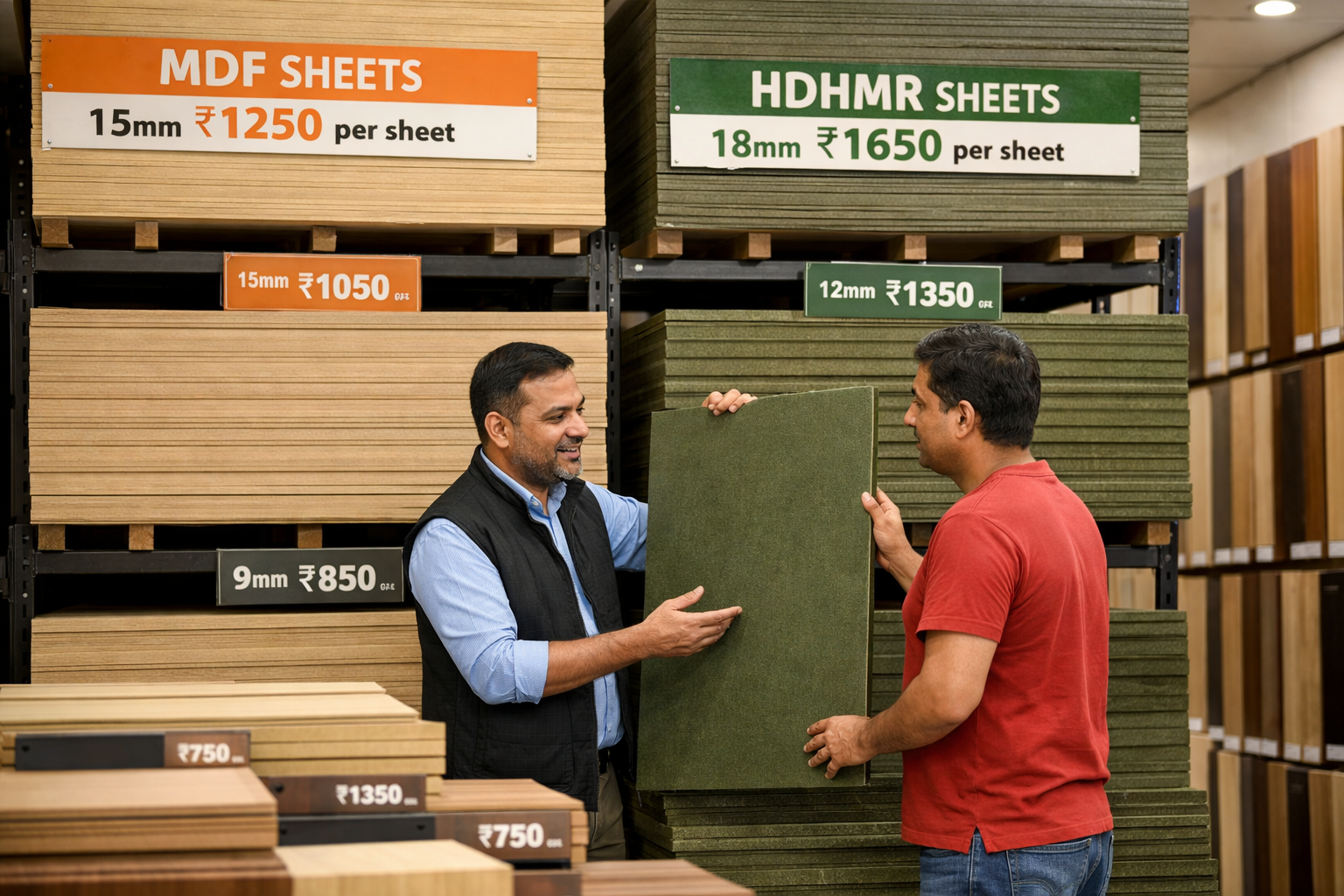
HDHMR Definition & Full Form: HDHMR stands for High Density High Moisture Resistance Board. It is an engineered wood product developed as a superior alternative to standard MDF and even certain plywoods. HDHMR boards are made by compressing wood fibers (typically hardwood) with special moisture-resistant resins under high heat and pressure, resulting in a dense, strong, homogeneous panel. In essence, you can think of HDHMR as an “advanced MDF” – it’s heavier and denser, with adhesives that make it far more moisture-resistant than normal engineered boards.
How HDHMR is Manufactured: The manufacturing process of HDHMR involves breaking down hardwood wood waste into fibers, then adding adhesive binders (and sometimes wax or other additives) that resist moisture. This mix is pressed into sheets at very high pressure and temperature, which densifies the board and cures the resin. The result is a smooth, uniform board with no natural grain or voids (unlike plywood which has layers). Because high-quality hardwood fibers are used, HDHMR panels turn out tougher and more moisture-resistant than standard Medium Density Fiberboard (MDF) or even many plywood grades.
Key Properties of HDHMR:
- High Density & Strength: As the name implies, HDHMR is a high-density board – considerably denser than normal MDF. A typical HDHMR board has density ~800–850 kg/m³ (versus ~600–700 kg/m³ for MDF). This high density gives it excellent strength and rigidity. It can bear heavy loads without sagging easily. In fact, shelves or cabinets made from HDHMR can confidently hold heavy appliances or books with minimal flexing. The superior density also means better durability and impact resistance; HDHMR is built for long-term use.
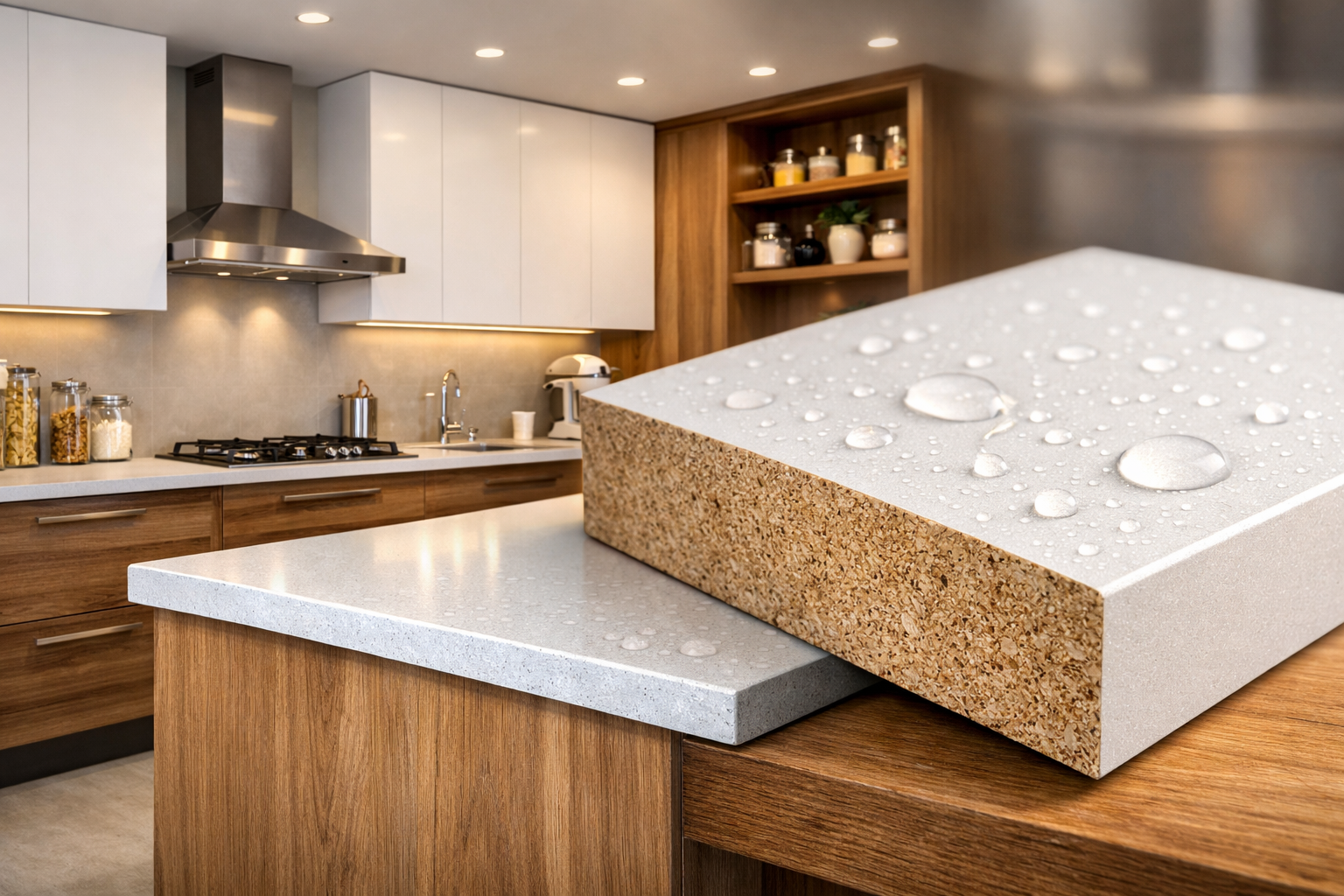
- Moisture Resistance: HDHMR’s standout feature is its resistance to humidity and moisture. The combination of water-resistant resins and dense fiber core means it tolerates high humidity without warping or swelling. Regular MDF swells and deteriorates quickly with moisture, and standard plywood can delaminate if it gets wet, but HDHMR is formulated to stay dimensionally stable. Important: moisture-resistant is not the same as fully waterproof – if HDHMR is in prolonged contact with water, it can still absorb water over time and get damaged. However, for environments like kitchens, bathrooms, or humid climates, HDHMR outperforms normal engineered wood by a large margin. Building materials experts note that HDHMR boards “can tolerate high humidity levels without warping or swelling”, maintaining a consistent surface even in damp conditions.
- Smooth, Workable Surface: HDHMR boards have an extremely smooth surface finish thanks to the fine fiber composition and dense pressing. There are no knots or grain, so the board is ready for finishes – you can paint it directly, or laminate or veneer it for a decorative look. The smooth surface takes laminate and paint uniformly without the unevenness you might get on plywood grain. This makes HDHMR a favorite for modern cabinets that require a flawless finish. Additionally, the uniform composition means it can be machined cleanly – cutting, routing, and drilling into HDHMR yields crisp edges with less splintering. Carpenters find that it’s easy to create intricate designs on HDHMR, similar to MDF, but with greater structural integrity.
- Improved Screw Holding: One common issue with lower-density boards (like MDF or particle board) is that screws can strip out or loosen over time due to the softer core. HDHMR, being very dense and made of hardwood fibers, offers superior screw-holding capacity. Screws bite in deeply and hold tight, giving strong connections for hinges, brackets, and handles. This is especially useful for assembling furniture or cabinet doors – HDHMR can hold hinge screws better than MDF, which might crumble or split under stress. (Note: While HDHMR’s screw holding is excellent, plywood typically still has an edge in screw retention along its grain. So for very heavy door shutters, additional screws or supports are recommended as a precaution, just as one would do with any material.)
- Termite & Borer Resistance: HDHMR boards are typically treated with chemicals in the resin that make them pest-resistant. Manufacturers often add termite- and borer-repellent additives during production. The result is that HDHMR is far less prone to termite attacks than normal plywood or particle boards (termites find it harder to chew through the dense fiber and resin). Many branded HDHMR boards advertise being termite-proof and often come with warranties against pest damage. This is a big advantage in regions like India where termite infestations can ruin wooden furniture. Of course, it’s still wise to ensure your board is from a reputed brand that indeed includes these treatments. When using HDHMR in areas prone to pests (e.g. ground-floor kitchens, storerooms), its inherent termite resistance is a valuable benefit over conventional wood products.
- Comparatively Eco-Friendly: Since HDHMR is made from wood fibers (often recycled wood waste or plantation timber like eucalyptus) bonded with resins, it maximizes usage of wood material. It avoids the need for large solid wood pieces as in plywood veneers. Some brands claim eco-friendliness by using sustainable wood sources and low-formaldehyde resins. HDHMR boards are an environmentally friendly substitute for solid wood, as they originate largely from waste materials and fast-growing timber. That said, the use of adhesives (usually urea formaldehyde or melamine formaldehyde) means HDHMR isn’t as “natural” as solid wood or formaldehyde-free plywood – there can be some off-gassing. Most quality brands meet emission standards (E1 or E0 grade for indoor air safety).
Common Uses of HDHMR Boards: Thanks to the above properties, HDHMR finds use in a variety of interior applications, especially where moisture or load is a concern:
- Modular Kitchens: Arguably the most popular use-case. HDHMR boards are ideal for kitchen cabinets, carcasses, and shutters. Kitchens see high humidity, occasional water spills, and need durable cabinets – HDHMR’s moisture resistance and strength shine here. It’s often used for kitchen shutters/doors, under-sink cabinets, and carcass panels. In fact, HDHMR is marketed as a cheaper alternative to BWR/BWP (boiling waterproof) plywood in kitchens. Homeowners report that HDHMR kitchen cabinets survive monsoon seasons without swelling or warping. (Do ensure edges are sealed and surfaces laminated for best results in kitchens.)
- Bathroom Vanities & Laundry Cabinets: For similar moisture reasons, HDHMR boards are used in bathroom cabinetry, sink vanity units, and laundry area storage, where ordinary particle board would rapidly deteriorate. While one should avoid direct water contact (like don’t use it inside a shower area), HDHMR handles general bathroom humidity well if properly laminated. It provides an affordable moisture-resistant solution for bathroom woodwork.
- Wardrobes and Furniture: HDHMR’s high screw holding and strength make it great for wardrobe cabinets, closet shelves, bed frames, dressers, and bookshelves. You get sturdy furniture that doesn’t wobble easily. For wardrobes, an added bonus is termite resistance – keeping your clothes safe from pest damage. Many interior designers choose HDHMR for modern TV units, study tables, wall-mounted shelves, and partition walls as well, thanks to its combination of smooth finish (good for painting/laminating to match decor) and durability. Essentially, any indoor furniture that needs to be robust and dimensionally stable can be built with HDHMR.
- Doors & Partitions: HDHMR boards (of higher thickness, e.g. 18mm) are sometimes used for flush doors or door shutters in homes. They can be laminated or veneered to look like solid wood doors, while being more resistant to warping in humid weather. For office partitions or wall paneling, HDHMR provides a smooth, paint-ready surface and solid feel. It’s heavier than plywood though, so for very large doors or panels, proper support is needed to avoid any slight bending over time.
- Flooring Substrate: Although plywood is more common for flooring base, HDHMR’s strength means it can be used as a substrate under laminate flooring or as a raised floor panel. However, its weight and cost usually mean it’s chosen when moisture is a concern (e.g. maybe a small bathroom platform).
In summary, HDHMR is especially useful where MDF would be too weak or vulnerable to moisture, and where plywood might be overkill or too expensive. A good example: kitchen cabinet carcasses – HDHMR will outperform MDF there, and cost less than marine plywood. On the other hand, HDHMR is not usually meant for structural uses (like house framing or outdoor use) – it’s an interior-grade engineered wood.
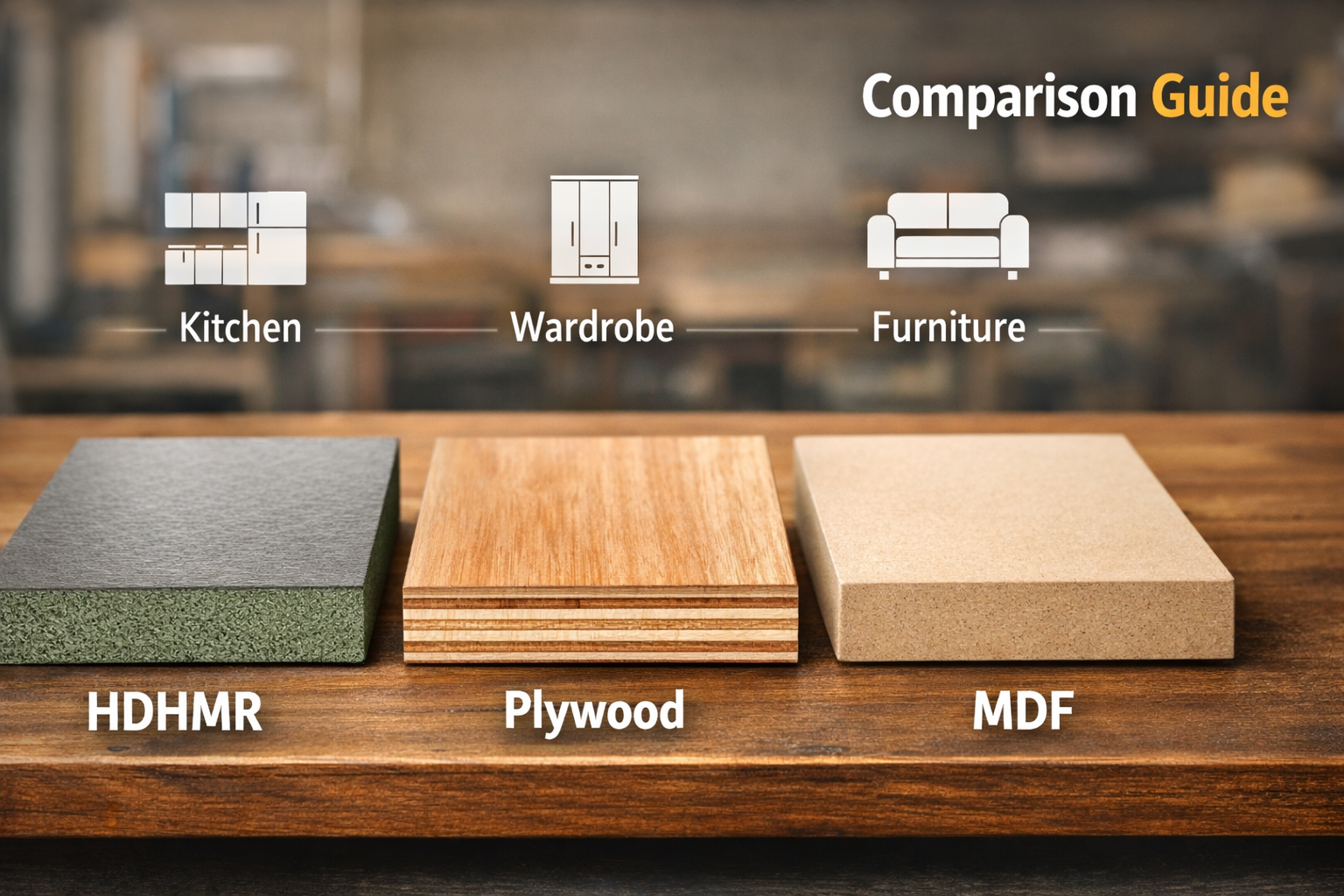
HDHMR vs MDF vs Plywood (Pros & Cons): How does HDHMR compare to these other popular board materials?
- Versus MDF: HDHMR and MDF are similar in that both are fiberboards with smooth surfaces, but HDHMR is denser and stronger. HDHMR has significantly better moisture resistance than standard MDF (which swells if it even sniffles moisture). It also holds screws better and is more durable for heavy usage. MDF’s advantages are that it’s cheaper and lighter to handle, and for purely dry, low-stress applications (like a decorative panel or small cabinet), MDF can do the job at lower cost. Bottom line: If budget allows, HDHMR is generally superior to MDF for furniture, especially in Indian climate or if longevity is desired. MDF might only win in cost or if you need a very light-weight piece.
- Versus Plywood: Plywood is a different beast – made of wood veneers, it’s strong and has been the traditional choice for decades. Moisture: A waterproof plywood (BWP grade) is highly water-resistant (even boil-proof), which can outperform HDHMR’s “moisture-resistant but not waterproof” nature. However, BWP plywood is expensive. Standard MR grade plywood (moisture resistant grade) is less moisture-protected than HDHMR and can warp or delaminate if it gets damp. Strength: Good plywood has excellent strength and a great strength-to-weight ratio (ply is lighter than HDHMR for the same thickness). Plywood also holds screws strongly, especially along the face grain. However, plywood can have internal voids or weaker layers if quality is not top-notch, whereas HDHMR is uniform throughout. Also, plywood can sometimes split or splinter when cut; HDHMR cuts smoothly. Cost: HDHMR often comes out cheaper than premium plywood – it provides a middle ground of cost and performance, being cheaper than full marine-grade ply while more moisture-proof than cheap plywood. Many see HDHMR as a modern substitute for plywood in interiors, except for cases where extreme strength or full waterproofing is required (or where one wants the natural wood grain of plywood). Plywood still excels in outdoor or structural uses (where you need weatherproof material), whereas HDHMR is for interiors. For a kitchen: HDHMR can absolutely replace plywood for cabinets to save cost, but for something like an outdoor pergola or bathroom door constantly hit by water, marine plywood or solid wood would be safer.
- Any Drawbacks of HDHMR? The advantages are clear – what about downsides? The main con of HDHMR is weight. The boards are heavy – roughly 20–30% heavier than an equivalent plywood sheet. This means handling large HDHMR panels is laborious and they put more stress on hinges and fasteners when used as doors or tall cabinets. For instance, an 18mm HDHMR wardrobe door will weigh more than an 18mm plywood door of the same size. You may need extra hinges or sturdier hardware to support HDHMR structures (which is doable). Another drawback is waterproofing – HDHMR is moisture-resistant but not meant for direct water exposure or outdoor use. If you soak it, it will absorb water at the edges eventually. So it’s not a replacement for truly waterproof materials in wet use (e.g., don’t use it for outdoor furniture or places where it’s perpetually wet). Also, edge sealing is critical – the cut edges of HDHMR boards should be sealed (with edge banding or paint) to ensure moisture doesn’t seep in from the sides. If an HDHMR panel is left with raw edges in a humid area, those edges can puff up slightly over time. Lastly, cost might be a factor: HDHMR is costlier than MDF/particle board, so it might overshoot a very tight budget. But as mentioned, it still often undercuts high-grade plywood in price.
In summary, HDHMR provides an excellent middle path between MDF and waterproof plywood – offering high density, strength, and moisture tolerance at a moderate price point. It’s not perfect for every scenario (heavily wet or structural use), but for most home and office interiors it’s arguably the best value material.
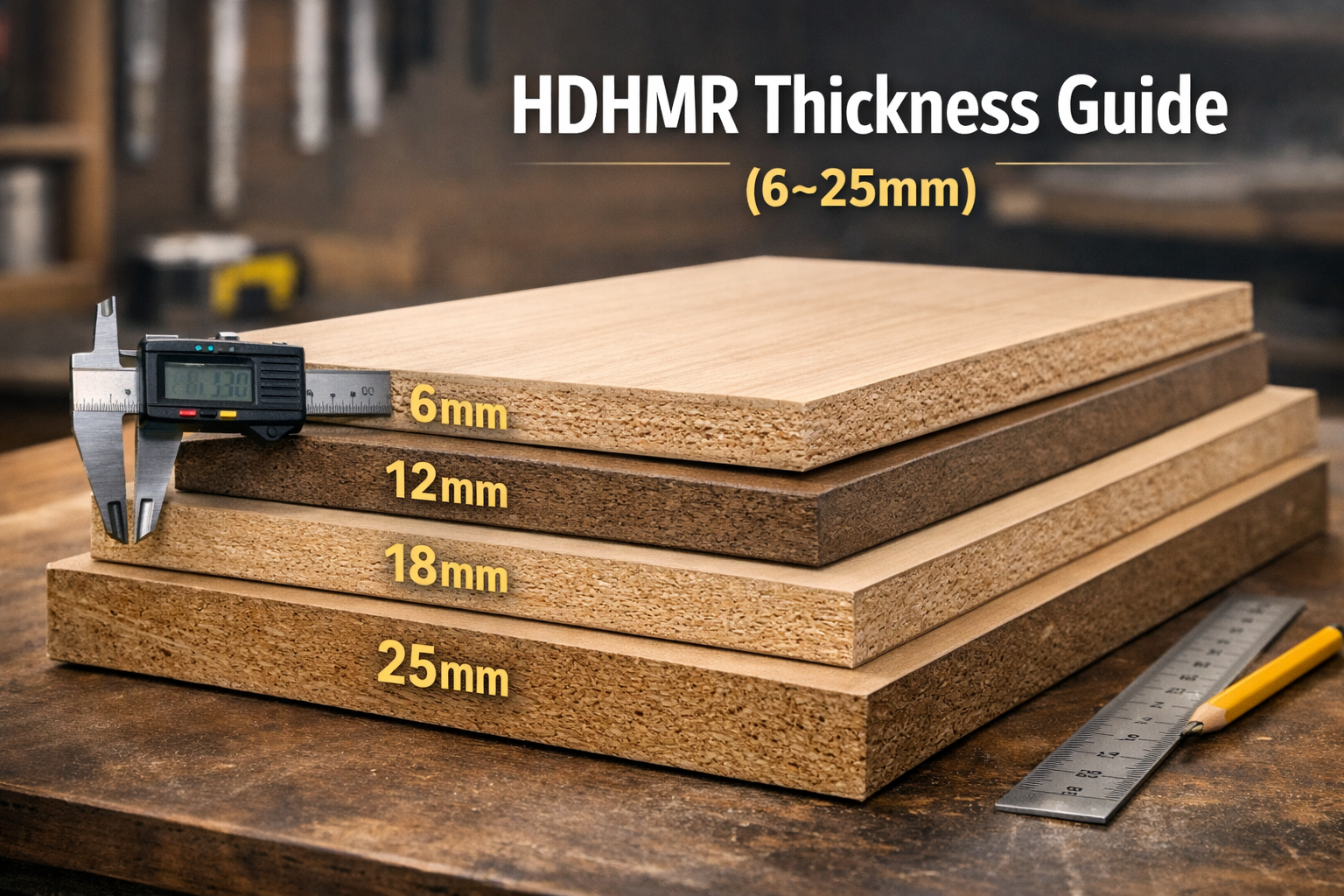
HDHMR Thickness Guide – Choosing the Right Board: HDHMR boards come in various thicknesses (usually from 6 mm up to 18 mm, and some brands even offer thicknesses beyond that, like 25 mm). Choosing an appropriate thickness is important for the application:
- 6mm – 9mm HDHMR: These thinner boards are used where lightweight or backing material is needed. For example, 6mm HDHMR can serve as backs of cupboards or wardrobes, drawer bottoms, and panels in places that don’t bear weight. They are great for wall paneling or decorative trims as well, since they are easy to cut into patterns and provide a smooth finish for painting/laminate. 6–9mm sheets are generally not used for making structural parts of furniture (too flexible if unsupported over a span). Always ensure thin HDHMR is properly supported or fixed to a frame. For instance, a 6mm panel could back a cabinet but will be nailed or screwed to the cabinet frame for support.
- 12mm HDHMR: A mid-range thickness, 12mm boards can be used for cabinet carcasses (side panels, dividers) in small to medium cabinets, for drawer fronts, or shelves for light loads. Many modular furniture pieces (like knock-down cupboards) use 12mm engineered wood for the panels to keep weight manageable while offering some strength. You can also use 12mm HDHMR for wall-mounted shelves that aren’t expected to hold a ton of weight (for heavy books one might jump to 18mm). It’s a versatile thickness – easier to handle than 18mm, and often sufficient for doors of small cabinets, or the boxed structure of a wardrobe (with enough support like hinges and shelving brackets).
- 16mm – 18mm HDHMR: Thicknesses in this range are recommended for load-bearing furniture components. 18mm HDHMR is very common for kitchen cabinet frames, wardrobe doors, large shelves, table tops, bed frameworks, etc. This thickness gives the board a lot of rigidity and screw depth. If you’re building something like a long bookshelf, 18mm will ensure minimal sag over time (for extra-long spans, one can even double up two sheets to effectively ~36mm or use supports). Use 16–18mm for door shutters that are big (tall wardrobes or pantry cabinets) – the sturdiness helps keep the door straight and not bent. In the Indian market, 18mm is often the go-to for any quality cabinet or furniture piece that you expect to last long and handle stress.
- 25mm (1 inch) HDHMR: Some manufacturers provide extra-thick boards (24mm, 25mm, up to 30mm). These are used more rarely, mostly for very heavy-duty applications or where a thicker profile is desired for aesthetics. For example, a large conference table top might use a 25mm HDHMR board for solidity. Or interior designers might use 25mm HDHMR to create a chunky floating shelf or a countertop sub-base. The board will be quite heavy, but extremely solid. One can also use these thick boards to cut out decorative engraved panels (CNC carving) that need depth. Do note, thicker boards cost more per square foot and each sheet will be heavy to lift – so use them only when necessary.
Pro Tip – Sheet Sizes: The standard HDHMR (and MDF) sheet size in India is 8x4 feet (2440 x 1220 mm). That covers most needs. A full sheet is 32 sq.ft area. Some suppliers also offer other sizes like 7x4 ft or 6x4 ft, but these might just be cut pieces from larger sheets. When planning your project, design in a way to optimize cutting from 8x4 sheets to minimize wastage. For instance, kitchen cabinet modules are often sized to fit well within 8x4 utilization.
Working and Finishing HDHMR: Always seal the edges of HDHMR after cutting. The internal fiber can absorb moisture from the air if left raw. Apply a PVC edge band (the most common solution) or at least a coat of paint/varnish on exposed edges. Edge banding not only protects against moisture and pests, it also gives a clean look and prevents the rough fiber edge from chipping. For finishes, you can directly laminate or veneer HDHMR boards. In fact, HDHMR’s smoothness makes laminating easy – good contact adhesives will create a strong bond, and you won’t have hollow spots as can happen with plywood. Experts note that laminates adhere well to HDHMR’s dense surface with minimal risk of bubbling or delamination. If painting, apply a primer first (HDHMR doesn’t have grain, so it takes paint nicely, but a primer will help the paint grip better and you might need fewer coats). Machining Tip: Because HDHMR is dense, use sharp carbide-tipped blades when cutting or routing. It will dull regular blades faster than cutting plywood. And always pre-drill holes for screws to avoid any splitting.
Pros & Cons Summary: To wrap up, here’s a quick recap of HDHMR Board benefits and drawbacks:
· ✅ Pros: Excellent moisture resistance (far better than MDF/particle board), high density and strength, smooth surface for finishes, termite/borer resistant, great screw holding, long lifespan for indoor use.
· ⚠️ Cons: Heavier weight than plywood/MDF (needs good support hardware), more expensive than MDF/particle board (though often cheaper than marine plywood), not suitable for outdoor/exterior use or constant water contact, and edges require sealing for best performance.
If used in the right applications, the advantages of HDHMR board far outweigh its few limitations, especially for homeowners who want durable interiors without paying the premium for high-end plywood. It has quickly become the go-to material for many interior contractors and modular furniture manufacturers in India.
Internal Links: (For more details on specific topics, you may explore our other guides. For a price-focused discussion, see our HDHMR Board Price in India (2026) guide which includes current rates and buying tips. Also, if you’re torn between materials, read HDHMR vs Plywood vs MDF: Best Choice for Furniture for an in-depth comparison.)
FAQs on HDHMR Board:
- Q1. Is HDHMR Board waterproof?
A: HDHMR is moisture-resistant, not fully waterproof. It can handle humid environments and the occasional splashes or spills (when laminated) without warping. However, if the board is exposed to constant water or submerged, it will eventually absorb water (particularly at unsealed edges) and may swell or get damaged. For applications like a kitchen countertop near a sink, HDHMR is fine with proper laminate and edge sealing. But for something like an outdoor bench in the rain, a marine-grade plywood or PVC board would be more appropriate.
- Q2. What is the full form of HDHMR and what is it made of?
A: HDHMR stands for High Density High Moisture Resistance board. It is made of wood fibers (especially from hardwood species) that are mixed with special resins and adhesives and then compressed under high pressure into sheets. Essentially, it’s an engineered fiberboard similar to MDF but with higher density and water-resistant bonding chemicals.
- Q3. HDHMR vs MDF – which is better for furniture?
A: HDHMR is generally better for most furniture applications, especially in kitchens or places with higher moisture or load. It has higher strength, better moisture resistance, and holds screws tighter than MDF. MDF’s only real advantages are cost and weight: it’s cheaper and a bit lighter, so if you only need a short-term piece or something decorative in a completely dry area, MDF could suffice. But if budget permits, HDHMR will yield a more durable, long-lasting piece of furniture than MDF.
- Q4. Where can I buy HDHMR board and are there different brands?
A: HDHMR boards are sold by most timber and plywood suppliers in cities. In India, Action Tesa is a leading brand offering HDHMR boards nationwide (often regarded for consistent quality). Other brands include Greenpanel (HDWR boards), Century Ply (they have an HDHMR variant in some markets), Rushil Décor (Vir Boards), and local manufacturers. Always ensure you’re getting a genuine HDHMR of a good brand – look for specifications like density (~850 kg/m³) and water-resistant properties in the product info. Prices can vary by brand (premium brands might charge a bit more for claimed higher density or added features like anti-fungal, fire resistance, etc.). For convenience, some retailers and e-commerce sites even sell HDHMR online in standard sizes.
- Q5. Can HDHMR board be used for the cabinet under my kitchen sink?
A: Yes, HDHMR is a great choice for under-sink cabinets or any kitchen cabinet carcass. In fact, its moisture resistance makes it well suited for the damp environment under a sink (much better than normal MDF or particle board, which would swell/crumbled in such conditions). Just make sure the board is properly laminated (both sides) and all edges are sealed. If there’s a serious leak and water pools for days, any engineered wood can be damaged – but for normal use and occasional splashes, HDHMR will hold up fine. Many modular kitchen companies use HDHMR specifically for sink cabinet modules and bathroom vanity units as a standard practice.
Disclaimer: This content is provided for general informational purposes based on industry practices and publicly available information. Product specifications, standards, prices, and availability may vary by manufacturer, region, and time. Readers should independently verify details with manufacturers, dealers, or qualified professionals before making purchase or construction decisions.