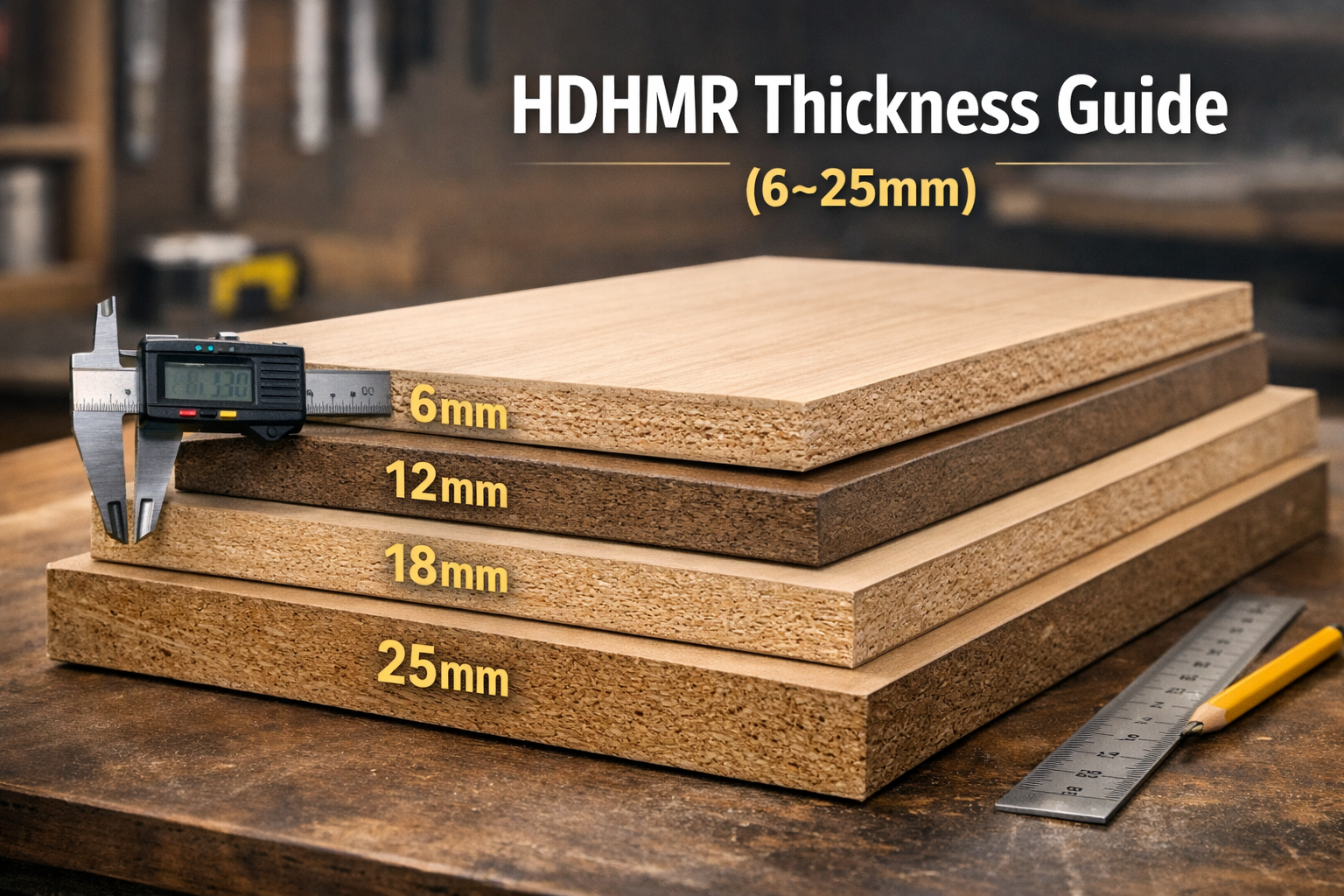
When planning to use HDHMR board for a project, it’s important to understand the available sheet sizes, thickness options, and grades, as well as which thickness suits which application. Using the right thickness of HDHMR can make the difference between a sturdy result and a sub-par one. This guide will walk you through standard sheet dimensions, the range of thicknesses (from 6mm up to 25mm and beyond), the typical density and grade ratings of HDHMR, plus tips on finishing (edge banding, laminating) and common pitfalls to avoid.
Standard Sheet Sizes: In India, the prevailing standard for HDHMR (and most engineered boards) is the 8 feet by 4 feet sheet (2440 mm x 1220 mm). This is the size you will find at almost every supplier. Some manufacturers also offer larger sheets (like 9x6 ft or 8x6 ft) for industrial buyers, but these are not commonly stocked and may require special orders. For retail and small contractors, 8x4ft is the go-to. There are also occasionally smaller sizes available such as 7x4 ft or 6x4 ft – however, these are often just cut pieces from the 8x4 (for convenience some shops pre-cut boards to sell half-sheets or quarter-sheets). Bottom line: assume 8x4 as the base size. If your project needs pieces longer than 8 feet, you’ll likely have to join boards or use plywood (which sometimes comes in 10ft lengths in specialty cases, but HDHMR generally doesn’t).
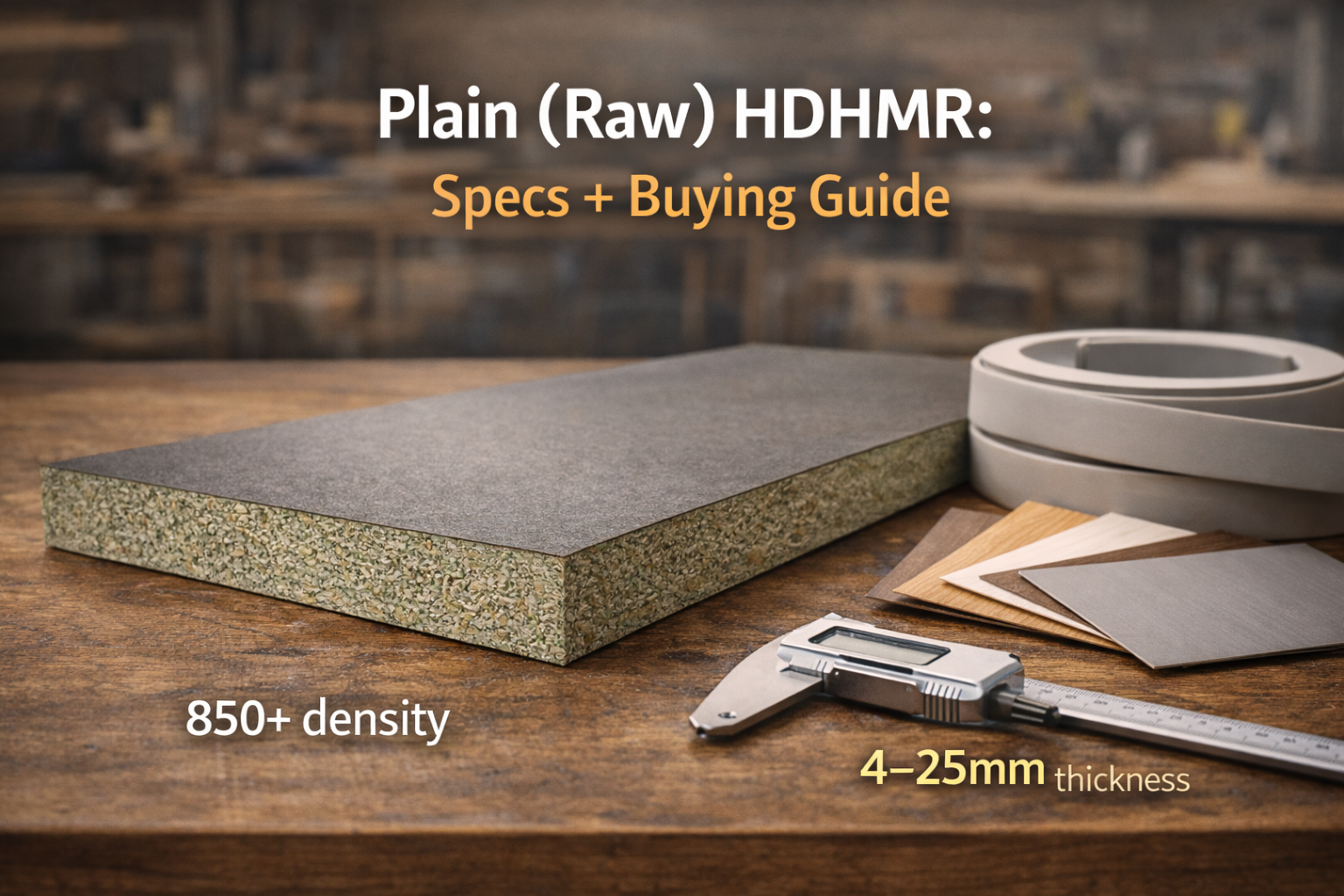
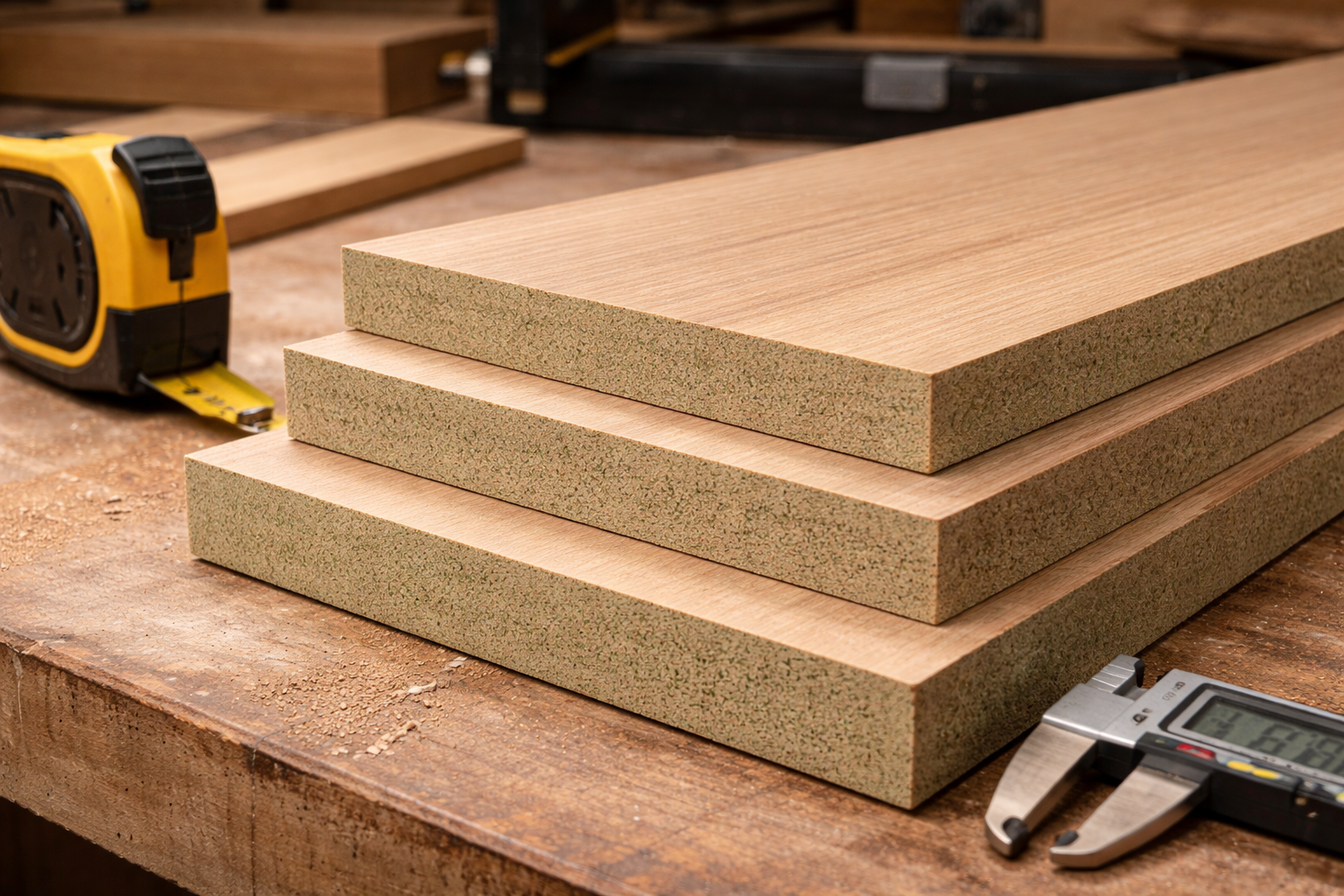
Thickness Range: HDHMR boards come in a variety of thicknesses, typically starting from about 4mm or 6mm on the thin end, going up to 25mm or even 30mm for the thickest. Not every supplier will carry every thickness, but common commercially available ones include: 6mm, 9mm (or 8mm in some brands), 12mm, 16mm, 18mm, and 25mm. For example, Action Tesa’s HDHMR range covers thicknesses from 4mm up to 25mm (they even list an odd 16.75mm which is basically 17mm).
Here’s how these thicknesses map to uses:
- 4mm – 6mm HDHMR: Ultra-thin boards at 4mm are rare (often that thin is more commonly MDF/HDF used for back panels), but some brands have them. 6mm is a common starting thickness for “HDHMR” labeled board. These thin sheets are used for backing panels, like the back of a cupboard or the back of a bookshelf, where you don’t need strength, just a cover. They’re also used in applications such as drawer bottoms, panel inserts, or sometimes wall paneling (especially if designing a pattern or using CNC to cut decorative jali patterns out of them). Because 6mm is quite flexible, it must be supported; you wouldn’t use 6mm for any load-bearing part. Some also use 6mm HDHMR to create curved surfaces (the board can bend slightly, though not as much as a ply of similar thinness, but with kerf cuts or steam one could form gentle curves). In summary: use 6mm for lightweight, non-structural purposes.
- 8mm – 9mm HDHMR: We group these because some brands make 8mm, some 9mm. This slightly thicker board is still considered relatively thin. It can serve similar purposes as 6mm but with a tad more rigidity. 9mm HDHMR could be used for cabinet backs where you want extra stiffness (for a very large wardrobe, a 9mm back panel will feel sturdier than 6mm). It can also be used for small cabinets or drawer sides. However, generally if you need structural integrity, you jump to 12mm+. One interesting use of ~8mm boards is for custom flush doors: some door manufacturers use two 8mm HDHMR sheets sandwiching a filler core to make a solid flush door that’s water-resistant. In interior design, 8-9mm is occasionally used for wall claddings and panel strips since it’s light enough to glue onto surfaces yet more robust than 6mm.
- 12mm HDHMR: Now we’re into the moderate thickness. 12mm is stiff and strong enough for many parts of furniture. You can build cabinet carcasses (side panels, bottom, top) of small to medium cabinets with 12mm. It’s also used for doors/shutters of cabinets up to a certain size – e.g., a 12mm kitchen cabinet door is fine if it’s a smaller door, but for large wardrobe doors 12mm might feel a bit flimsy. Many modular kitchen companies use 12mm HDHMR or similar for the cabinet boxes to save weight, and then use thicker for the door front if needed. Another use: shelving for light loads (e.g., a bookshelf holding few decor items could use 12mm thick shelves over short spans). Wall paneling often uses 12mm if they want some depth for CNC patterns or grooves. In short, 12mm is a versatile mid-thickness – good for structural parts that aren’t too large or heavy duty. If in doubt and budget allows, many opt for 18mm for critical parts and reserve 12mm for secondary parts or where weight saving is needed.
- 16mm – 18mm HDHMR: This range covers the most used thickness for robust furniture. 18mm is something of an industry standard for cabinet construction (analogous to 19mm blockboard or ply in old terms). When you use 18mm HDHMR, you get a very solid feel: wardrobe frames, kitchen cabinets, bed frameworks, partition panels – all these are ideal at 16-18mm. The board at this thickness can hold screws very well and has enough meat to support heavy hinges, drawer slides, etc. For countertops or worktops, one might double up 18mm to make a thick front edge, but one layer of 18mm HDHMR as a sub-top is usually plenty strong (just ensure it’s properly supported underneath). If you’re building a long shelf (say 4-5 feet long) to hold a library of books, 18mm will sag less over time compared to 12mm. In fact, one rule of thumb: for spans over ~800mm without center support, 18mm is recommended to avoid noticeable sag, whereas 12mm should have support every ~500mm. 16mm can be used similarly to 18mm; some brands just offer 16 as an intermediate, but many times 16 and 18 are so close that dealers stock one or the other. You can treat them interchangeably in terms of application, with 18 being slightly stronger of course. Overall, if you want sturdy, long-lasting furniture, 18mm HDHMR is a great choice for most load-bearing panels.
- 25mm (and 24mm, 25mm, 30mm): These thick boards are specialty options. 25mm HDHMR is extremely rigid and heavy. Use cases: table tops, bench tops, window seating boards, or places where you want a chunky look and high strength. Sometimes, 25mm is used in making stairs or risers (indoors) or for carving out decorative engraved panels that are backlit (thicker board allows deeper carving). If you have a very long span that must hold weight (like a loft storage shelf spanning 5-6 feet without vertical supports), a 25mm board will perform better with less deflection. Another scenario: if creating a door jamb or frame extension in a modular setup, these thick boards might be used to block out thickness. However, do note that a 25mm HDHMR sheet weighs a lot – handling and cutting it requires manpower and good tools. Only get this thickness if your design truly demands it; otherwise, two layers of 12mm laminated together on site could also achieve ~24mm thickness with more flexibility to handle separately.
Density and Grades: HDHMR boards are generally high-density by definition. A quality HDHMR will have density in the range of 750 to 880 kg/m³. For instance, Action Tesa HDHMR is specified at 850+ kg/m³ density, which is significantly higher than normal MDF (around 600–700 kg/m³). What does this mean practically? It means HDHMR is heavier and stronger – density correlates with screw holding and impact resistance. When comparing brands, if one advertises a higher density, that’s usually a good sign of sturdiness (though all true HDHMR are in a close range).
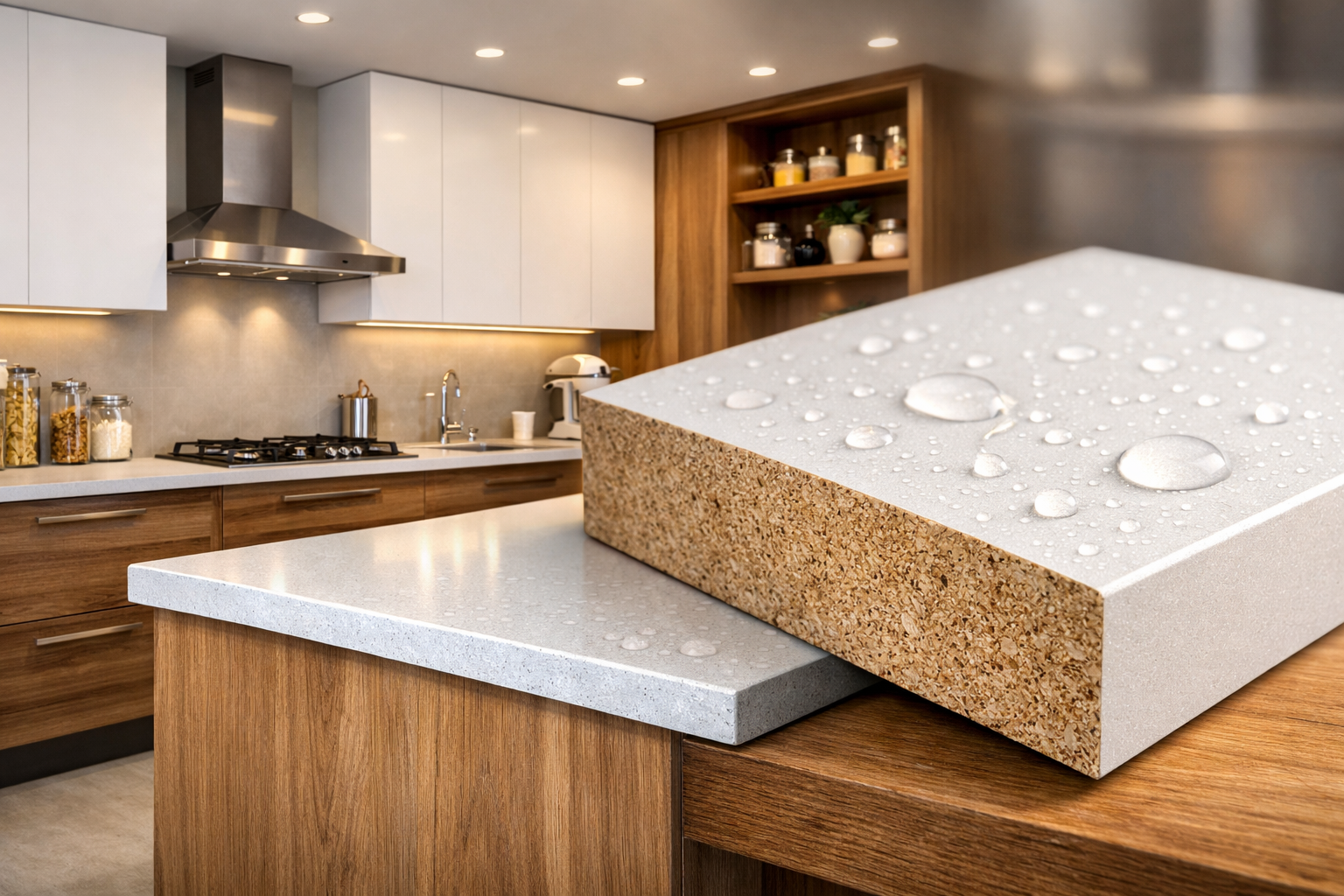
In terms of grades, most HDHMR boards on the market are for interior use (Grade-II) meaning they are moisture-resistant but not meant for exterior exposure. Some brands use terms like HMR (High Moisture Resistance) or Exterior Grade HDF – e.g., Greenpanel markets “HDWR” boards that they suggest can even be used in covered exteriors. Generally, you might come across: - Grade MR: which is moisture-resistant (suitable for interior, kitchen, bathroom use when laminated). This is essentially what all HDHMR is. - Grade FR: a few manufacturers produce Fire-Retardant HDHMR boards (they add special salts/chemicals to make the board resist ignition). These are used in commercial projects needing a fire rating. They are niche and costlier. - Emission Grades: Look for E1 or E0 certification if you are concerned about formaldehyde emissions (indoor air quality). Some top brands offer E1 (European Standard) which indicates low formaldehyde. E0 is even stricter. If not specified, assume it’s standard (E2 or so). For home use, E1 is good to have, especially for enclosed spaces like cabinets. - “Exterior HDHMR”?: Technically, HDHMR is not exterior plywood, but some products like “Boilo” (Action Tesa’s BWP HDF) or Greenpanel’s Exterior HDF exist – these are similar boards treated to be water-proof and boil-proof, often used for outdoor furniture or door skins. They are more like HDF with phenolic resin (like a hybrid between HDHMR and marine ply). If your use-case is exterior, consider those specialized boards or conventional plywood, because regular HDHMR, even if high moisture resistant, shouldn’t be directly rained on.
For 99% of readers, the HDHMR available to you will be the standard interior grade high-density MR board, which is what we focus on.
Edge Banding and Lamination Tips: Working with HDHMR is rewarding due to its smooth finish, but you have to handle finishing properly: - Always Edge Band or Seal Edges: We can’t stress this enough – when you cut HDHMR, the raw edge exposes the fibrous core. In a humid environment, that edge can absorb moisture and slightly swell or soften. Use PVC edge band tapes (available in various widths matching the board thickness) to cover those edges. The edge band is applied with hot-melt glue and a trimming blade; your carpenter will likely have an edge banding tool or you can use an iron for small DIY projects. Edge banding not only protects from moisture but also from termite ingress (pests can’t easily get into a sealed board). If edge banding is not an option (say you plan to paint the edge or it’s a curved shape where tape can’t be applied), at least apply a coat of wood primer or shellac to seal it. - Lamination/Veneering: HDHMR’s surface is ideal for laminates and veneers. Because it’s so smooth and has uniform absorption, laminates adhere evenly and you won’t get bubbles (provided the glue is applied uniformly). Carpenters often comment that laminating HDHMR is actually easier than laminating plywood because there’s no natural undulation or core gaps. One tip: sand the surface lightly with fine grit sandpaper before applying adhesive, just to ensure any pressing-release agents are gone and to create a tiny bit of roughness for glue. Use a good contact adhesive (Fevicol SH or similar PVA glue for woodworks) or take it to a press for veneering. Pre-laminated HDHMR boards are an alternative – they come ready with laminate, saving you this step. But if you do it manually, rest assured HDHMR bonds well. According to industry notes, the dense surface bonds laminates firmly without delamination issues. After laminating, flush trim the edges and then do the edge banding (edge band comes last to cover the seams). - Painting: If you choose to paint HDHMR for a sleek finish (some do PU paint or duco on wardrobes and panels), the smoothness is a boon. Clean the board, apply a coat of primer-surfacer, sand lightly, then apply paint. You won’t have grain patterns to fight with (unlike plywood) and the result can be a very smooth painted surface akin to MDF but with the moisture resistance benefit. In fact, many premium painted kitchen cabinets use HDHMR as the substrate beneath the paint for durability. - Machining & Joinery: HDHMR can be cut with standard woodworking tools. Use carbide blades as mentioned – HSS blades will blunt quickly on this hard material. For joinery, you can use screws, confirmat fasteners, dowels, lamello biscuits – all standard techniques for panel furniture. Just remember to pre-drill for screws to avoid any splitting at the entry point (especially near edges). Also, because HDHMR is dense, using slightly larger pilot holes than you would in plywood can help prevent the screws from overheating or getting stuck. Clamps and glue work well too (glue bonds are decent on HDHMR edges, but not as strong as wood-to-wood because the resin in HDHMR might inhibit some absorption; use a good quality wood glue and perhaps screws in combination for structural joints).
Common Mistakes to Avoid: - Using the Wrong Thickness: A very frequent mistake is trying to cut cost by using a thinner board where a thicker one is needed. For example, using 12mm for a large wardrobe door – over time it may warp or feel flimsy. Or using 6mm for a shelf – it will definitely sag. Match the thickness to the need (refer to the mapping above). A related mistake is using HDHMR in places it’s not needed – e.g., using 18mm HDHMR for the back panel of a wardrobe is overkill (and adds unnecessary weight) when 6mm MDF could do. Optimize thickness for function. - Not Sealing Edges or Exposed Areas: We mentioned this, but it bears repeating. If you leave edges raw (say the bottom edge of a kitchen cabinet that’s near a wet floor, or the cutouts for a sink), you are inviting moisture trouble. Always seal those edges with banding or waterproof coating. Similarly, if you cut holes (for wires, plumbing etc.), seal the cut surface with paint or varnish. - Overtightening Screws: HDHMR holds screws well, but if you overtighten, you can still strip the hole (the screw will spin free). This especially can happen with smaller gauge screws. Tighten just until snug; if a screw strips out, you may need to re-drill and insert a wall plug or use a fatter screw. Using Euro screws or confirmat screws for assembling panels is a good practice as they are designed for particle/fiber boards and give a solid hold. - Long Unsupported Spans: Even though HDHMR is stiff, any board will bend if span is too long without support. We’ve seen cases where someone puts a 4 foot long shelf with no middle support and loads it with heavy files – over time, a slight bow is seen. If you plan a long shelf (>3 feet) with heavy loading, either choose a thicker board (18mm or 25mm) or add an L-bracket/support in middle underneath. As noted in our HDHMR Doors article, extremely long HDHMR shutters or panels can have minor bending if not thick enough or if unsupported. - Using HDHMR in Soaking Wet Conditions: While it’s great in kitchens/baths, don’t use it where it will get rained on or sit in water. E.g., HDHMR for an outdoor signboard that gets rained on is a bad idea (it’s not marine ply). Or using HDHMR for bathroom door threshold where water accumulates – it can get ruined unless fully encased. For such scenarios, use BWP ply or PVC boards. - Mishandling during Installation: HDHMR is heavy – if a sheet or panel is dropped or hit hard on a corner, it can dent or the laminate can chip. Ensure proper handling: carry large panels upright with two people, don’t drag them on the floor (it can damage edges or top layer). Pre-plan how you’ll lift and fix the pieces in place due to the weight.
Edge and Surface Finishing Example: A homeowner in a coastal city chose HDHMR for all her kitchen cabinets. She made sure the carpenter edge-banded every single cut, and laminated the outer and inner surfaces. Two years and two monsoons later, the cabinets show no swelling or delamination – a testament to both the material and the importance of sealing it properly. The only minor issue was a long loft door (8 feet wide, single panel) that had a slight sag at the middle – the lesson learned was that such a long door should have been either thicker or divided into two doors for better stability. Small planning considerations like this can ensure your HDHMR installations perform flawlessly.
Internal Links: (Make sure to check our HDHMR vs Plywood vs MDF comparison if you’re debating materials. Also, if cost is a concern, see our HDHMR Price Guide for budget planning. For a deep dive into general HDHMR properties, refer back to HDHMR Board 101.)
FAQs – HDHMR Sizes & Usage:
- Q1. What sizes do HDHMR sheets come in?
A: The most common sheet size is 2440 x 1220 mm (8ft x 4ft). This covers the majority of what you’ll find in shops. Some manufacturers produce larger sheets (like 9x6 ft or 10x4 ft), but these are not usually found in retail. If you need a half sheet, you can get 8x4 cut into two 4x4 pieces at some shops. But essentially, plan around 8x4 availability when designing.
- Q2. I need a 20mm or 30mm thick HDHMR – is that available?
A: Boards around 25mm are available (some call them 1-inch). 20mm specifically might not be a standard, but 18mm and 25mm are. If you need exactly 20mm, you might either use 18mm (close enough usually for design/hinges tolerance) or laminate a 12mm + 8mm together. 30mm boards are rare but a few manufacturers might do ~30mm on special order or for doors. Check with dealers; sometimes they have 25mm which is close to 1 inch. Another approach if you need extra thick sections (like a thick edging) is to join two pieces of 18mm with glue and screws – effectively making a 36mm composite. This is done for thick curved edges or table tops often.
- Q3. Are there different grades of HDHMR like there are for plywood (MR, BWR, etc.)?
A: Not in the same way as plywood. Plywood is graded by the type of resin (Moisture Resistant, Boiling Water Proof, etc.). HDHMR by definition is made with moisture resistant resins, so almost all HDHMR boards are already MR grade at least. There isn’t a “BWP HDHMR” commonly – if you need boiling waterproof, you’d look at specialized HDF boards or just use marine ply. That said, within HDHMR products, some companies have variants like “Exterior Grade” or “Plus Grade” with claims of higher water resistance or termite proofing. But they are all under the broad umbrella of HDHMR. Focus on brand and features (like warranty, density, emission class) rather than named grades.
- Q4. How do I finish the edges of an HDHMR shelf?
A: Use edge banding tape – it's a thin strip of PVC or laminate that you iron on or apply with an edge banding machine. It comes in various colors (to match your laminate or a neutral color). This will cover the raw fiber edge and give it a clean look, while protecting it from moisture. If you’re painting the shelf, you can alternatively fill the edge with wood filler, sand it smooth and paint over it, but that’s more effort. Edge banding is quick and effective.
- Q5. My carpenter suggests 18mm HDHMR for cabinet sides and 9mm for back; is that okay?
A: Yes, that’s a common and sensible combination. Use thicker board (16 or 18mm) for structural parts like sides, top, bottom of cabinets, and a thinner board (6mm or 9mm) for the back which just encloses the cabinet. The back (9mm) will be nailed or screwed to the 18mm frame, making the whole box stable. This optimizes cost and weight. There’s usually no need to use 18mm for back panels unless the cabinet is very large and you want it extremely sturdy or floating (even then, usually 9mm suffices if fixed well).
Disclaimer: This content is provided for general informational purposes based on industry practices and publicly available information. Product specifications, standards, prices, and availability may vary by manufacturer, region, and time. Readers should independently verify details with manufacturers, dealers, or qualified professionals before making purchase or construction decisions.